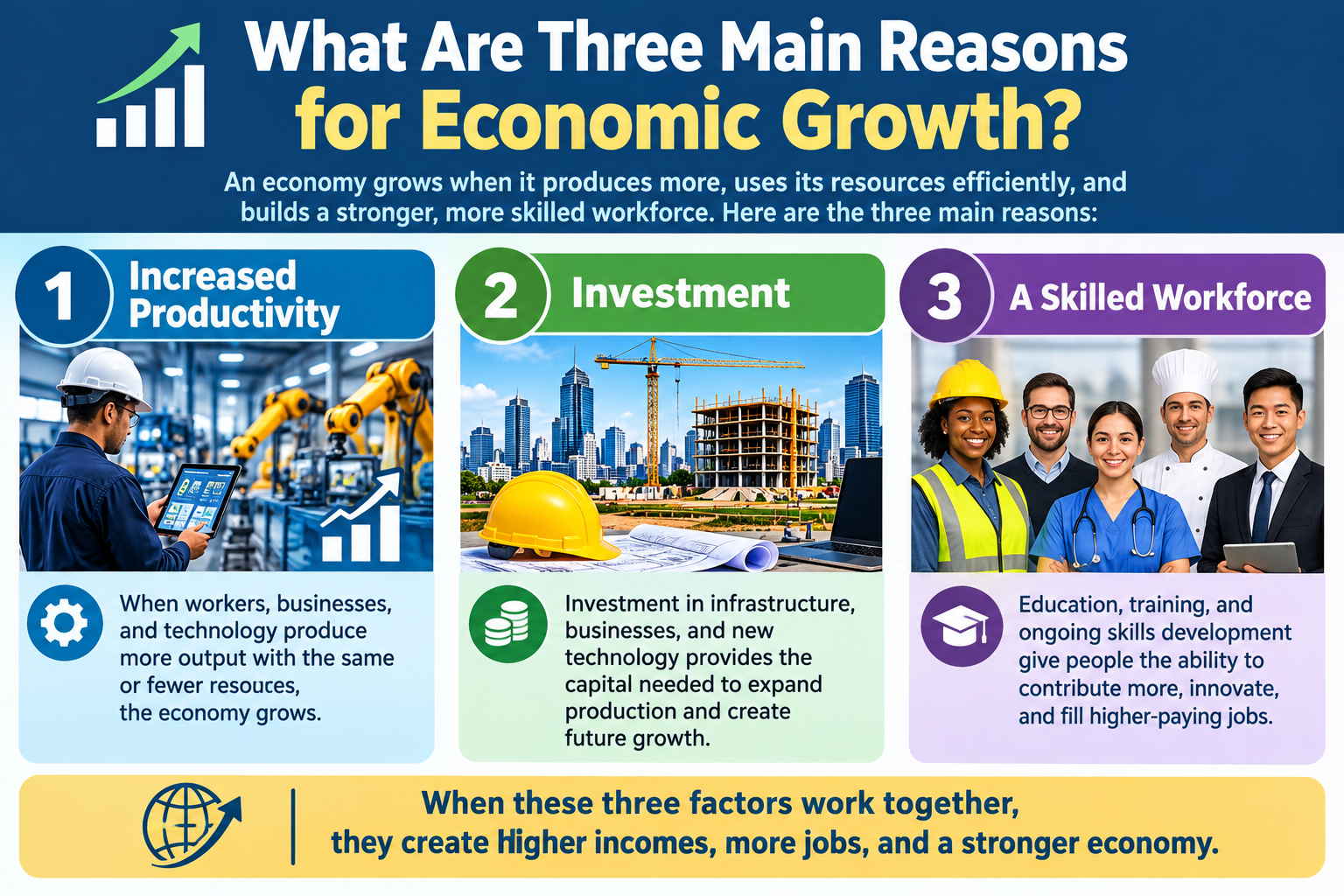
Economic growth is the process by which an economy increases the amount of goods and services it can produce over time. It is usually measured by the growth of real Gross Domestic Product (GDP). When an economy grows, businesses may produce more, employment opportunities can increase, household incomes may rise, and governments may have greater resources to provide public services.
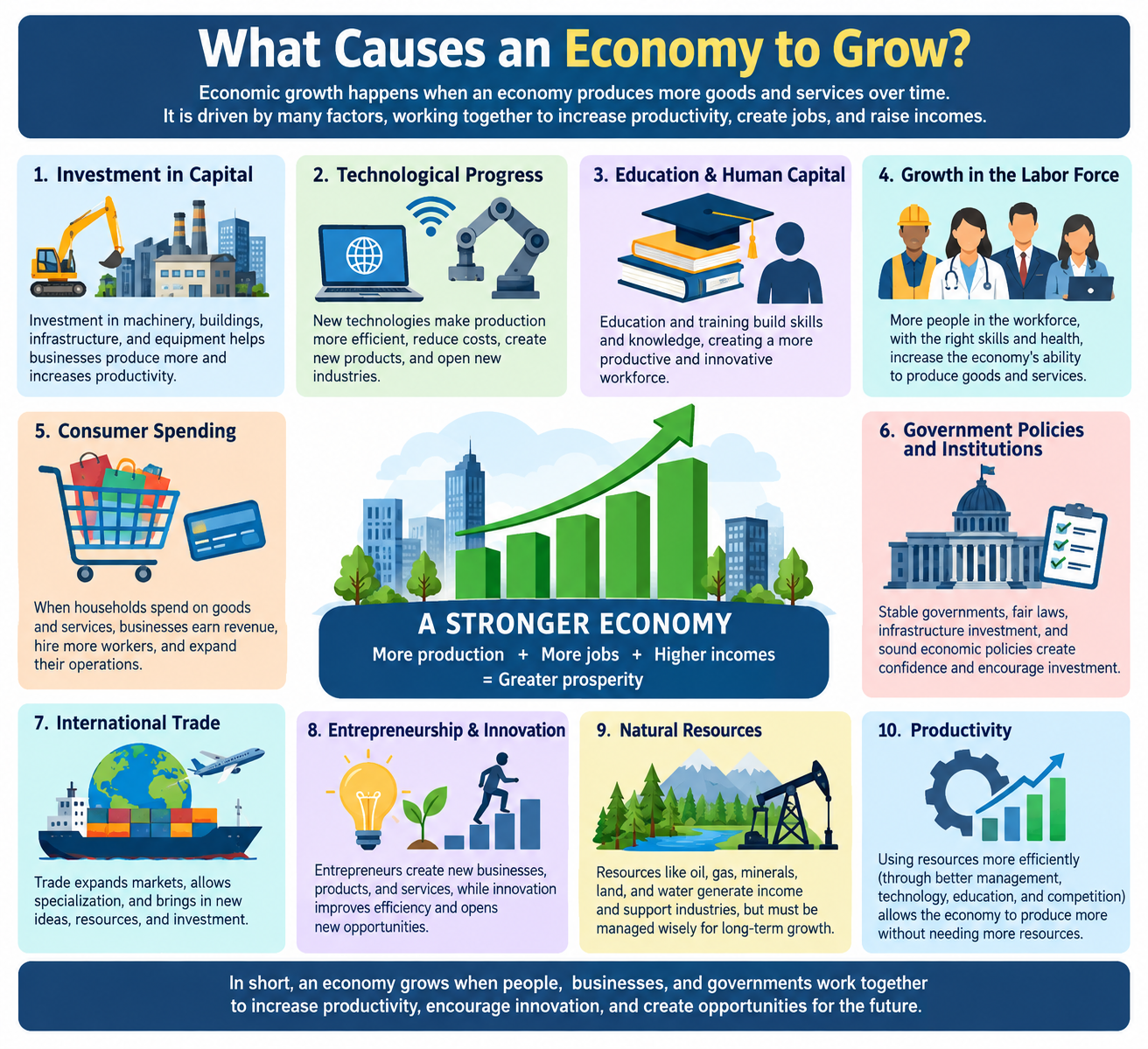
Although many factors influence economic growth, three of the most important reasons are increased resources, higher productivity, and technological progress and innovation. These factors are closely connected. An economy can grow by using more workers and capital, by using existing resources more efficiently, and by developing new technologies and methods of production.
1. Increased Resources
The first major reason an economy grows is an increase in the resources available for production. Economists often refer to these resources as the factors of production. They include labor, capital, land, and entrepreneurship.
Labor refers to the people who work in an economy. If the number of workers increases, businesses may have a larger workforce available to produce goods and services. Population growth, immigration, and higher labor-force participation can all increase the supply of workers.
For example, if more people enter the workforce, companies may be able to expand production because they have access to additional employees. A growing workforce can therefore increase the total productive capacity of an economy.
Capital is another important resource. Capital includes machinery, factories, tools, vehicles, computers, and other equipment used in production. When businesses invest in new capital, they can increase the amount of goods and services they are capable of producing.
Government investment can also expand productive resources. Building roads, bridges, airports, ports, electricity networks, and communication systems can make it easier for businesses to operate and transport goods.
Natural resources can contribute to growth as well. Countries with access to resources such as oil, gas, minerals, agricultural land, forests, or water may be able to use these resources in productive activities. However, natural resources alone do not guarantee economic growth. Countries also need investment, technology, skilled workers, and effective institutions to use resources efficiently.
Therefore, increasing the quantity of available resources can expand an economy’s productive capacity. However, simply adding more resources has limits. Long-term growth increasingly depends on how effectively those resources are used.
2. Higher Productivity
The second major reason for economic growth is increased productivity. Productivity refers to how efficiently resources are used to produce goods and services.
An economy can grow even without significantly increasing the number of workers or the amount of capital if each worker and machine becomes more productive.
For example, imagine a factory that produces 1,000 products per day using 100 workers. If the factory improves its production process and can now produce 1,500 products with the same 100 workers, productivity has increased.
Higher productivity is extremely important because it allows an economy to produce more output without requiring the same proportional increase in resources.
Productivity can improve in many ways. Businesses can introduce better management techniques, reorganize production, provide employee training, reduce waste, improve supply chains, or invest in better equipment.
Education is another major contributor to productivity. Workers who have stronger skills and knowledge can often perform more complex tasks and make better use of modern equipment and technology. This is why investment in education and training is often considered an investment in human capital.
Infrastructure can also increase productivity. Reliable transportation, electricity, internet access, and communication systems allow businesses to operate more efficiently.
Higher productivity can have benefits beyond GDP. When workers become more productive, businesses may be able to pay higher wages, reduce prices, increase profits, or invest more in expansion.
For this reason, productivity growth is one of the most important foundations of long-term improvements in living standards.
3. Technological Progress and Innovation
The third major reason for economic growth is technological progress and innovation. Technology allows economies to produce goods and services more efficiently and can create entirely new products, industries, and markets.
Technological progress can take many forms. It can involve new machinery, software, production methods, transportation systems, medical technologies, communication tools, or digital platforms.
Consider how the development of computers changed business activity. Tasks that once required large amounts of paperwork and manual calculation can now be completed quickly using software. Similarly, the internet has allowed businesses to communicate instantly, sell products internationally, provide digital services, and operate across borders.
More recently, developments in artificial intelligence, automation, cloud computing, robotics, and advanced data analysis have created new opportunities for businesses to improve productivity.
Innovation does not always mean inventing something completely new. It can also involve improving an existing product or discovering a more efficient way to perform a task.
For example, a company may redesign its supply chain so products reach customers more quickly. A farmer may use modern equipment and data to increase crop yields. A bank may introduce digital services that allow customers to complete transactions without visiting a branch.
Technological progress can therefore increase output while reducing the resources required to produce that output.
Innovation also creates new industries. The growth of the technology industry, for example, has created millions of jobs and generated demand for software, hardware, cybersecurity, digital advertising, online services, and other products.
However, technology works best when combined with skilled workers, investment, infrastructure, and supportive institutions. A country may have access to advanced technology, but it still needs people and businesses capable of using it effectively.
How the Three Reasons Work Together
These three causes of economic growth are not independent. They often reinforce one another.
A larger workforce provides more labor, but education can make that workforce more productive. Businesses can invest in more machinery, but technological improvements can make that machinery more effective. Governments can build infrastructure, while businesses use that infrastructure to invest and expand.
For example, consider a country that invests heavily in education. Its workers become more skilled. Businesses then adopt advanced technologies because they have workers capable of using them. Productivity rises, businesses become more competitive, investment increases, and the economy expands.
This demonstrates that economic growth is usually the result of several factors working together rather than one isolated change.
Why Long-Term Growth Matters
Economic growth matters because it can improve people’s material living standards. When an economy becomes more productive, it can produce more goods and services with the resources available.
Growth can create employment opportunities and increase household incomes. Governments may also collect additional tax revenue, giving them greater capacity to invest in healthcare, education, infrastructure, and other public services.
However, economic growth does not automatically benefit everyone equally. The distribution of income, access to education, employment opportunities, environmental sustainability, and the quality of institutions can influence how the benefits of growth are shared.
For this reason, many economists distinguish between simply increasing GDP and achieving sustainable and inclusive economic growth.