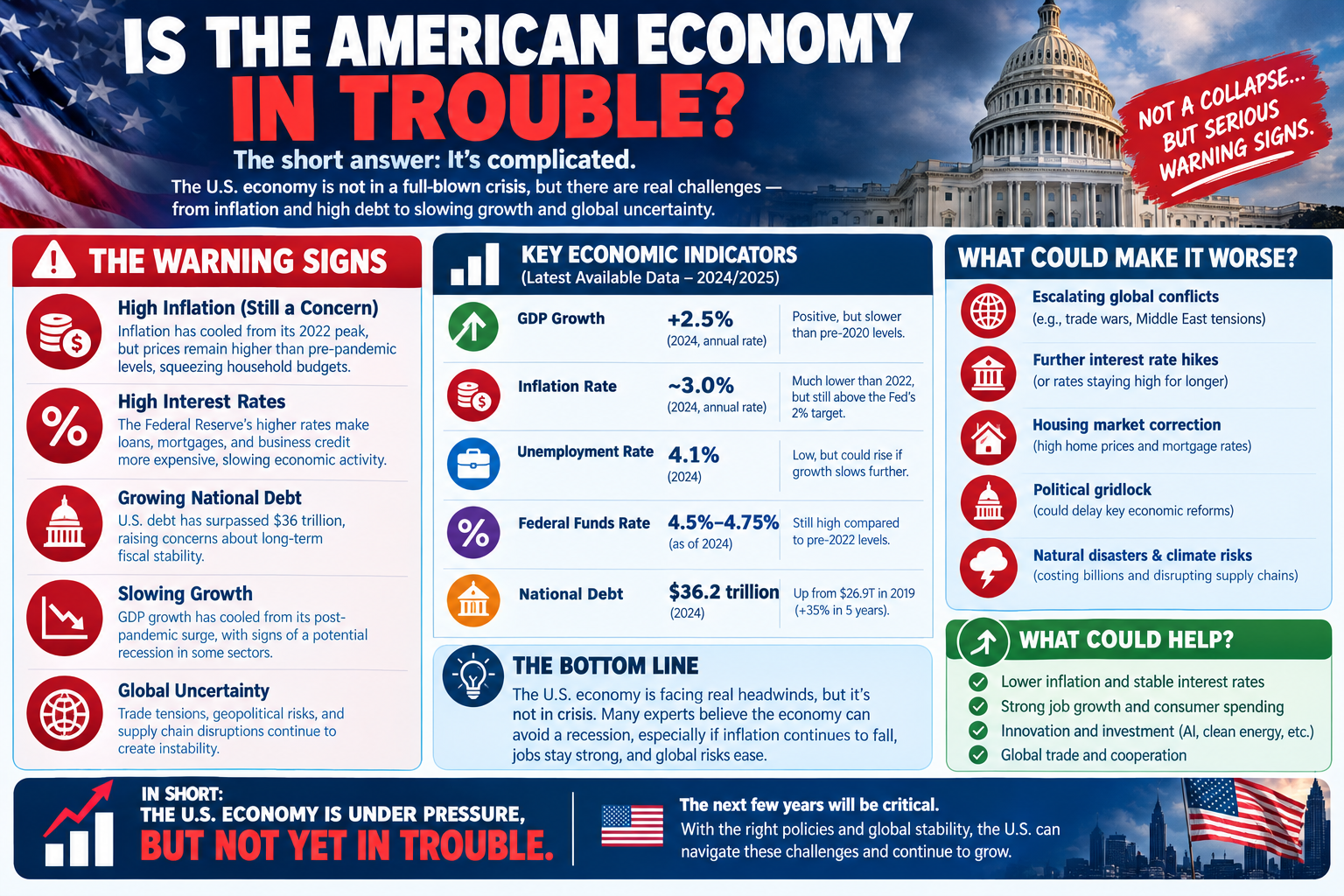
The American economy is the largest economy in the world, but that does not mean it is immune to problems. In 2026, investors, businesses and households are watching several economic pressures closely, including inflation, government debt, interest rates, housing costs, trade uncertainty and slower growth in some parts of the economy.
So, is the American economy in trouble?
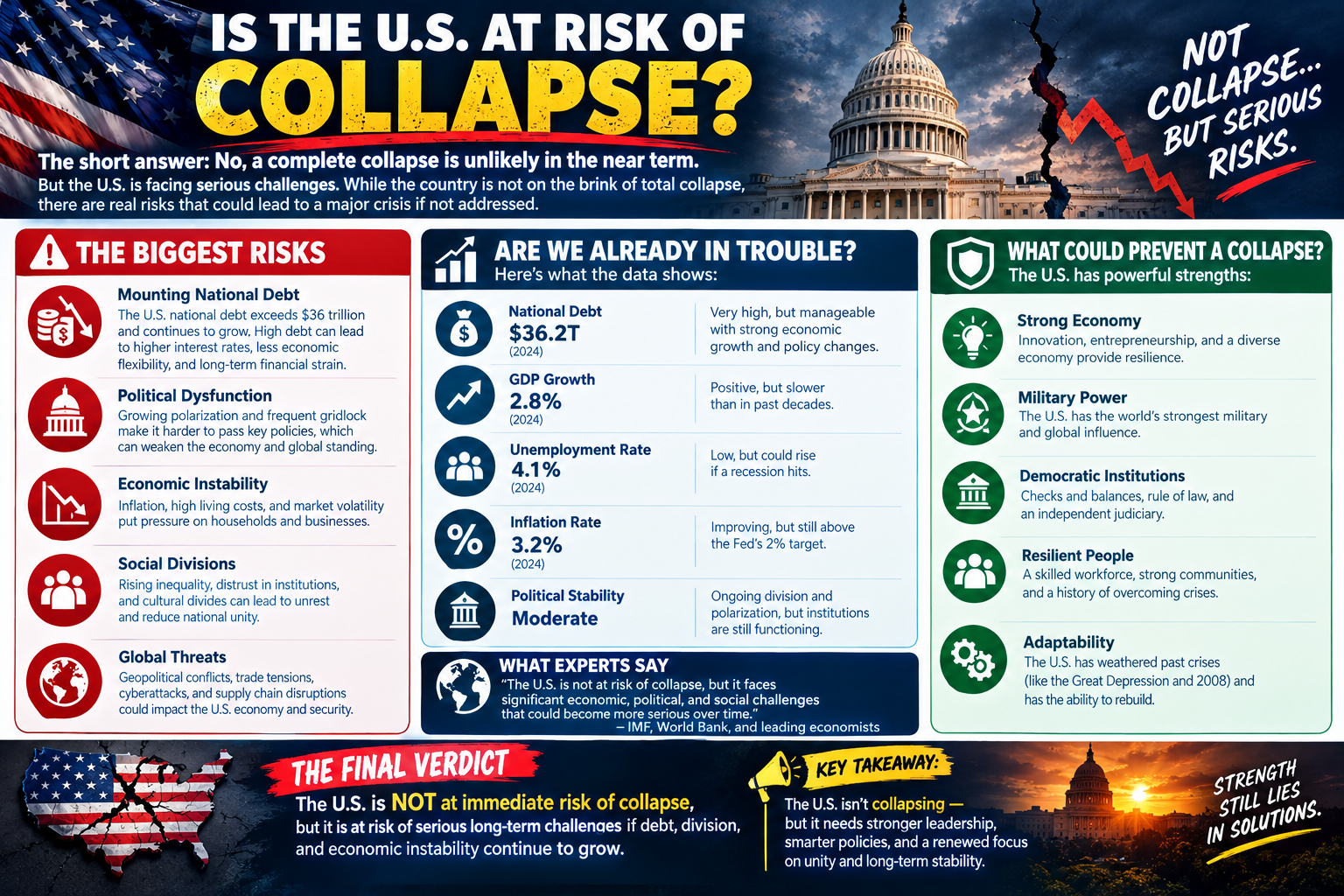
The most accurate answer is that the U.S. economy is facing important challenges, but that does not necessarily mean an economic collapse or major recession is inevitable. The economy continues to produce goods and services at a very high level, businesses continue to invest, and consumer spending remains an important source of economic activity. At the same time, several risks could make future growth more difficult.
The U.S. Economy Is Still Growing
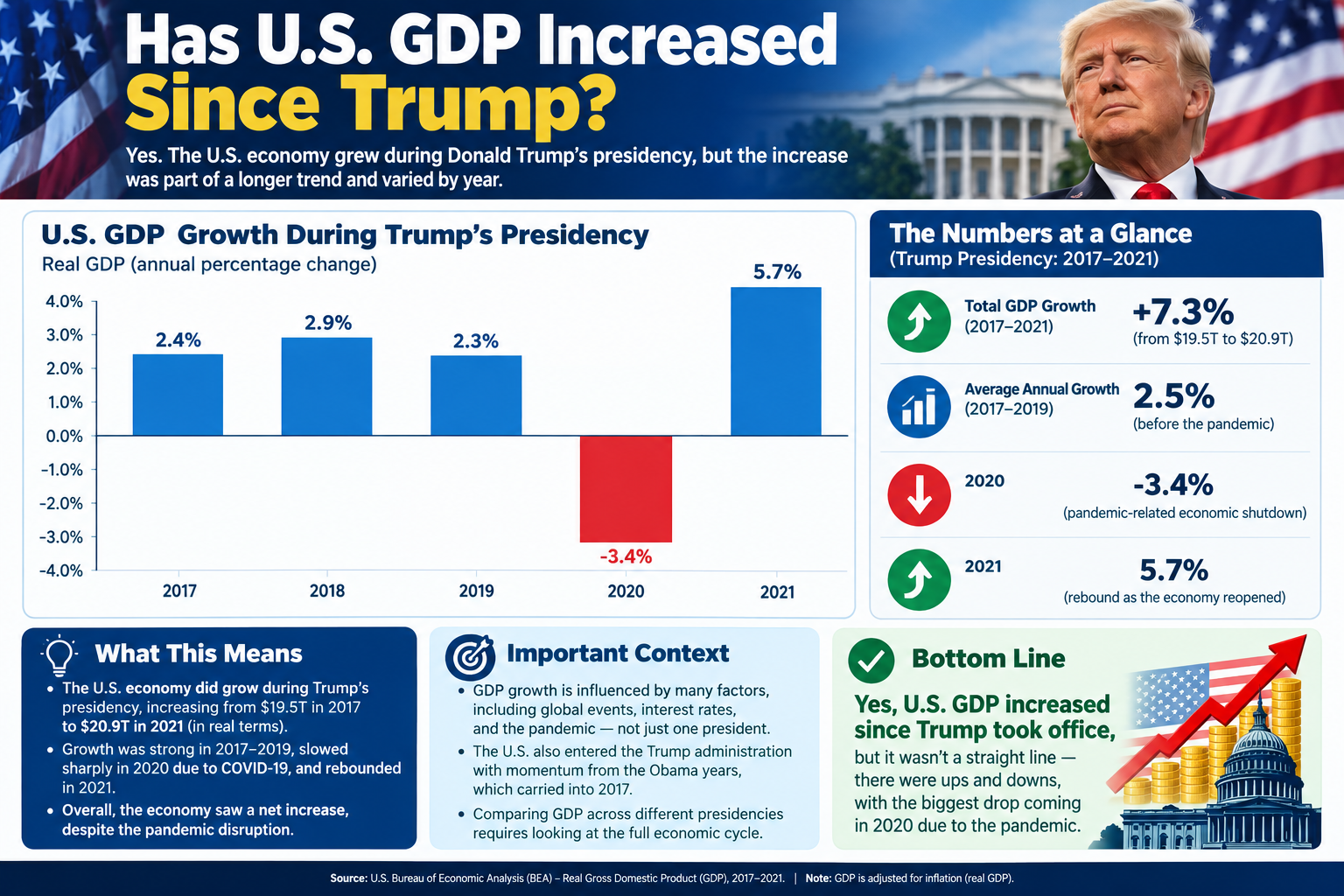
One of the strongest arguments against describing the American economy as being in immediate crisis is that real GDP has continued to grow.
According to the U.S. Bureau of Economic Analysis, real GDP increased during the first half of 2026. The economy grew at an annualized rate of 2.5% in the first quarter and 2.2% in the second quarter.
This means the economy has continued expanding rather than entering a prolonged contraction.
However, GDP growth does not tell the entire story. An economy can grow while households still struggle with high living costs, expensive housing and borrowing costs.
The important question is therefore not simply whether GDP is increasing, but whether economic growth is strong enough to support jobs, incomes and living standards.
Inflation Remains an Important Problem
Inflation is one of the biggest economic concerns for American households.
Although inflation has fallen substantially from the extreme levels experienced earlier in the decade, prices remain much higher than they were several years ago.
This distinction is important.
When inflation slows, it does not mean that prices return to their previous levels. It simply means prices are increasing more slowly.
For households, the cumulative increase in prices can still be significant. Food, housing, healthcare, insurance and other essential expenses can put pressure on household budgets.
The International Monetary Fund projected global headline inflation at approximately 4.7% in 2026, while warning that renewed geopolitical tensions and higher energy prices could create additional inflationary pressure. (imf.org)
Persistent inflation is particularly difficult because it can limit the ability of central banks to reduce interest rates quickly.
Interest Rates and Borrowing Costs
Interest rates are another major part of the economic picture.
When interest rates are high, borrowing becomes more expensive. Consumers may pay more for mortgages, credit cards and other loans, while businesses face higher costs when financing new projects.
High interest rates can therefore slow economic activity.
At the same time, interest rates are an important tool for controlling inflation. Central banks have to balance the need to keep inflation under control against the risk of weakening economic growth too much.
This creates a difficult environment for policymakers.
If rates remain high for too long, economic activity could weaken. If rates are reduced too quickly while inflation remains high, price pressures could return.
America’s Government Debt
One of the longer-term challenges facing the United States is federal government debt.
The U.S. government has accumulated a very large amount of debt over many years. High debt does not automatically cause an economic crisis, particularly for a country with a large economy and a major global currency.
However, the cost of servicing that debt becomes increasingly important when interest rates are elevated.
As the government spends more money on interest payments, fewer resources are available for other priorities unless taxes increase or spending is reduced.
The International Monetary Fund has repeatedly emphasized the importance of addressing high public debt and rebuilding fiscal buffers. Its 2026 assessments also identify elevated debt and frequent economic shocks as important challenges for financial stability. (imf.org)
This does not mean the United States is about to run out of money. Rather, it means that managing government finances becomes increasingly difficult over time.
The Housing Market Is Under Pressure
Housing affordability is another major concern.
Higher mortgage rates have made buying a home significantly more expensive for many Americans. At the same time, housing prices remain elevated in many parts of the country.
This creates a difficult situation for younger households and first-time buyers.
Even when the economy is growing, people may feel financially stressed if their income does not rise as quickly as housing and other essential costs.
A weak housing market can also affect the broader economy because construction, real estate, furniture, appliances and financial services are all connected to housing activity.
The Labor Market Matters
Employment is one of the most important indicators of economic health.
A strong labor market gives households income to spend and generally supports consumer confidence. A weakening labor market can have the opposite effect.
If unemployment rises significantly, households may reduce spending. Businesses may then experience weaker sales and reduce investment or hiring.
This can create a negative cycle.
For that reason, economists closely monitor unemployment, job creation, wage growth and labor-force participation alongside GDP.
A slowdown in employment does not necessarily mean a recession is coming, but a sharp deterioration would be an important warning sign.
Trade and Geopolitical Risks
The United States is also exposed to changes in international trade.
Tariffs, trade restrictions and geopolitical conflicts can affect the prices of imported goods, supply chains and business investment.
Companies that depend on international suppliers may face higher costs when trade relationships change.
At the same time, trade restrictions can encourage domestic production in certain industries.
The overall effect therefore depends on the scale and duration of the policies involved.
The IMF has warned that geopolitical tensions, trade fragmentation and renewed conflict represent downside risks to global economic growth. Its July 2026 outlook projected global growth of 3.0% in 2026 and 3.4% in 2027, but emphasized that the outlook remains vulnerable to new shocks. (imf.org)
Technology Could Be a Major Strength
Not every part of the American economic outlook is negative.
The United States remains one of the world’s most innovative economies, with major strengths in technology, artificial intelligence, software, finance, biotechnology, aerospace and advanced manufacturing.
Investment in artificial intelligence and computing infrastructure has become a particularly important source of business investment.
If these technologies significantly increase productivity, they could support stronger economic growth in the future.
However, there is also a risk that expectations surrounding new technologies become too optimistic. If companies invest heavily based on unrealistic expectations and expected profits fail to materialize, financial markets could experience a correction.
The IMF has identified a reassessment of AI-related profitability expectations as one of the potential downside risks to the global economy. (imf.org)
Is a Recession Coming?
A recession is possible, but it is not the same thing as an economic collapse.
Recessions occur regularly in market economies. Economic activity slows, unemployment may rise and businesses can experience declining sales.
An economic collapse would be much more severe, involving a major breakdown in financial or economic activity.
Current conditions do not automatically point toward such an outcome.
The U.S. economy remains enormous and diversified. It has deep financial markets, a highly developed banking system, advanced technology companies, substantial productive capacity and the world’s most important reserve currency.
These strengths provide significant resilience.
What Should Americans Watch?
Several indicators can help determine whether economic conditions are genuinely deteriorating.
The most important include:
- Real GDP growth: Persistent negative growth would be a major warning sign.
- Unemployment: A sharp increase would indicate weakening economic conditions.
- Inflation: Renewed rapid inflation could keep interest rates high.
- Consumer spending: A significant decline could weaken overall economic activity.
- Business investment: Falling investment could signal declining confidence.
- Financial markets: Large and sustained declines can affect wealth and confidence.
- Banking stability: Problems in the financial system could spread quickly through the economy.
- Government finances: Rising interest costs and persistent deficits represent longer-term risks.
Looking at all of these indicators together is much more useful than focusing on a single economic statistic.