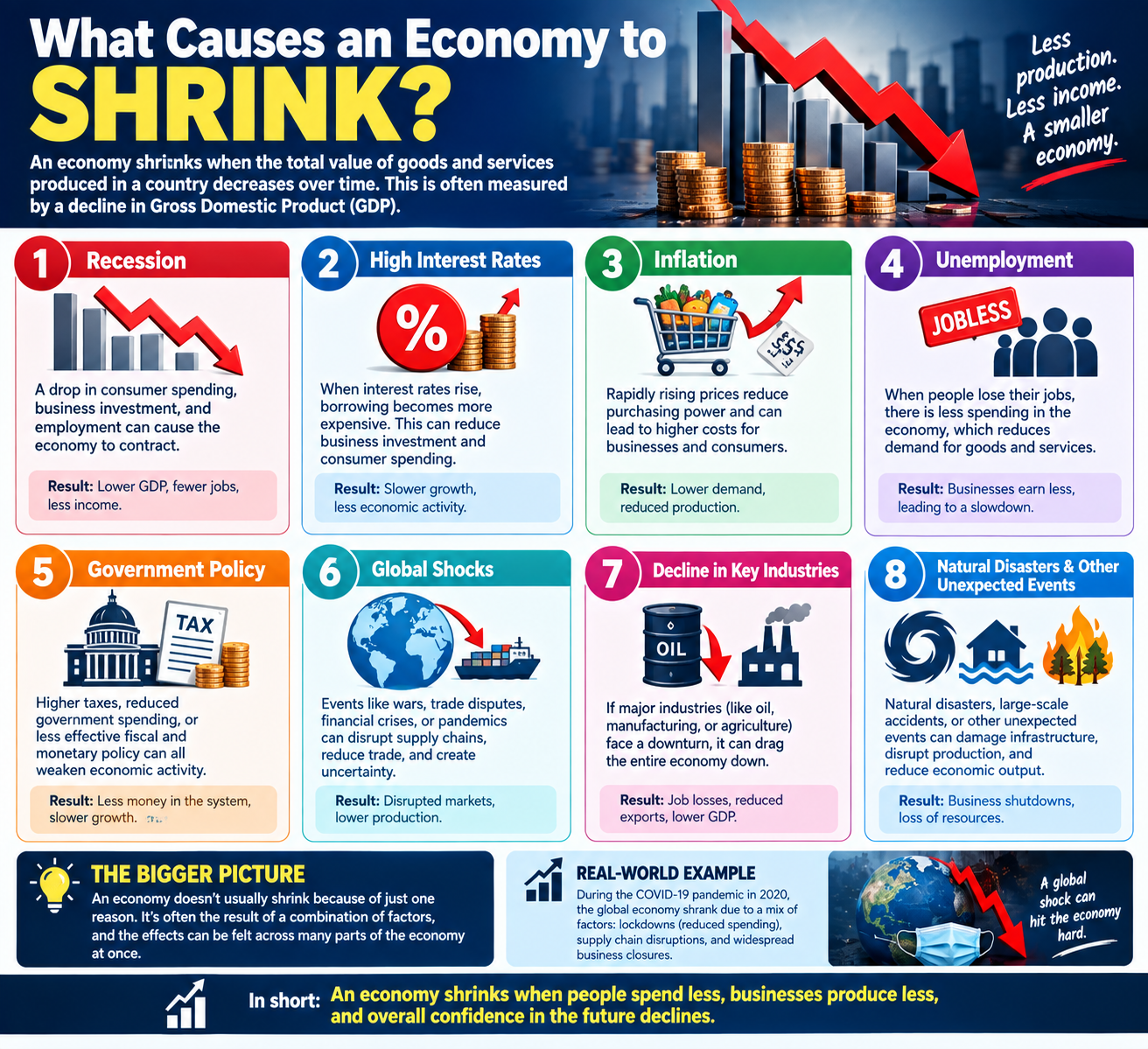
Economic growth is often used as a sign of a country’s financial health. When an economy grows, businesses generally produce more goods and services, incomes can rise, investment can increase and employment opportunities may expand. But economies do not always grow. Sometimes economic activity slows down or contracts.
So, what causes an economy to shrink?
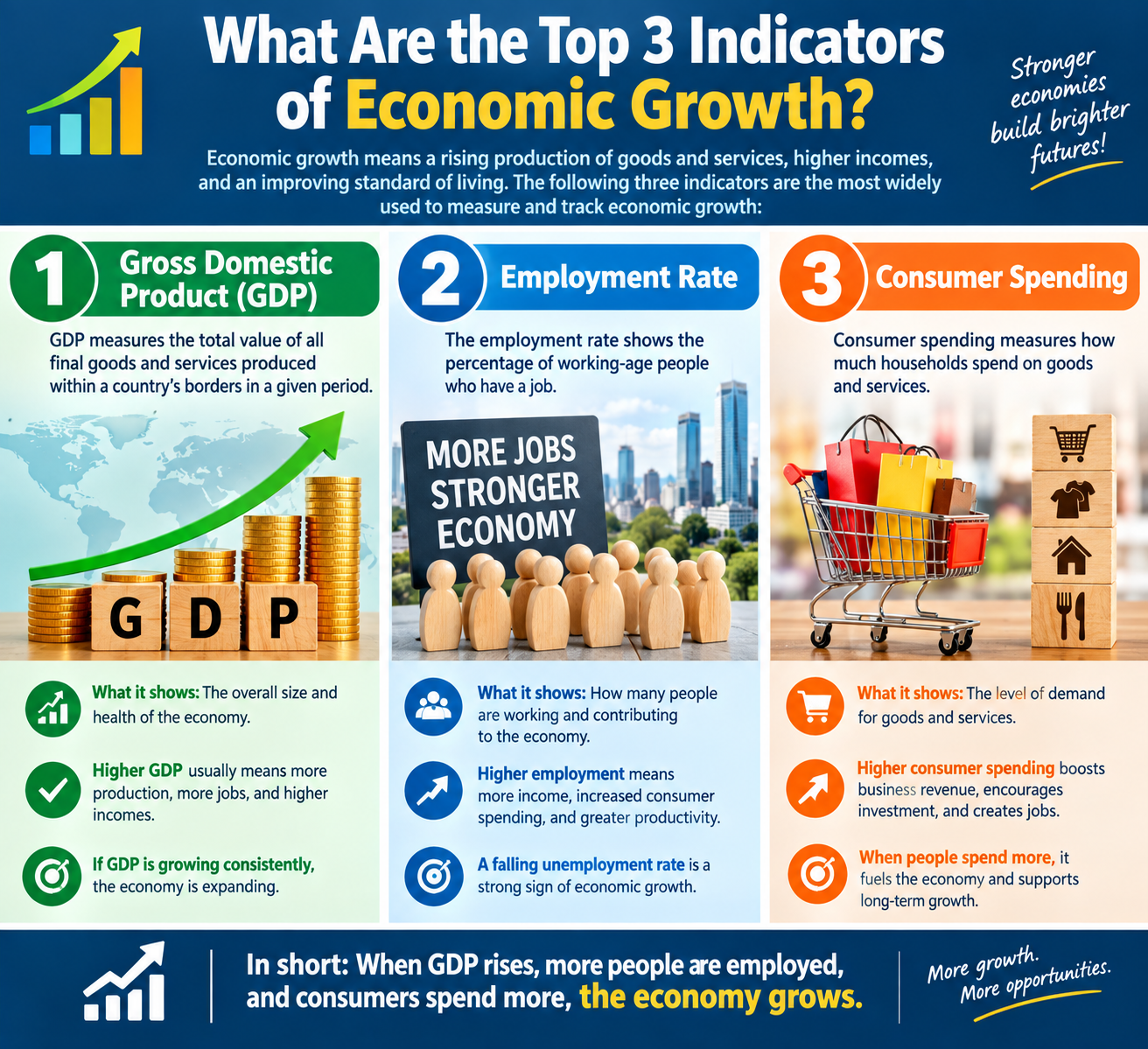
An economy shrinks when the total amount of goods and services produced falls. Economists usually measure this using real gross domestic product (GDP). If real GDP declines over a period of time, it means the economy is producing less after adjusting for changes in prices.
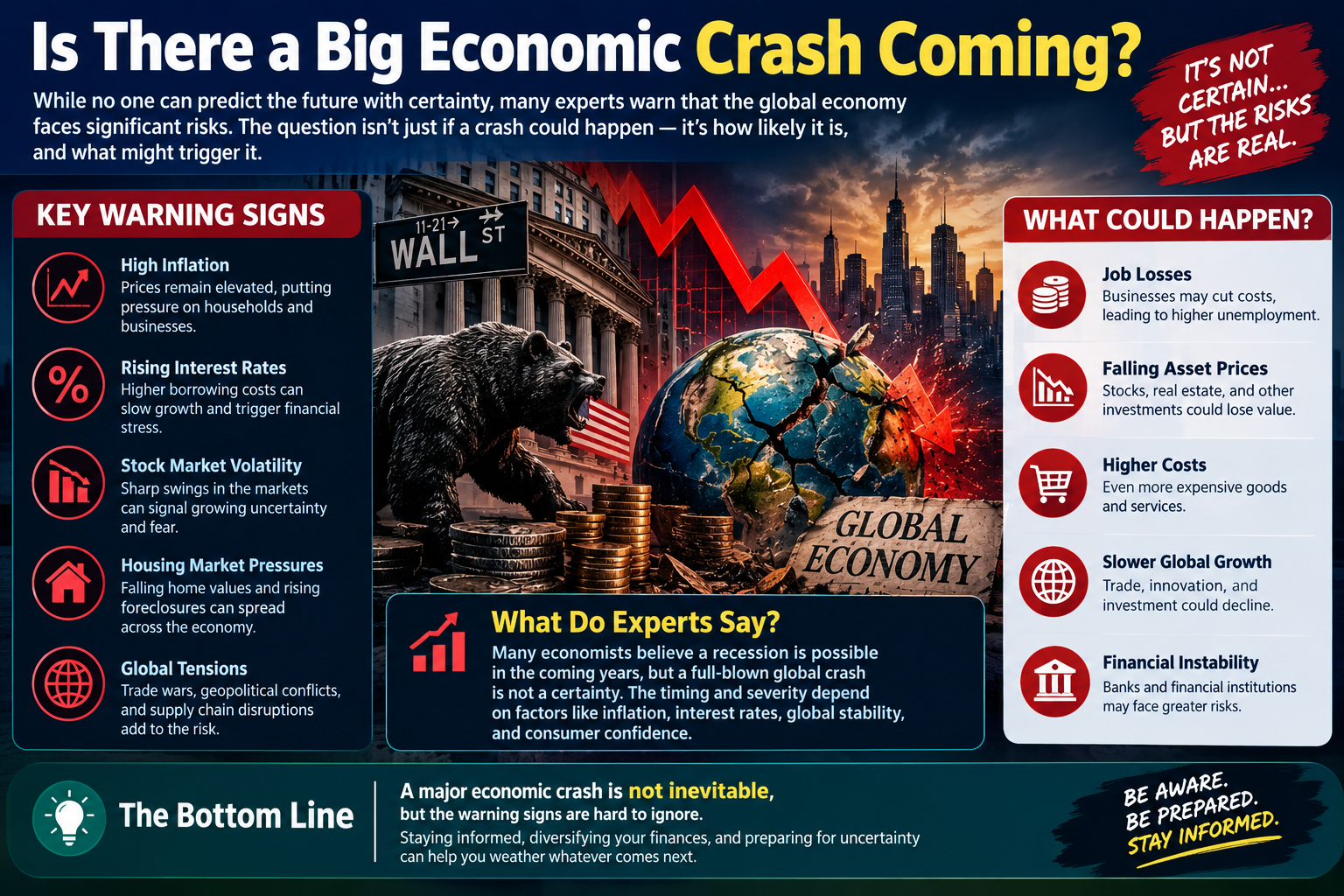
Economic contraction can happen for many reasons. A recession may be caused by falling consumer spending, high interest rates, inflation, financial crises, declining investment, trade disruptions, political instability or major external shocks. Understanding these causes helps explain why some economies struggle and why governments and central banks try to prevent severe downturns.
What Does It Mean When an Economy Shrinks?
An economy is considered to be shrinking when its real economic output decreases.
For example, imagine that businesses in a country produce $10 trillion worth of goods and services in one year. If real production falls to $9.7 trillion the following year, the economy has contracted.
A short decline does not necessarily mean an economic disaster. Economies regularly experience periods of slower growth and occasional contractions.
A prolonged and significant contraction can become a recession, especially when falling production is accompanied by rising unemployment, weaker household income and declining business investment.
1. Falling Consumer Spending
Consumer spending is one of the biggest components of economic activity in many countries.
Households purchase food, clothing, housing services, transportation, entertainment, healthcare and countless other goods and services.
When consumers become worried about the future, they may reduce their spending and save more money.
This can happen because of rising unemployment, high inflation, expensive borrowing or falling confidence.
When millions of households reduce spending at the same time, businesses can experience lower sales. Companies may respond by reducing production, delaying investment or cutting jobs.
Those job losses can reduce household income even further, creating a cycle of weaker spending and weaker economic activity.
2. High Interest Rates
Interest rates can have a major effect on economic growth.
When central banks raise interest rates, borrowing becomes more expensive. Consumers may reduce spending on houses, cars and other large purchases. Businesses may also delay investments because loans and other forms of financing become more expensive.
Higher interest rates can therefore slow demand throughout the economy.
Central banks sometimes deliberately raise interest rates to control inflation. The challenge is finding the right balance.
If rates remain high for too long, economic activity can weaken substantially.
3. High Inflation
Inflation can also contribute to economic contraction.
When prices rise rapidly, households lose purchasing power if their incomes do not increase at the same pace.
People may respond by reducing discretionary spending.
Businesses can also face higher costs for energy, materials, transportation and labor.
If companies cannot pass those higher costs to customers, their profits can decline. They may respond by reducing hiring, investment or production.
High inflation can therefore weaken both consumers and businesses.
It can also encourage central banks to raise interest rates, which may create additional pressure on economic activity.
4. Falling Business Investment
Businesses need investment to expand production.
Companies invest in factories, equipment, technology, buildings, software and research.
When businesses become pessimistic about future demand, they may postpone these investments.
For example, if companies expect customers to spend less in the future, they have less reason to build new factories or purchase expensive equipment.
Falling business investment can therefore become an important signal of economic weakness.
Over time, reduced investment can also damage productivity because businesses may have fewer modern machines, technologies and facilities available.
5. Financial Crises
Financial crises can cause particularly severe economic contractions.
Banks play a critical role in modern economies by providing credit to households and businesses.
If banks suffer major losses, they may become reluctant or unable to lend.
Businesses that depend on loans may then struggle to finance operations and investment. Consumers may also find it harder to obtain mortgages, car loans or other forms of credit.
The result can be a sharp reduction in spending and investment.
The global financial crisis of 2008 demonstrated how problems in the financial system can spread into the wider economy.
6. Falling Housing Activity
The housing market can have a significant influence on economic activity.
When housing construction is strong, it creates demand for construction workers, materials, appliances, furniture, transportation and financial services.
But when house prices fall sharply or mortgage rates rise, construction and home purchases can decline.
A major housing downturn can therefore affect many other industries.
It can also reduce household wealth and confidence, causing consumers to spend less.
7. Declining Exports and International Trade
Countries that depend heavily on exports can experience economic problems when global demand falls.
If foreign consumers and businesses purchase fewer products, exporters may see their sales decline.
Trade disruptions can create another problem.
Tariffs, sanctions, wars, shipping disruptions or supply-chain problems can make international trade more expensive or difficult.
A country that relies heavily on exports may therefore experience a significant slowdown when global trade weakens.
8. War and Geopolitical Conflict
War can cause severe economic disruption.
Businesses may be forced to close, infrastructure can be damaged and workers may be displaced.
Transportation networks, energy supplies and international trade can also be disrupted.
Governments may have to redirect large amounts of spending toward defense and emergency measures.
The economic effects can extend beyond the countries directly involved. Higher energy prices and disrupted supply chains can affect countries around the world.
9. Natural Disasters
Natural disasters can also cause economies to shrink, at least temporarily.
Earthquakes, hurricanes, floods, droughts and other disasters can destroy homes, factories, roads, bridges and agricultural production.
Economic activity may fall because businesses cannot operate normally.
However, reconstruction can later create additional economic activity. This means the long-term effects depend on the severity of the disaster and the economy’s ability to rebuild.
10. Population Decline
Demographics can influence economic growth over the long term.
A shrinking working-age population can reduce the number of people available to work.
An aging population can also increase spending on healthcare and pensions while reducing the size of the workforce.
Countries experiencing long-term population decline may therefore face weaker economic growth unless productivity increases enough to compensate.
Immigration, higher labor-force participation and technological improvements can help offset some of these demographic pressures.
11. Political Instability
Businesses need confidence to invest.
Political instability can make companies uncertain about taxes, regulations, property rights and future economic policies.
When uncertainty becomes very high, businesses may delay investment and households may reduce spending.
In extreme cases, political instability can lead to capital flight, currency depreciation and financial instability.
Strong institutions and predictable economic policies can therefore play an important role in preventing severe economic contractions.
12. Productivity Problems
Long-term economic growth depends heavily on productivity.
Productivity measures how efficiently workers and businesses produce goods and services.
If productivity growth slows significantly, the economy may struggle to increase output and living standards.
Low productivity can result from inadequate infrastructure, weak education systems, insufficient investment, outdated technology or poor business conditions.
A temporary productivity slowdown does not necessarily cause a recession, but persistent weakness can reduce an economy’s long-term growth potential.
How an Economic Contraction Can Become a Recession
Economic problems often reinforce one another.
Imagine that inflation becomes very high. The central bank raises interest rates to control prices. Higher rates reduce borrowing and spending. Businesses experience weaker sales and reduce investment. Companies begin cutting jobs. Unemployment rises, causing households to spend even less.
This creates a feedback loop.
The economy can move from slower growth into a recession.
This is why policymakers monitor economic indicators carefully. The goal is often to address problems before they become severe enough to create a self-reinforcing downturn.
Can Governments Prevent an Economy From Shrinking?
Governments and central banks have several tools available.
Central banks can adjust interest rates and use other monetary-policy tools to influence borrowing and financial conditions.
Governments can change taxes, public spending and investment to support economic activity during periods of weakness.
They can also invest in infrastructure, education and technology to improve long-term productivity.
However, policymakers cannot prevent every contraction.
Some economic shocks are extremely difficult to control, particularly wars, natural disasters and global financial crises.
The goal is generally to reduce the severity of downturns and create conditions for recovery.