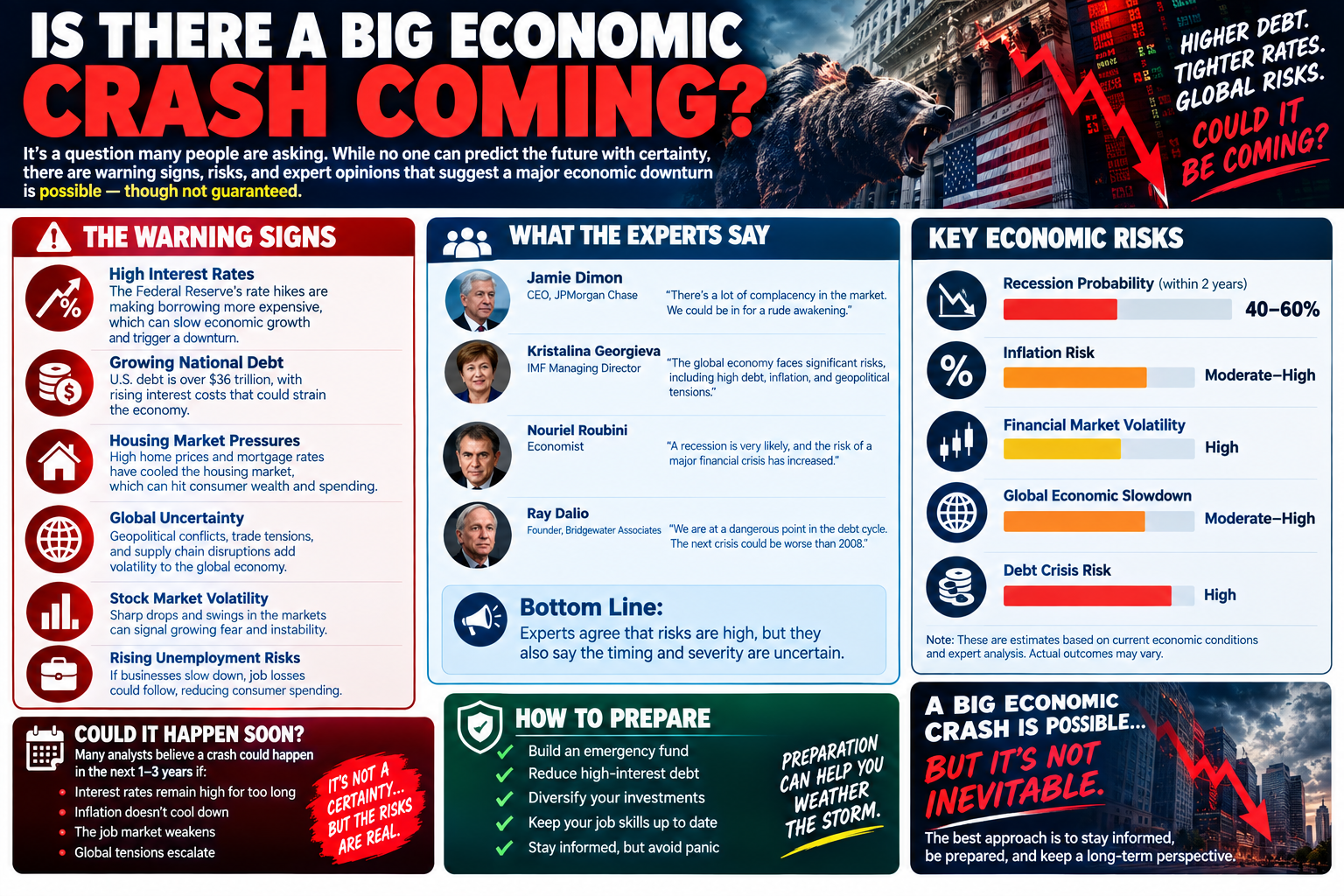
Whenever inflation remains high, markets become volatile, government debt rises or geopolitical tensions increase, people naturally begin asking the same question: Is a big economic crash coming?
The answer is not straightforward. Economic crashes are extremely difficult to predict with precision, and there is currently no evidence that a global economic collapse is inevitable. However, there are several risks that could cause a serious slowdown or financial shock if they occur at the same time.
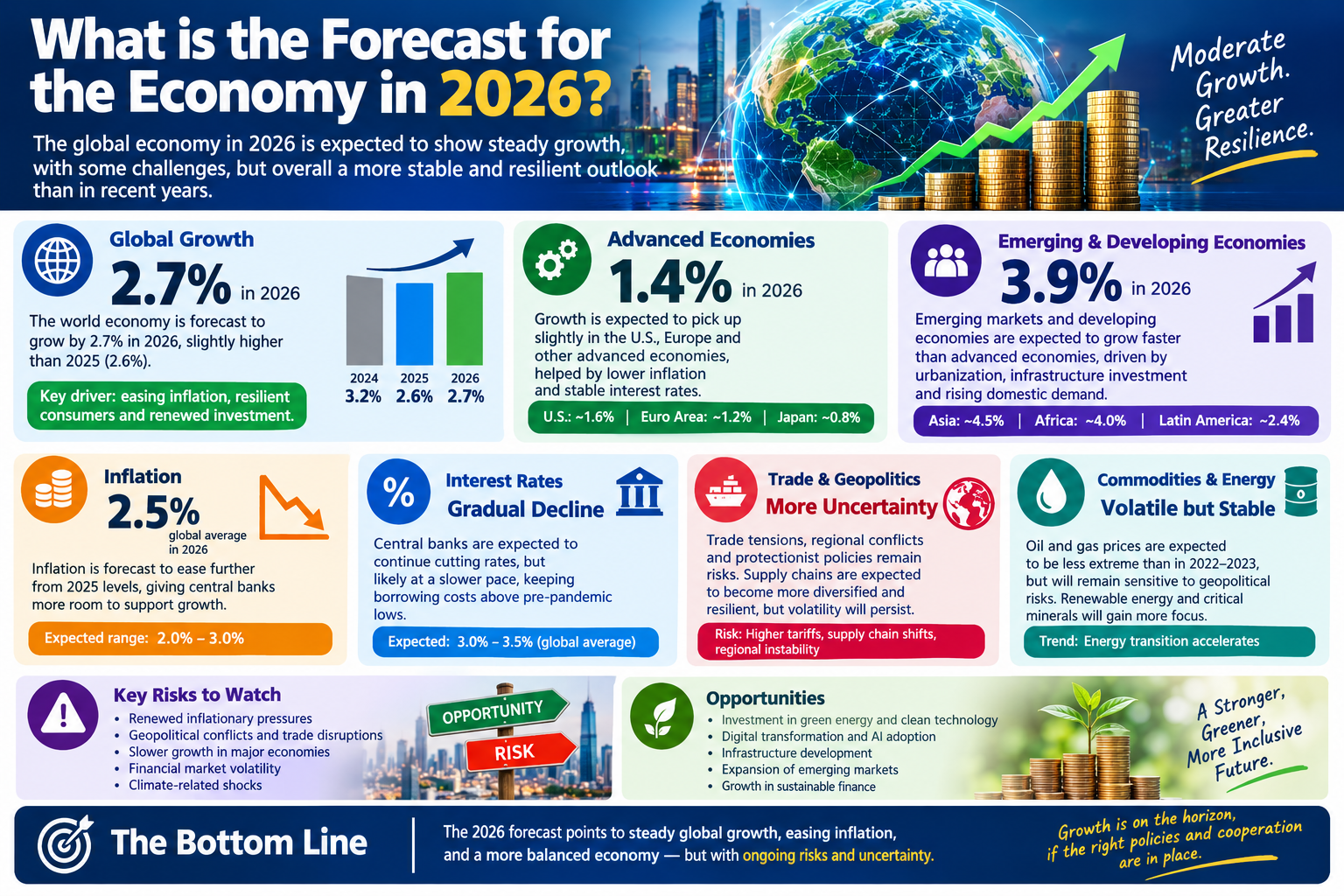
As of late 2026, the global economy is still growing. The International Monetary Fund projected global growth of around 3.0% in 2026 and 3.4% in 2027 in its July outlook. The U.S. Federal Reserve’s September projections also showed a median expectation of 2.3% U.S. real GDP growth in 2026 and 2.4% in 2027. These forecasts do not resemble a baseline scenario of an imminent global collapse.
Nevertheless, important risks remain.
What Is an Economic Crash?
An economic crash is much more severe than an ordinary recession.
A recession generally involves declining economic activity, weaker business conditions and rising unemployment. A crash can involve a sudden and severe decline in economic output, financial markets, credit availability and confidence.
The 2008 financial crisis is one example of how problems in one part of the financial system can spread throughout the wider economy.
A crash could potentially begin in financial markets, housing, banking, government debt, commodities or another major economic sector.
The important point is that a falling stock market does not automatically mean the economy is crashing. Markets can experience corrections without causing a major recession.
Why Are People Worried About a Crash?
There are several reasons economic concerns remain elevated.
The global economy is dealing with geopolitical conflict, high levels of public debt, changing trade relationships, inflationary pressures and significant investment in new technologies.
The IMF has warned that the combination of frequent shocks, high uncertainty and elevated debt makes it more difficult for countries to protect economic stability and sustain growth.
Financial markets can also become vulnerable when asset prices rise faster than underlying economic fundamentals.
If investors suddenly change their expectations, prices can fall quickly.
That does not guarantee a crash, but it creates the possibility of a sharper correction.
Government Debt Is a Major Risk
One of the biggest long-term concerns is government debt.
Governments around the world accumulated significant debt during the pandemic and subsequent economic crises. High interest rates can make that debt more expensive to service.
The problem becomes particularly serious if investors begin demanding higher interest rates to lend to governments.
Higher borrowing costs can increase government interest expenses, reduce fiscal flexibility and potentially weaken confidence in financial markets.
The IMF has emphasized the importance of rebuilding fiscal space because high debt can make economies more vulnerable when another major shock occurs.
However, high debt alone does not mean a crash is about to happen. The United States and other major economies have substantial financial resources and institutions capable of responding to economic stress.
Inflation Could Create Another Problem
Inflation is another potential source of instability.
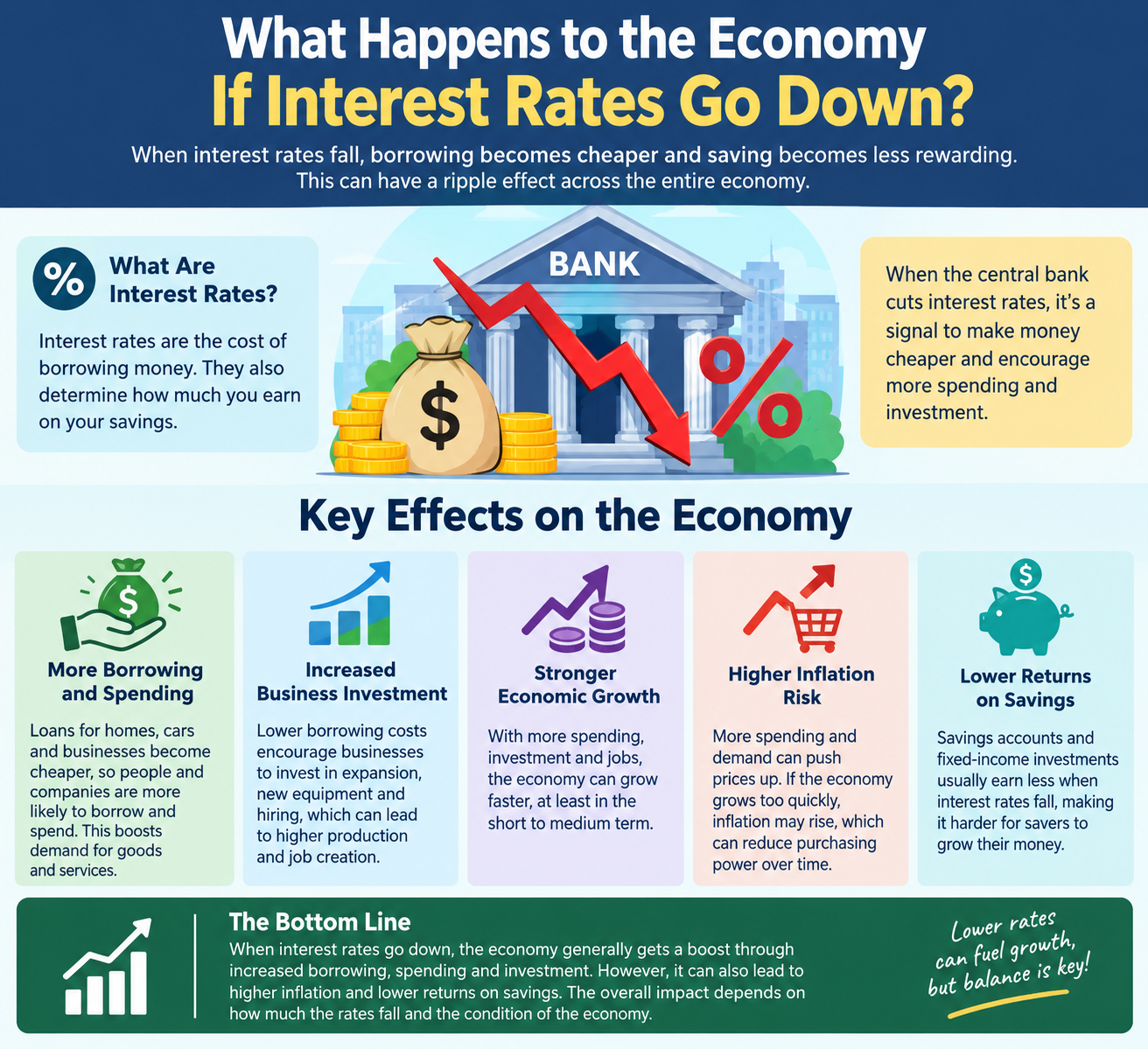
If inflation falls steadily, central banks can gradually reduce interest rates when economic conditions require it.
But if energy prices, trade disruptions or geopolitical conflicts cause inflation to rise again, central banks may have less room to lower interest rates.
This could create a difficult combination of slower economic growth and persistent inflation.
The IMF’s July 2026 outlook warned that global disinflation had stalled and that renewed conflict and financial-market repricing remained important downside risks.
This situation can be particularly difficult for households because prices may remain high even if economic growth slows.
Could the Stock Market Crash?
Stock markets are one of the most visible potential sources of concern.
Markets can become expensive when investors expect very strong future earnings. If those expectations suddenly change, stock prices can fall sharply.
Artificial intelligence has become a particularly important area of investment.
Companies involved in AI, semiconductors, cloud computing and data centers have attracted enormous amounts of capital. If AI generates the productivity and profits investors expect, this investment could support future economic growth.
But if expectations become unrealistic, a major correction could occur.
The IMF has specifically warned that a reassessment of AI-related profitability expectations could lead to sharp declines in equity valuations, wealth losses and layoffs. It has also highlighted concentration and stretched valuations in AI-related companies as financial stability risks.
An AI-related market correction would not necessarily produce another 2008-style crisis, but a sufficiently large decline could weaken consumer confidence, business investment and financial conditions.
Geopolitical Conflict Could Trigger a Shock
Geopolitical events can also affect the global economy.
Wars and international tensions can disrupt energy supplies, shipping routes, trade and investment.
Higher energy prices can increase inflation while reducing consumers’ purchasing power.
The IMF’s April 2026 outlook warned that a longer or broader conflict could significantly weaken economic growth and destabilize financial markets.
This is one reason economic forecasts can change rapidly.
An economy may look relatively stable until an unexpected geopolitical event creates a new shock.
The Banking and Financial System
Banks and other financial institutions are another area economists monitor closely.
A banking crisis can spread quickly because banks are connected through lending, payments and financial markets.
There are also risks outside traditional banks. Hedge funds, private credit markets and other nonbank financial institutions have become increasingly important parts of the financial system.
The IMF has warned that high leverage among some nonbank financial intermediaries can amplify market volatility through forced selling and liquidity pressures.
At the same time, modern financial regulation and central-bank intervention provide tools for containing financial stress.
The existence of risks therefore does not mean that a crisis will necessarily occur.
What About the U.S. Economy?
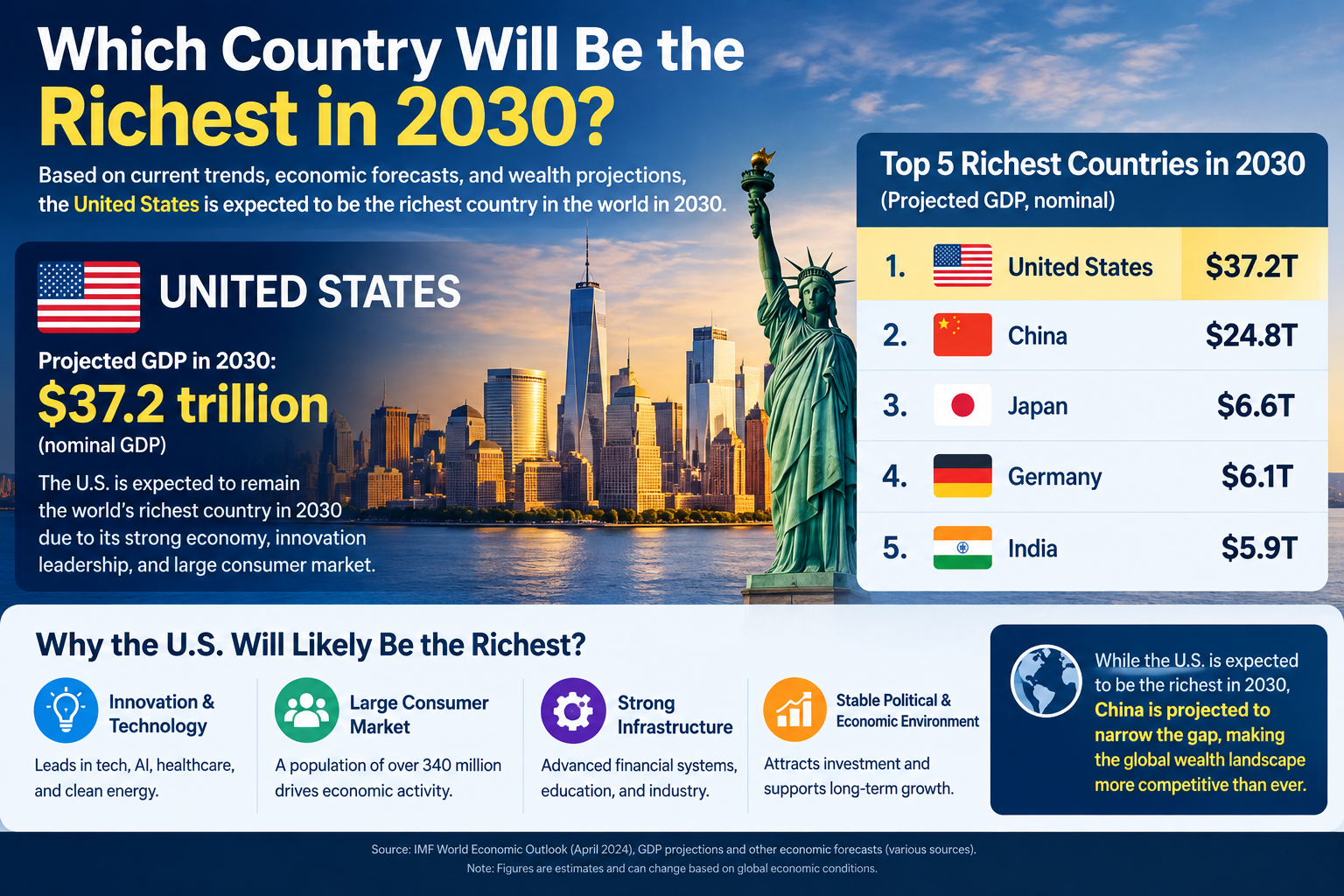
The United States remains a particularly important part of the global economic picture.
The Federal Reserve’s September 2026 projections showed a median forecast of 2.3% real GDP growth for 2026, with unemployment projected at 4.1% and PCE inflation at 3.7%. For 2027, the median GDP-growth projection was 2.4%, while unemployment was projected at 4.1%.
These projections suggest continued economic expansion rather than an expected collapse.
However, the Fed’s projections are forecasts, not guarantees.
Unexpected events can change economic conditions quickly.
What Would a Real Crash Look Like?
A major economic crash would probably involve several warning signs occurring simultaneously.
These could include:
- A sharp and sustained decline in GDP
- Rapid increases in unemployment
- Major banking failures
- A severe stock-market collapse
- Tight credit and falling business investment
- A major housing-market decline
- Persistent financial-market instability
- A loss of confidence in government finances
- Severe disruptions to international trade
One indicator alone would not necessarily signal a crash.
For example, the stock market could fall 20% while the wider economy continues growing. Similarly, a recession could occur without becoming a financial collapse.
The greatest danger would be a situation in which several of these problems reinforce each other.
Why a Crash Is Not Inevitable
Despite these risks, there are reasons for optimism.
The global economy continues to grow. The U.S. economy remains highly diversified. Businesses continue to invest in technology and productive capacity, while central banks have extensive experience responding to financial stress.
Technology could also become a major source of future productivity growth.
If artificial intelligence and other technologies produce meaningful efficiency improvements, they could support higher economic growth and partially offset some demographic and productivity challenges.
The IMF expects AI-driven demand to benefit economies integrated into global technology supply chains, although it also warns about the financial risks associated with excessive expectations.
What Should Investors and Households Watch?
Rather than trying to predict the exact date of a crash, it is more useful to monitor several economic indicators.
Watch unemployment for signs that companies are cutting jobs.
Watch inflation to determine whether central banks can ease monetary policy.
Watch GDP growth for evidence that the economy is slowing.
Watch credit markets and banks for signs of financial stress.
Watch government bond markets for signs that borrowing costs are becoming difficult to manage.
And watch stock-market valuations, particularly in areas where expectations have become extremely high.
No single indicator can predict the future, but a combination of worsening indicators would deserve serious attention.