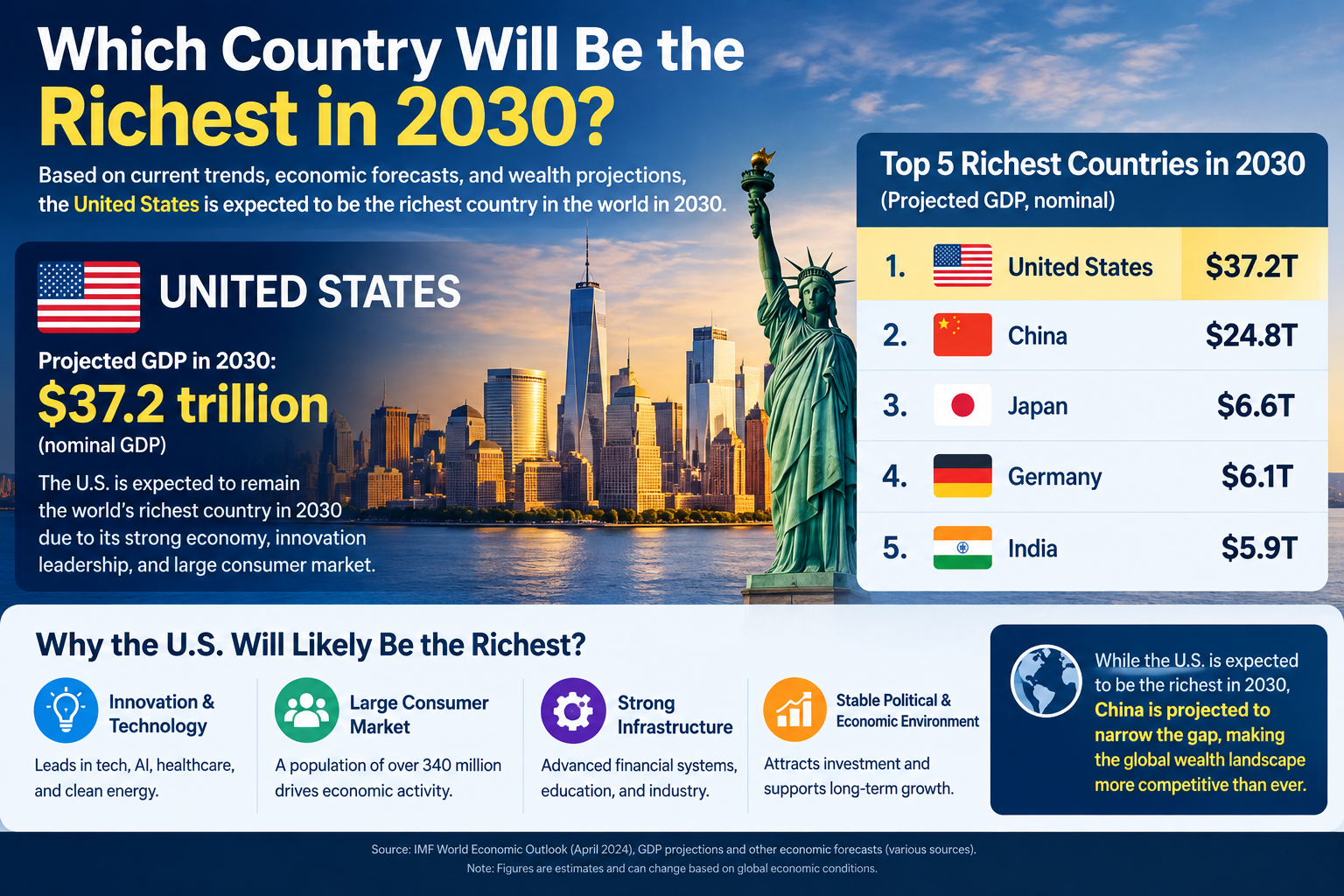
Which country will be the richest in 2030? This is one of the most interesting questions about the future of the global economy. Countries are constantly changing in terms of economic growth, population, technology, investment and productivity. As a result, the economic rankings of countries could look quite different by the end of the decade.
The answer depends on what we mean by “richest.” If we are talking about the largest economy based on total nominal GDP, the United States is likely to remain one of the leading candidates for the world’s largest economy in 2030, while China is its strongest competitor. If we measure wealth per person, however, countries such as Luxembourg, Singapore, Switzerland and other small high-income economies are likely to remain near the top.
Forecasting economic rankings six years into the future is uncertain. The International Monetary Fund’s World Economic Outlook provides projections through 2031, but these are forecasts rather than guarantees. Economic growth can be affected by technological changes, wars, trade policies, financial conditions, demographics and unexpected global events.
What Does “Richest Country” Mean?
Before identifying the likely richest country in 2030, it is important to understand how countries are compared.
The most common measurement is GDP, or gross domestic product. GDP measures the value of goods and services produced within an economy.
There are several ways of comparing GDP. Nominal GDP converts countries’ economic output into a common currency, usually U.S. dollars, using market exchange rates. GDP based on purchasing power parity (PPP) adjusts for differences in the prices of goods and services between countries.
These measurements can produce different rankings.
For example, a country may have a huge economy in PPP terms because its domestic prices are relatively low, while its nominal GDP ranking may be lower because of exchange-rate differences.
Therefore, when people ask which country will be the richest in 2030, it is important to specify whether they mean the largest overall economy or the highest wealth per person.
The United States
The United States is currently the world’s largest economy by nominal GDP and is a strong candidate to remain at or near the top in 2030.
The U.S. has several major economic advantages. It has a large domestic market, a highly developed financial system, world-leading technology companies, significant natural resources and a large pool of skilled workers.
The country is also home to many of the world’s most valuable businesses. Its technology, financial, pharmaceutical, aerospace and entertainment industries have a major influence on the global economy.
According to the IMF’s April 2026 data, U.S. nominal GDP is projected at about $32.4 trillion in 2026. The IMF projects real U.S. economic growth of 2.3% in 2026.
The United States also has an important advantage in innovation. Investment in artificial intelligence, software, semiconductors, biotechnology and other advanced industries could support productivity growth during the remainder of the decade.
However, the U.S. also faces challenges, including high government debt, demographic changes, political uncertainty and the possibility of slower productivity growth.
China
China is the most important competitor to the United States in the race to become the world’s largest economy.
China has an enormous population, a huge manufacturing base and extensive infrastructure. It is also a major exporter and has developed strong positions in industries such as electric vehicles, batteries, electronics, renewable energy and advanced manufacturing.
On a PPP basis, China is already larger than the United States. The IMF’s April 2026 data put China’s 2026 GDP at approximately $44.3 trillion in purchasing-power-parity terms, compared with about $32.4 trillion for the United States.
However, nominal GDP comparisons are different. Exchange rates have a major influence on the dollar value of China’s economy.
China’s economy is also facing structural challenges. Its population is aging, property-market problems have weighed on activity, and domestic demand and productivity growth are important concerns.
The IMF’s July 2026 outlook projects Chinese real GDP growth of 4.6% in 2026 and 4.1% in 2027.
China could therefore challenge the United States for the top position by 2030, but predicting exactly when or whether an overtaking will occur is uncertain.
India: A Major Future Economic Power
Another country that deserves attention is India.
India is not currently the largest economy by nominal GDP, but its growth rate and population give it significant long-term potential.
The IMF’s July 2026 outlook projects India’s growth at 6.4% in 2026 and 6.7% in 2027. The IMF also estimates medium-term growth at around 6.5%.
India’s advantages include a large working-age population, expanding infrastructure, a growing middle class, a large technology sector and increasing investment.
If India maintains relatively strong growth over several decades, its economy could become one of the world’s largest.
However, becoming the largest economy by 2030 would require an enormous increase in economic output over a relatively short period. India is therefore more likely to be viewed as a major long-term challenger rather than the most likely number-one economy in 2030.
Why Technology Could Change the Rankings
Technology could be one of the biggest factors affecting the economic rankings of 2030.
Artificial intelligence, automation, robotics, advanced computing, biotechnology and renewable energy could significantly change productivity.
The IMF has highlighted the economic effects of the current technology cycle, noting that AI-related demand is supporting countries integrated into global technology supply chains.
Countries that successfully develop and adopt new technologies may experience faster productivity growth.
This is particularly important because economic size is not determined only by population. Productivity allows workers and businesses to produce more valuable goods and services.
If one country achieves a major productivity breakthrough while another struggles to adopt new technology, their economic positions could change significantly.
GDP Per Person Tells a Different Story
The country with the largest economy is not necessarily the richest country for its citizens.
The United States may have one of the world’s largest total economies, but smaller countries can have much higher GDP per capita.
Countries such as Luxembourg, Singapore and Switzerland have relatively small populations but very high levels of output per person.
This distinction is important because total GDP measures economic size, while GDP per capita provides a rougher indication of average economic output per person.
Therefore, if the question is “Which country will have the largest economy in 2030?”, the United States and China are the main candidates.
If the question is “Which country will be richest per person?”, the answer is likely to involve a smaller, high-income economy.
Could China Overtake the United States?
China overtaking the United States by 2030 is possible, but it should not be treated as certain.
The outcome will depend on several factors, including economic growth rates, exchange rates, inflation, productivity, population trends, investment and government policy.
The U.S. economy has shown considerable resilience, while China’s economy continues to benefit from its enormous manufacturing capacity and investment base.
At the same time, both countries face significant challenges.
The United States must manage debt, demographic pressures and economic inequality while maintaining its technological advantage.
China must address demographic aging, weak domestic demand, property-sector difficulties and the need to maintain productivity growth.
The Global Economy in 2030
The economic world of 2030 is likely to be more competitive than today’s economy.
The United States and China will probably remain the two most important economic powers, while India is likely to become increasingly influential.
Other countries will also play major roles. European economies, Japan, South Korea, Canada, Brazil, Indonesia, Mexico and other emerging markets could benefit from investment, technological development and changing global supply chains.
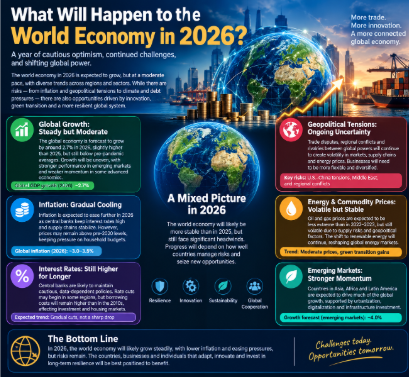
The global economy itself is expected to continue expanding, although growth is likely to vary significantly between countries. The IMF’s July 2026 outlook projects global growth of 3.0% in 2026 and 3.4% in 2027.