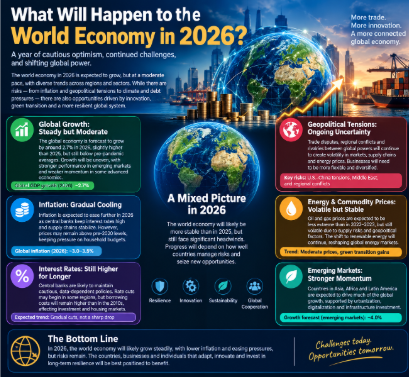
The world economy in 2026 is likely to be defined by moderate growth, persistent uncertainty, technological transformation, geopolitical tensions, and uneven economic performance across countries. Rather than experiencing either a dramatic global boom or a universal recession, the global economy is entering a period in which some economies will expand strongly while others struggle with inflation, high debt, weak investment, and expensive energy.
The International Monetary Fund (IMF) projected global economic growth of about 3.0% in 2026, while warning that growth remains uneven. The World Bank has also highlighted significant downside risks, particularly from geopolitical conflicts, energy prices, debt, and trade disruptions.
1. Global Growth Will Continue, but Slowly
One of the most important characteristics of the 2026 economy is that the world is still growing, but not at the rapid pace seen during some previous periods of expansion.
The IMF’s July 2026 outlook projected global growth at 3.0%, with growth expected to increase to 3.4% in 2027. However, the IMF noted that the expansion is uneven. Countries closely connected to the technology sector are benefiting from strong investment in artificial intelligence, while economies affected by war and high energy costs face greater pressure.
This means that 2026 is unlikely to feel economically the same everywhere. Some countries may experience rising business investment, employment and consumer spending, while others may face weak currencies, expensive imports and declining purchasing power.
2. Inflation Will Remain an Important Problem
Although inflation has fallen significantly from the extreme levels experienced after the pandemic, price stability remains a major challenge.
The IMF reported that global disinflation has stalled, partly because of geopolitical tensions and energy-market disruptions. More recently, the IMF warned that energy prices remained elevated, with fuel prices significantly higher than before the conflict-related energy shock.
For ordinary households, this means that even if inflation rates decline, the cost of living may remain high. Food, transportation, housing, electricity and other essential expenses could continue to consume a large share of household income.
Central banks will therefore face a difficult balancing act. If they keep interest rates high for too long, they could slow economic activity and employment. If they reduce rates too quickly, inflation could return.
3. Interest Rates and Borrowing Costs Will Matter
Interest rates will be one of the biggest economic stories of 2026.
Central banks around the world must decide whether inflation is sufficiently under control to allow lower borrowing costs. At the same time, governments and businesses are dealing with high levels of debt.
In the United States, for example, financial markets have faced higher long-term bond yields. The 10-year U.S. Treasury yield recently reached levels not seen in many years, increasing borrowing costs across the global financial system.
Higher interest rates affect almost everyone. Businesses may delay investment, governments may spend more on debt servicing, and consumers may reduce borrowing for houses, cars and businesses.
For developing economies, the problem can be even more serious because higher global interest rates can put pressure on local currencies and make external debt more expensive.
4. Artificial Intelligence Could Transform the Economy
Perhaps the most positive economic story of 2026 is artificial intelligence.
AI is no longer simply a technology-sector trend. It is increasingly affecting finance, manufacturing, healthcare, education, transportation, agriculture, customer service and professional services.
The IMF has specifically identified AI-driven demand as an important force supporting countries integrated into global technology supply chains.
Companies are investing heavily in data centres, chips, cloud computing, software and automation. This investment could eventually increase productivity and allow businesses to produce more with fewer resources.
However, AI also creates risks. Automation could replace or transform some jobs, particularly repetitive administrative and information-processing work. Countries that invest in digital infrastructure, education and workforce training may benefit more than countries that fail to adapt.
5. Global Trade Will Become More Complicated
International trade is another major area of uncertainty.
In recent years, governments have increasingly focused on tariffs, domestic manufacturing, strategic industries and supply-chain security. In October 2026, U.S. trade officials were still pushing for a more protectionist approach, particularly toward Chinese industrial production and trade practices.
This could lead companies to diversify their supply chains rather than depending on one country.
For businesses, this creates both costs and opportunities. Manufacturing may move toward countries that offer competitive wages, stable political environments and access to major markets. Countries in Africa, Asia and Latin America could attract more investment if they can provide reliable infrastructure and business-friendly policies.
6. Emerging Markets Will Have Opportunities and Challenges
Emerging economies will experience mixed results in 2026.
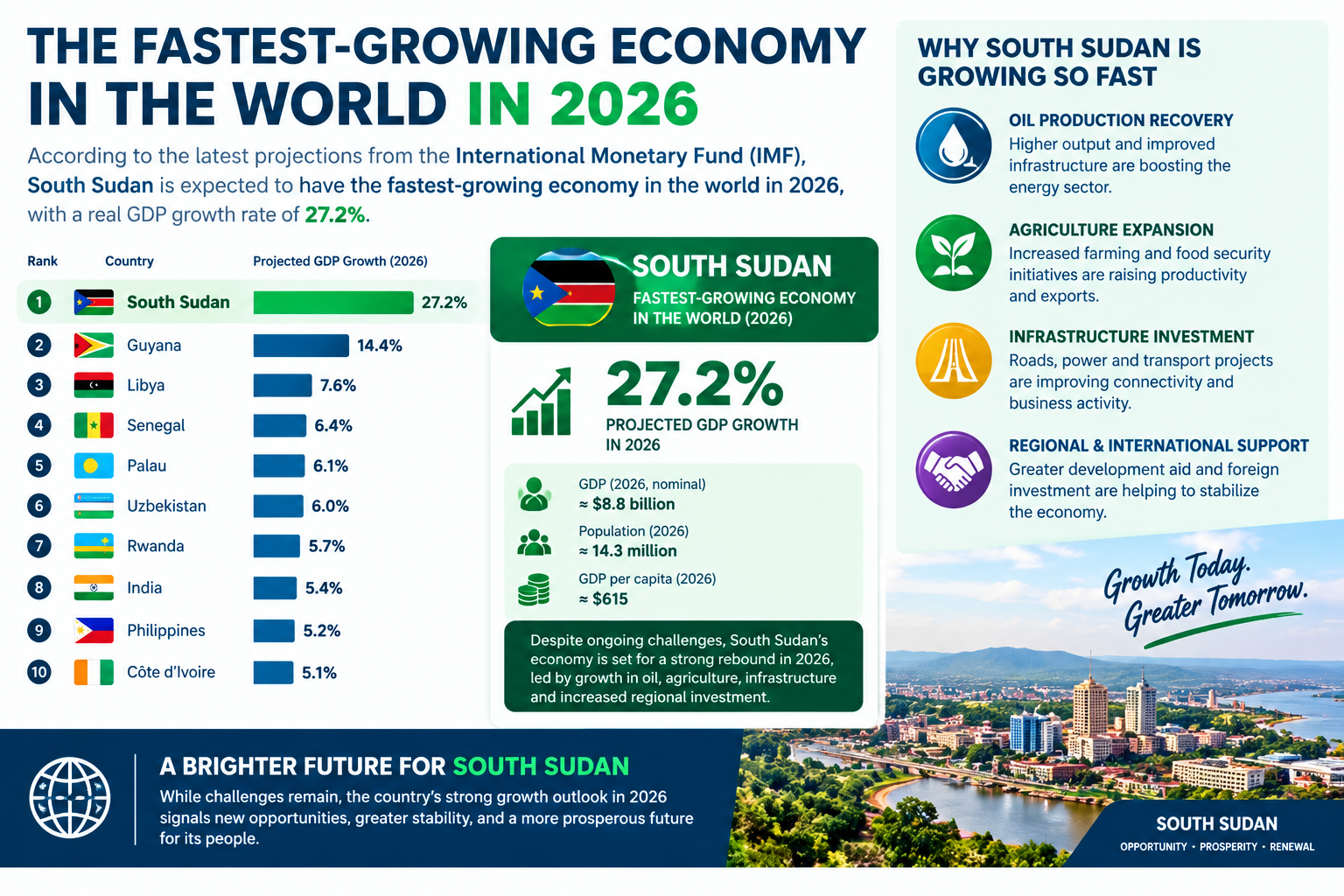
The World Bank’s January outlook projected developing-economy growth at around 4% in 2026, with Sub-Saharan Africa expected to grow faster than the global average.
For countries such as Nigeria and other African economies, population growth, urbanization, digital services, agriculture, energy and infrastructure could create significant opportunities.
However, challenges remain. Many developing countries face high debt, weak currencies, infrastructure shortages and limited access to affordable capital.
The key question will be whether economic growth translates into better living standards and more jobs. Fast GDP growth alone does not guarantee that ordinary citizens will become wealthier.
7. Energy and Geopolitics Will Shape the Economy
Geopolitical conflicts are likely to remain one of the biggest threats to global economic stability.
Wars and political tensions can disrupt oil and gas supplies, shipping routes, food markets and international investment. The IMF’s 2026 outlook has already highlighted the economic effects of war and energy disruptions.
If energy prices remain high, energy-importing countries could experience higher inflation and weaker growth. Energy exporters, on the other hand, may receive higher revenues.
This creates an unusual situation in which the same global shock can hurt one economy while benefiting another.
8. The Biggest Risk: A Combination of Problems
The greatest danger for the world economy may not be one individual problem, but several problems happening simultaneously.
Imagine a scenario in which geopolitical tensions push energy prices higher, inflation rises again, central banks keep interest rates high, governments face increasing debt costs and businesses reduce investment.
Such a combination could produce a significant global slowdown.
The IMF has identified several downside risks, including renewed conflict, geopolitical fragmentation, financial-market repricing, trade tensions and disappointment surrounding AI-driven productivity gains.