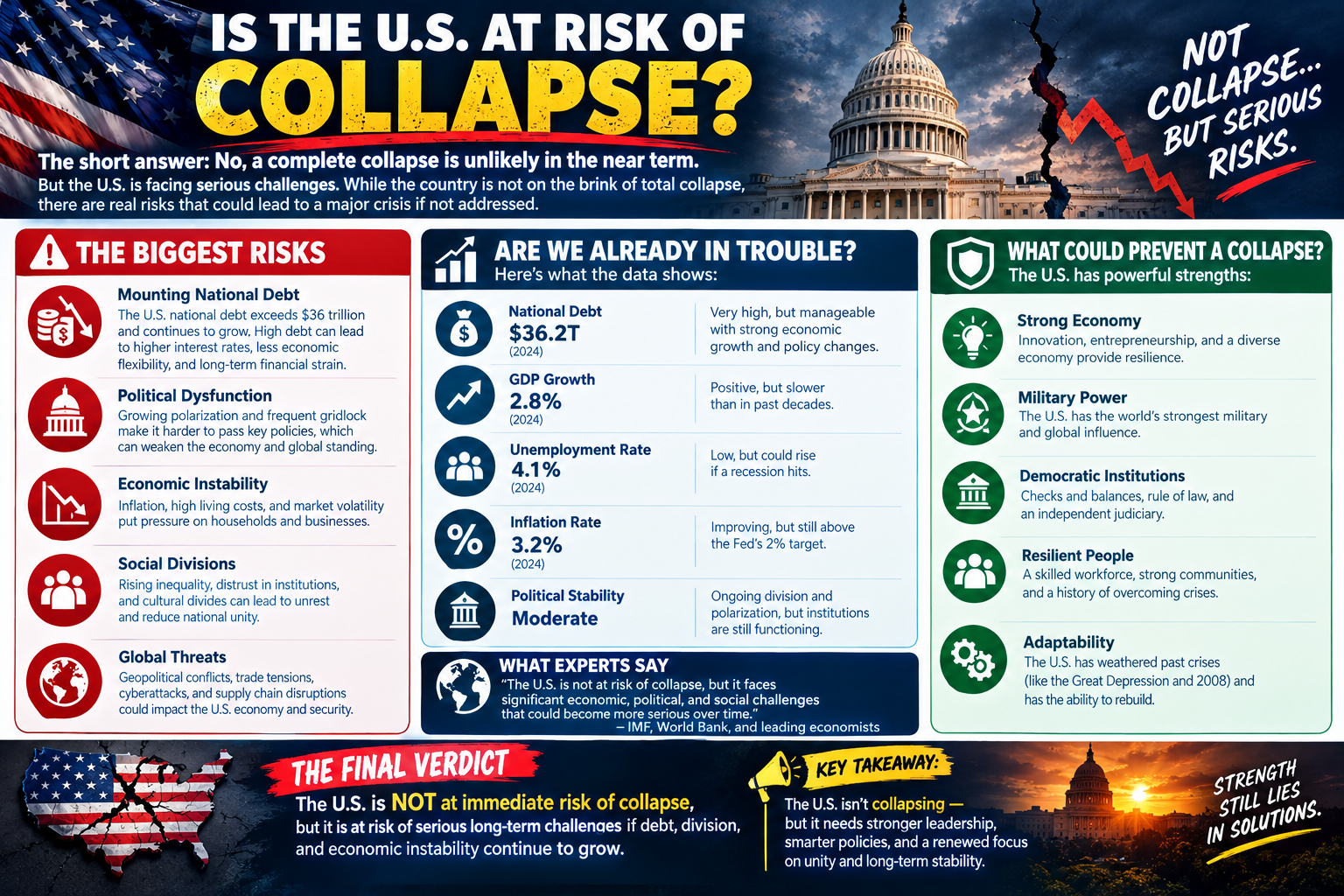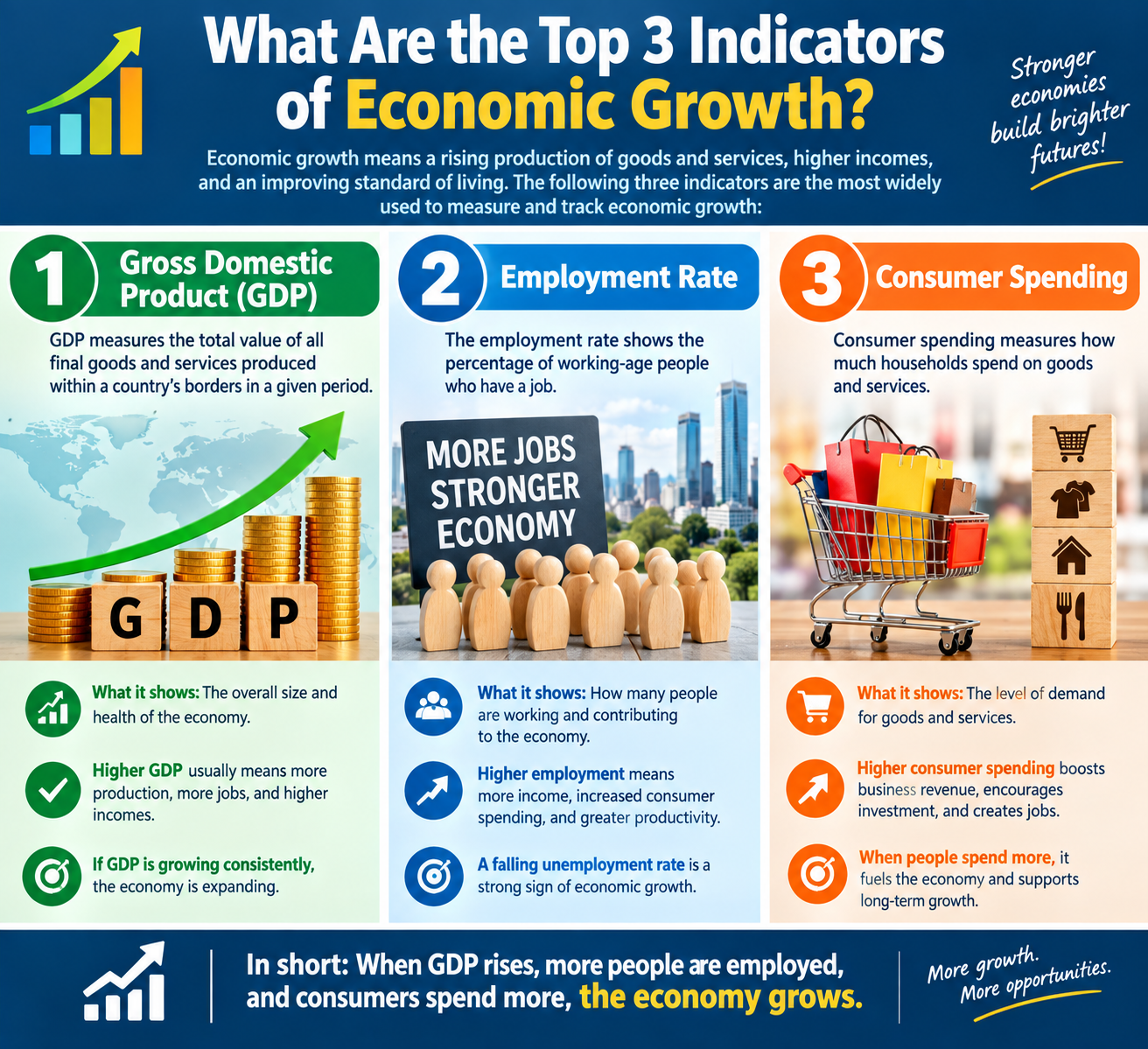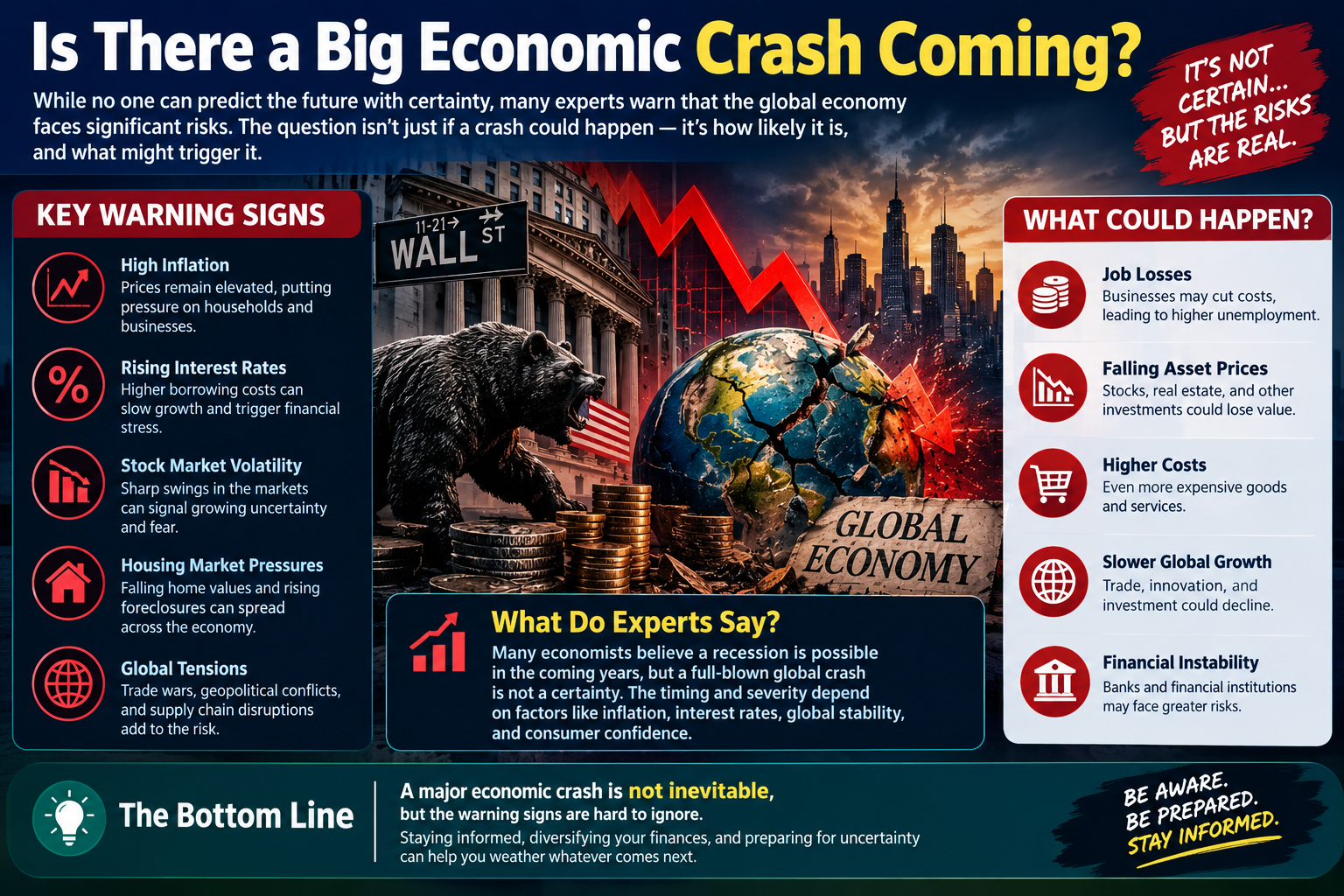
Concerns about a major economic crash appear whenever inflation remains high, debt levels rise, financial markets become volatile, or geopolitical tensions increase. In 2026, these concerns are particularly relevant because the global economy is facing several significant risks at the same time.
However, there is an important difference between an economic slowdown, a recession, and a major economic crash. A slowdown means economic growth becomes weaker. A recession involves a significant decline in economic activity. An economic crash is much more severe and can involve rapidly falling asset prices, widespread business failures, financial instability, rising unemployment, and a sharp contraction in economic output.
So, is a big economic crash coming? There are meaningful risks, but current evidence does not make a major global economic crash inevitable. The International Monetary Fund’s July 2026 outlook projected global economic growth of 3.0% in 2026 and 3.4% in 2027. At the same time, the IMF warned that renewed conflict, financial-market repricing, inflation and other shocks could weaken the outlook.
What Could Cause an Economic Crash?
Economic crashes usually happen when several weaknesses interact. A problem in one part of the economy can spread to other areas through banks, financial markets, businesses and consumers.
One potential trigger is excessive debt. Governments, companies and households around the world have accumulated substantial debt. High debt does not automatically cause a crisis, but it can make economies more vulnerable when interest rates rise or economic growth slows.
If borrowers struggle to make payments, banks and investors can suffer losses. Businesses may reduce investment, households may cut spending, and financial institutions may become more cautious about lending.
This can create a cycle in which weaker economic activity causes financial problems, while financial problems further weaken economic activity.
Inflation and Interest Rates
Inflation is another important risk.
When prices rise quickly, central banks may need to keep interest rates higher for longer. Higher interest rates increase borrowing costs for households, businesses and governments.
For consumers, expensive mortgages and loans can reduce spending. For companies, higher financing costs can discourage investment and expansion.
The IMF reported in July 2026 that global disinflation had stalled and that global headline inflation was projected at 4.7% for 2026. The IMF also warned that renewed energy-price shocks could push inflation expectations higher and tighten financial conditions.
A prolonged period of inflation combined with weak growth can be particularly difficult because policymakers have less room to stimulate the economy without potentially creating additional inflation.
Financial Markets Could Be a Source of Risk
Financial markets can sometimes move much faster than the real economy.
Stock markets, bond markets, property markets and other asset markets can experience large price increases followed by sharp corrections. If investors become convinced that asset prices are too high, selling can accelerate.
A major market correction does not necessarily produce an economic crash. Markets can fall substantially while the broader economy continues to grow.
The danger becomes greater when falling asset prices damage banks, businesses or households. For example, a large decline in property values can reduce household wealth and weaken financial institutions that have significant exposure to real estate.
The IMF has identified financial-market repricing as one of the downside risks facing the global economy in 2026.
Geopolitical Conflict
Geopolitical conflict is another major risk to the global economy.
Wars can disrupt energy supplies, transportation routes, international trade and investment. They can also cause commodity prices to rise.
The IMF’s April 2026 World Economic Outlook warned that a longer or broader conflict could significantly weaken global growth. Under a severe scenario examined by the IMF, global growth could be reduced by 1.3 percentage points in 2026, bringing the global economy close to a recession-level growth rate.
The effects can spread beyond the countries directly involved. Higher energy prices, supply-chain disruptions and weaker consumer and business confidence can affect economies around the world.
The Risk of a Global Recession
A global recession would be serious, but it would still not necessarily be the same as a financial crash.
The IMF’s April 2026 analysis noted that a global growth rate below 2% would represent a close call for a global recession and estimated that such an outcome could occur under a severe shock scenario.
The July outlook was more positive, with global growth projected at 3.0% for 2026 and 3.4% for 2027. This suggests that the baseline outlook was not for a global recession, although significant risks remained.
This distinction matters because economic forecasts describe probabilities and scenarios rather than certain outcomes.
Could the AI Boom Cause Problems?
Artificial intelligence is another unusual factor in the current economic environment.
Investment in AI infrastructure, computing equipment and related technologies has become an important source of economic activity. The IMF has noted that AI-driven demand is benefiting countries connected to global technology supply chains.
However, there is also a potential downside.
If financial markets become convinced that companies have been valued too highly because of unrealistic expectations about AI, a sharp reassessment could cause technology stocks and related assets to fall.
The IMF has specifically identified a potential correction driven by a reassessment of AI profitability as a downside risk.
That does not mean an AI-related market correction would automatically cause another global financial crisis. The economic consequences would depend on the size of the correction, financial-system exposure, business investment and consumer confidence.
High Government Debt
Government debt is another long-term vulnerability.
When public debt is high, governments have less fiscal room to respond to a crisis. During previous downturns, governments have often used spending programs, tax measures and other policies to support economic activity.
But if debt levels are already elevated, borrowing more can become expensive or raise concerns among investors.
The IMF’s October 2026 surveillance review noted that elevated debt levels, combined with more frequent shocks and uncertainty, are making it more difficult for countries to safeguard economic stability and sustain growth.
This does not mean high debt automatically produces a crash. It means that countries with limited fiscal space may have fewer options when a major shock occurs.
Why a Crash Is Not Inevitable
Despite these risks, there are reasons not to assume that a major economic crash is coming.
Modern financial systems have stronger regulatory frameworks than they did before some previous financial crises. Central banks monitor financial markets and banking systems closely, while governments can respond to economic shocks through monetary and fiscal policies.
Businesses and households can also adapt.
The global economy is not one single system operating at the same speed. Some countries may experience weak growth while others expand rapidly. The IMF’s July 2026 outlook described global growth as uneven, with technology investment supporting some economies while war-related shocks weigh on others.
This diversity can help prevent a problem in one region from automatically becoming a worldwide economic collapse.
What Would a Major Economic Crash Look Like?
A genuine global economic crash would probably involve several problems occurring simultaneously.
Stock and property markets could fall sharply. Banks and financial institutions could experience significant losses. Businesses could reduce investment and employment. Consumer confidence could collapse. Unemployment could rise rapidly, while governments and central banks might have to introduce emergency measures.
International trade could also decline if companies and consumers dramatically reduce spending.
The 2008 global financial crisis provides an example of how problems in financial markets can spread into the broader economy. The COVID-19 pandemic provides another example of how an unexpected external shock can cause an exceptionally rapid economic contraction.
However, each crisis is different. Historical examples cannot tell us exactly when the next crisis will occur.
What Should People Watch?
Several indicators can provide clues about the direction of the economy.
These include:
- Inflation and inflation expectations
- Interest rates
- Unemployment
- Consumer spending
- Business investment
- Bank lending
- Government bond yields
- Corporate defaults
- Housing markets
- Stock-market valuations
- Global trade
- Commodity and energy prices
No single indicator can predict an economic crash. The greatest danger usually comes when several warning signs appear simultaneously.