Interest rates are one of the most powerful tools used to influence a country’s economy. They affect how much it costs to borrow money, how attractive it is to save, how much consumers spend, how much businesses invest and even how a country’s currency performs.
When a central bank changes its interest rate, the effects can spread throughout the economy. A decision that begins in a central-bank meeting can eventually influence mortgages, business loans, employment, consumer prices, exchange rates and economic growth.
Understanding interest rates is therefore essential to understanding how modern economies work.
What Are Interest Rates?
An interest rate is essentially the cost of borrowing money or the reward for saving money.
When a person takes out a loan, they usually pay interest to the lender. When someone deposits money in a savings account, the bank may pay interest to the customer.
Central banks, such as the U.S. Federal Reserve, the Bank of England or the Central Bank of Nigeria, use monetary policy to influence borrowing and financial conditions throughout their economies.
When inflation becomes too high, a central bank may raise interest rates to reduce spending and demand. When the economy is weak, it may lower rates to encourage borrowing and investment.
Demand (MD / AD)
Supply (MS / SRAS)
Long-run supply (LRAS)
Money market
AD–AS2468105MoneyInterest rate2468105Real GDPPrice level
Money ↓→Rate ↑→Investment ↓→AD ↓
Less money raises the interest rate to 6.1, lowers investment, and shifts AD left
Policy typeExpansionaryContractionary
ExpansionaryContractionary
Policy strength
Policy strength
Give feedback
1. Interest Rates Affect Consumer Spending
One of the first ways interest rates influence an economy is through consumer spending.
When interest rates are low, borrowing becomes cheaper. Consumers may be more willing to take out loans to buy houses, cars and other expensive goods.
For example, if mortgage rates fall, more people may be able to afford to purchase homes. Homeowners may also have more disposable income if their loan payments become cheaper.
Lower interest rates can therefore encourage people to spend more.
When interest rates rise, the opposite can happen. Mortgage payments, car loans, credit-card balances and other borrowing costs can increase.
Consumers may then reduce spending and save more money.
Because consumer spending represents a large part of economic activity in many countries, changes in interest rates can have a significant impact on overall economic growth.
2. Interest Rates Affect Businesses
Businesses also depend heavily on borrowing.
Companies may borrow money to build factories, purchase equipment, expand offices, develop technology or hire additional workers.
When interest rates are low, borrowing becomes cheaper. This can encourage businesses to invest.
For example, a manufacturing company might decide to build a new factory because the cost of financing the project is affordable.
When interest rates rise, the company may decide to delay the investment because loan repayments are more expensive.
This can reduce business investment and eventually slow economic growth.
The effect can be particularly significant for small and medium-sized businesses, which often depend more heavily on bank financing.
3. Interest Rates Influence Inflation
Controlling inflation is one of the main reasons central banks change interest rates.
Inflation occurs when the general level of prices for goods and services rises over time.
If inflation is too high, people may lose purchasing power because their incomes do not rise as quickly as prices.
Central banks can respond by raising interest rates.
Higher interest rates make borrowing more expensive and can encourage saving. As consumers and businesses spend less, overall demand in the economy can weaken.
Lower demand can reduce pressure on businesses to increase prices.
This process can help bring inflation under control.
However, there is a trade-off.
If interest rates are raised too aggressively, economic activity can slow too much, potentially causing recession and higher unemployment.
4. Interest Rates Affect Employment
Interest rates can also influence the job market.
When rates are low, consumers tend to spend more and businesses may invest more. Higher demand can encourage companies to produce more goods and services.
To increase production, businesses may need to hire more employees.
Therefore, lower interest rates can indirectly support employment.
Higher interest rates can have the opposite effect.
If consumers spend less and businesses reduce investment, companies may have less need to expand their workforce.
Hiring can slow, and in severe economic downturns some businesses may reduce their workforce.
This is why central banks carefully consider employment when making monetary-policy decisions.
5. Interest Rates Affect House Prices
The housing market is particularly sensitive to interest rates.
When mortgage rates are low, monthly payments become more affordable. This can increase demand for houses.
Higher demand can push property prices upward, particularly when the supply of homes is limited.
When interest rates rise, mortgage payments become more expensive. Some potential buyers may postpone purchasing a home.
This can reduce demand and slow the housing market.
Higher rates can also affect property developers because construction projects often depend on financing.
As a result, interest rates can influence both house prices and the construction industry.
6. Interest Rates Affect Saving
Interest rates do not only affect borrowers. They also affect savers.
When interest rates rise, banks may offer higher returns on savings accounts and other interest-bearing investments.
This can encourage households to save more.
When interest rates are low, the reward for saving may be smaller. Consumers may therefore have a greater incentive to spend or invest their money elsewhere.
The balance between saving and spending is important because economies need both.
Saving provides money that can eventually be used for investment, while consumer spending creates demand for goods and services.
7. Interest Rates Affect Exchange Rates
Interest rates can also influence a country’s currency.
Imagine that Country A offers significantly higher interest rates than Country B.
International investors may find assets in Country A more attractive because they can potentially earn higher returns.
Demand for Country A’s currency may increase as investors purchase its financial assets.
This can strengthen the currency.
A stronger currency can make imported goods cheaper, which may help reduce inflation.
However, it can also make a country’s exports more expensive for foreign buyers.
A weaker currency can have the opposite effect: exports may become more competitive, but imported goods, fuel and raw materials can become more expensive.
This is particularly important for countries that depend heavily on imports.
8. Interest Rates Affect Government Debt
Governments are also affected by interest rates.
Countries borrow money by issuing government bonds. When interest rates rise, the cost of issuing new debt generally increases.
Governments may therefore have to spend more money servicing their debt.
This can reduce the amount of money available for infrastructure, education, healthcare and other public programs.
Countries with large amounts of debt can be particularly vulnerable to higher interest rates.
Developing economies may face additional pressure if they have significant foreign-currency debt.
9. High Interest Rates Can Slow Economic Growth
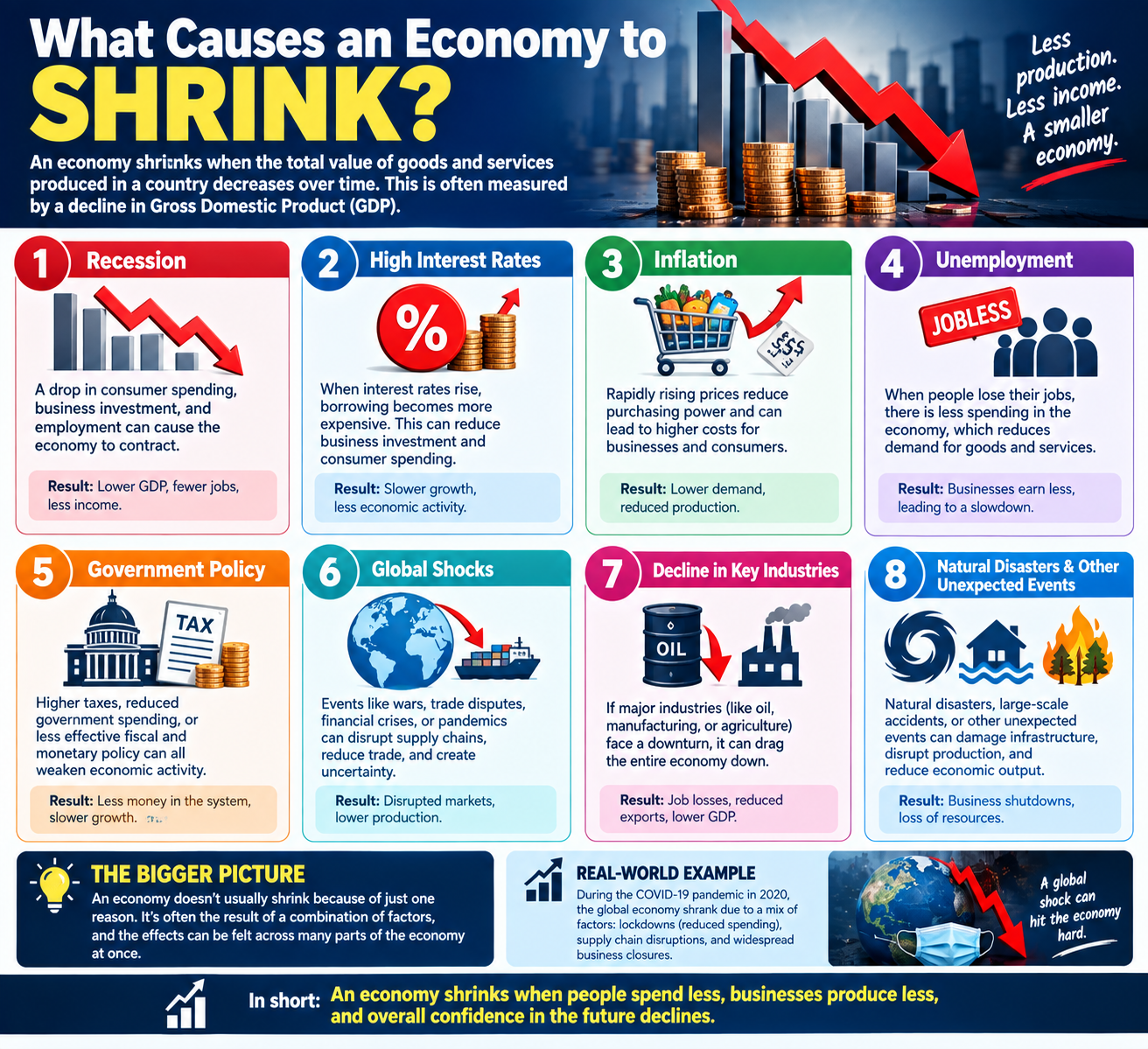
Although high interest rates can help control inflation, they can also reduce economic growth.
Businesses may delay investment.
Consumers may reduce spending.
Construction activity may decline.
Housing markets may weaken.
Government borrowing costs may rise.
Together, these effects can reduce overall demand.
If rates remain high for too long, the economy may enter a recession.
This is why central banks face a difficult balancing act: they must try to control inflation without unnecessarily damaging economic growth.
10. Low Interest Rates Can Stimulate Growth
Lower interest rates are often used when an economy is weak.
Cheaper borrowing can encourage consumers to spend and businesses to invest.
For example, a company that previously considered a new factory too expensive might decide to proceed when financing costs fall.
More investment can increase production and create employment.
Consumers may also borrow more and purchase houses, cars and other goods.
These activities increase economic demand and can help an economy recover from a slowdown.
However, keeping rates too low for too long can create problems.
Excessive borrowing can contribute to asset bubbles, high household debt and rising inflation.
Interest Rates and the Nigerian Economy
Interest rates are particularly important for countries such as Nigeria.
Nigeria’s central bank uses monetary policy to influence inflation, credit conditions, exchange-rate pressures and economic activity.
When interest rates are high, borrowing can become more expensive for Nigerian businesses and consumers. Companies may find it harder to finance expansion, while households may reduce borrowing.
However, higher rates can also help control inflation and make savings and Nigerian financial assets more attractive.
Nigeria faces an especially complicated monetary-policy environment because inflation, exchange-rate movements, government finances, oil prices and imported goods all influence the economy.
The challenge for policymakers is finding a balance between price stability and economic growth.
The Importance of Finding the Right Balance
There is no perfect interest rate for an economy.
If rates are too low, borrowing and spending can become excessive, potentially creating inflation and financial bubbles.
If rates are too high, borrowing and investment can collapse, causing unemployment and recession.
Central banks therefore constantly monitor economic indicators such as inflation, unemployment, consumer spending, business investment, wage growth and exchange rates.
Their objective is usually to create conditions in which the economy can grow sustainably while inflation remains under control.