The United States is the world’s largest economy and one of the most powerful countries in the world. It has a massive consumer market, advanced technology, deep financial markets, a highly developed infrastructure system and the world’s most widely used reserve currency. Yet concerns about America’s future have become increasingly common.
Government debt is high, political divisions are significant, housing remains expensive in many areas, and the economy faces risks from inflation, interest rates, geopolitical conflict and rapid technological change. These challenges raise an important question: Is the United States at risk of collapse?
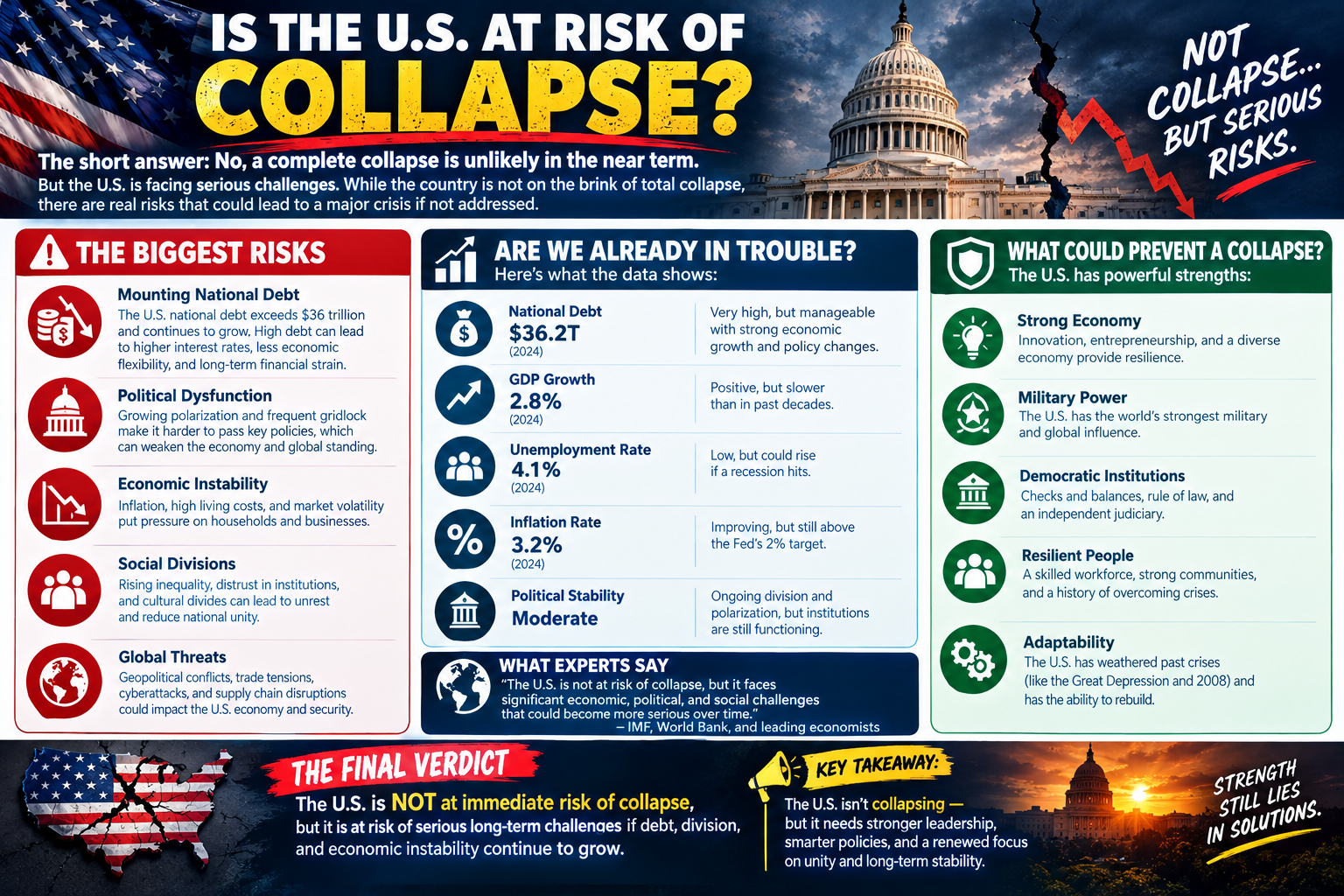
The short answer is that a complete economic or national collapse is not the most likely scenario. The United States faces serious challenges, but it also has enormous economic and institutional strengths. A more realistic concern is a period of slower growth, financial stress, political instability or declining living standards rather than a sudden collapse.
What Would an American Collapse Actually Mean?
Before considering the risks, it is important to define what “collapse” means.
An economic collapse would be much more serious than an ordinary recession. During a recession, economic activity falls, unemployment increases and businesses may struggle. However, the financial system and basic economic institutions continue to operate.
A collapse would involve a much deeper breakdown. It could include widespread bank failures, severe currency instability, major shortages, extreme unemployment, a prolonged breakdown in economic production or a loss of confidence in government institutions.
There is currently no clear evidence that the United States is heading toward such an extreme outcome.
The Biggest Long-Term Risk: Government Debt
One of the most frequently discussed risks is America’s enormous federal debt.
The U.S. government has accumulated debt over many decades through spending on programs, defense, infrastructure, healthcare, interest payments and responses to economic crises.
High government debt does not automatically cause an economic collapse. The United States has a unique advantage because the dollar is the world’s dominant reserve currency and U.S. Treasury securities are widely used by investors around the world.
However, debt becomes more difficult to manage when interest payments consume an increasing share of government revenue.
The International Monetary Fund has repeatedly warned about elevated public debt and the need for stronger fiscal positions. Its 2026 assessments identify high debt and repeated economic shocks as important challenges for financial and economic stability.
The danger is therefore more likely to be long-term fiscal pressure than an overnight collapse.
Could the Dollar Collapse?
Another concern is the future of the U.S. dollar.
The dollar plays an extraordinary role in the global financial system. It is widely used in international trade, finance and central-bank reserves.
This gives the United States significant financial advantages.
A collapse in confidence in the dollar would be extremely disruptive, but replacing the dollar as the world’s dominant currency would also be difficult. Other currencies and financial systems do not currently have all the same characteristics and global infrastructure.
That does not mean the dollar’s international role can never decline. Over a long period, changes in global trade, financial markets and geopolitical relationships could reduce America’s dominance.
But a sudden collapse of the dollar is not the most likely outcome.
Political Division Is Another Risk
Economic strength depends partly on political stability.
The United States has experienced increasing political polarization over recent decades. Disagreements over taxes, government spending, immigration, trade, regulation and other issues can make policymaking more difficult.
Political uncertainty can also influence businesses and investors.
If companies are uncertain about future regulations or taxes, they may delay investment. If households lose confidence in government institutions, consumer and business sentiment can weaken.
However, political disagreement is not the same thing as national collapse.
The United States has experienced major political conflicts throughout its history and has continued functioning through many of them.
The greater concern is that prolonged political division could make it harder to address problems such as debt, infrastructure, healthcare costs and economic inequality.
Economic Growth Remains Important
A country’s ability to grow its economy is one of the strongest defenses against long-term economic decline.
The U.S. economy continues to produce a huge amount of goods and services. Real GDP has continued to expand, although growth has been uneven.
The International Monetary Fund projected U.S. economic growth to remain positive in 2026, while also warning about risks from inflation, financial conditions, geopolitical tensions and changing expectations around technology investment.
Continued economic growth makes it easier for businesses to invest, workers to earn income and governments to collect tax revenue.
A prolonged period of very weak growth would therefore be more concerning than a temporary slowdown.
America’s Technology Advantage
Technology is one of the biggest reasons the United States remains economically powerful.
American companies are global leaders in artificial intelligence, software, semiconductors, biotechnology, aerospace, financial technology and other advanced industries.
Companies based in the United States attract enormous amounts of investment and research talent.
Artificial intelligence could potentially increase productivity substantially during the coming decade. Higher productivity means an economy can produce more goods and services with the same amount of labor and capital.
However, technology also creates risks.
Financial markets can become overly optimistic about new technologies. If investors expect enormous profits that fail to materialize, asset prices could fall sharply.
The IMF has identified a potential reassessment of AI-related profitability expectations as one of the risks facing the global economy.
A technology-market correction would not automatically cause an American collapse, but a severe financial shock could weaken investment and confidence.
Could a Banking Crisis Cause Collapse?
The banking system is another area economists monitor closely.
Banks connect households and businesses to the financial system. They provide loans, hold deposits and facilitate payments.
A major banking crisis can spread rapidly because problems at one institution can affect confidence in others.
However, the United States has extensive financial regulation and mechanisms designed to protect the banking system.
A recession or financial-market correction could still create problems for individual banks or financial institutions, but that is very different from the entire financial system collapsing.
America’s Global Position Is a Major Strength
The United States also benefits from its enormous international economic influence.
It has a large domestic market, major corporations operating around the world, advanced universities and research institutions, extensive natural resources and deep capital markets.
The country is also geographically protected by two large oceans and has strong trade and security relationships with numerous countries.
These advantages make a sudden national collapse difficult.
At the same time, geopolitical competition is increasing. Tensions involving China, Russia, the Middle East and other regions can affect energy prices, trade routes, supply chains and government spending.
The biggest geopolitical risk is not necessarily one specific conflict, but the possibility of several global shocks occurring simultaneously.
What Could Actually Put the U.S. in Serious Danger?
Several risks could become more dangerous if they happened at the same time.
For example, imagine a scenario involving high inflation, rising interest rates, a severe recession, falling financial markets and a major geopolitical conflict.
Each problem would put pressure on the economy individually. Together, they could create a much more serious crisis.
A prolonged loss of confidence in government institutions could make the situation even more difficult.
This is why economists generally focus on resilience rather than trying to predict a single dramatic collapse.
The question is not whether America has problems. It clearly does. The more important question is whether its institutions and economy are strong enough to absorb those problems.
What Should Americans Watch?
Several indicators can provide clues about the direction of the U.S. economy.
GDP growth shows whether economic production is expanding or contracting.
Unemployment indicates whether businesses are continuing to hire workers.
Inflation shows whether purchasing power is being eroded rapidly.
Interest rates affect mortgages, business investment and consumer borrowing.
Government debt and interest payments reveal longer-term fiscal pressures.
Financial-market stability can indicate whether investors are becoming seriously concerned about economic conditions.
Productivity growth is particularly important because higher productivity can support stronger wages and living standards over the long term.
None of these indicators alone can predict collapse. Together, however, they provide a much clearer picture of economic health.