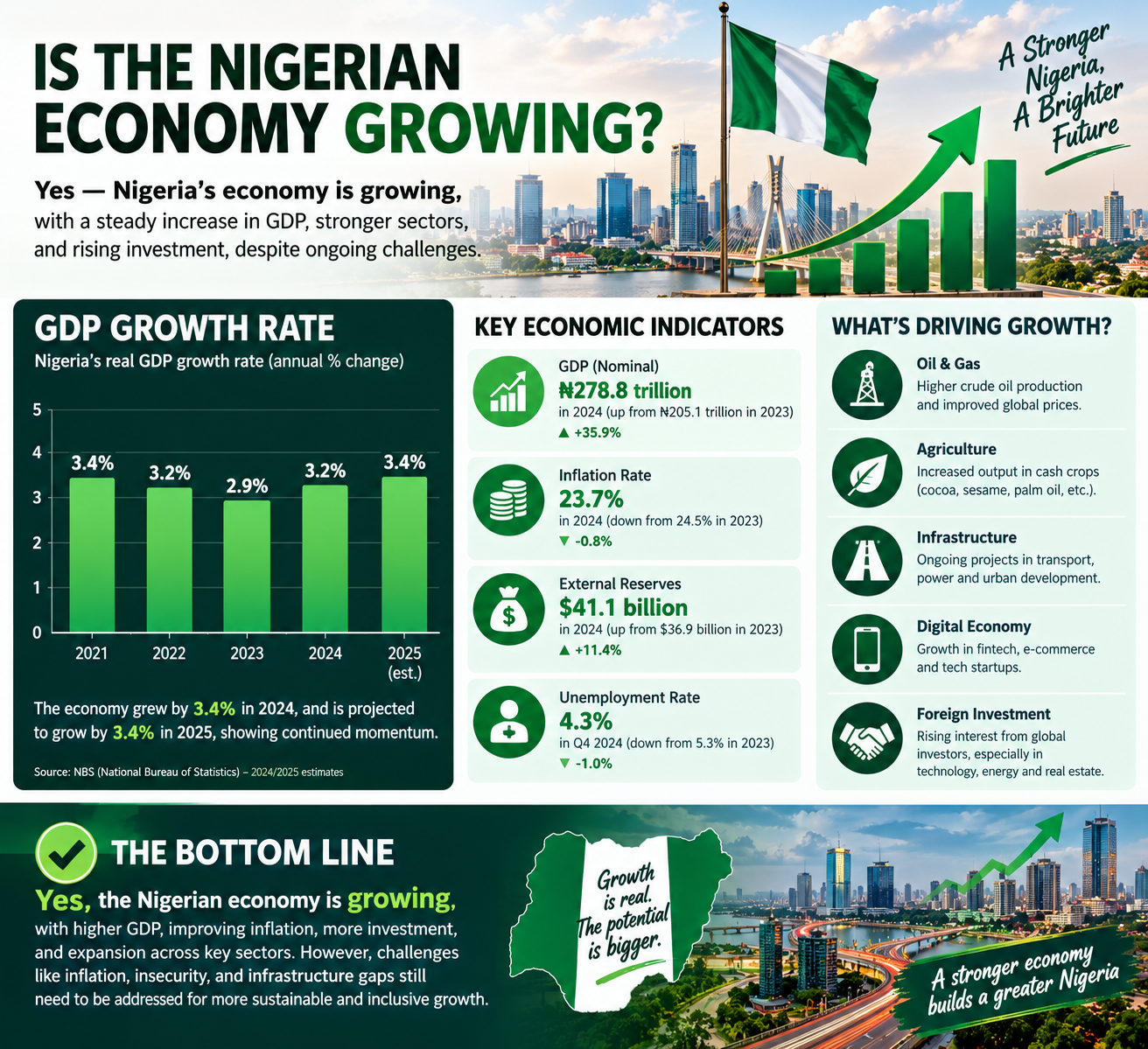
Yes, the Nigerian economy is growing in 2026, but the picture is more complicated than the headline growth figures suggest. Nigeria is experiencing an expansion in economic activity, supported by services, agriculture, oil and gas, manufacturing, construction and improving macroeconomic conditions. However, many Nigerians are still dealing with high living costs, food prices, transportation expenses and limited purchasing power.
The latest data from Nigeria’s National Bureau of Statistics (NBS) shows that real GDP grew by 3.89% year-on-year in the first quarter of 2026, compared with 3.13% in the first quarter of 2025. The IMF currently projects Nigeria’s economy to grow by about 4.1% in 2026, while the World Bank says Nigeria’s real GDP grew by 4.2% in the first half of 2026.
So, the short answer is yes—but Nigeria’s economic growth is still facing major challenges.
Nigeria’s Economy Is Expanding
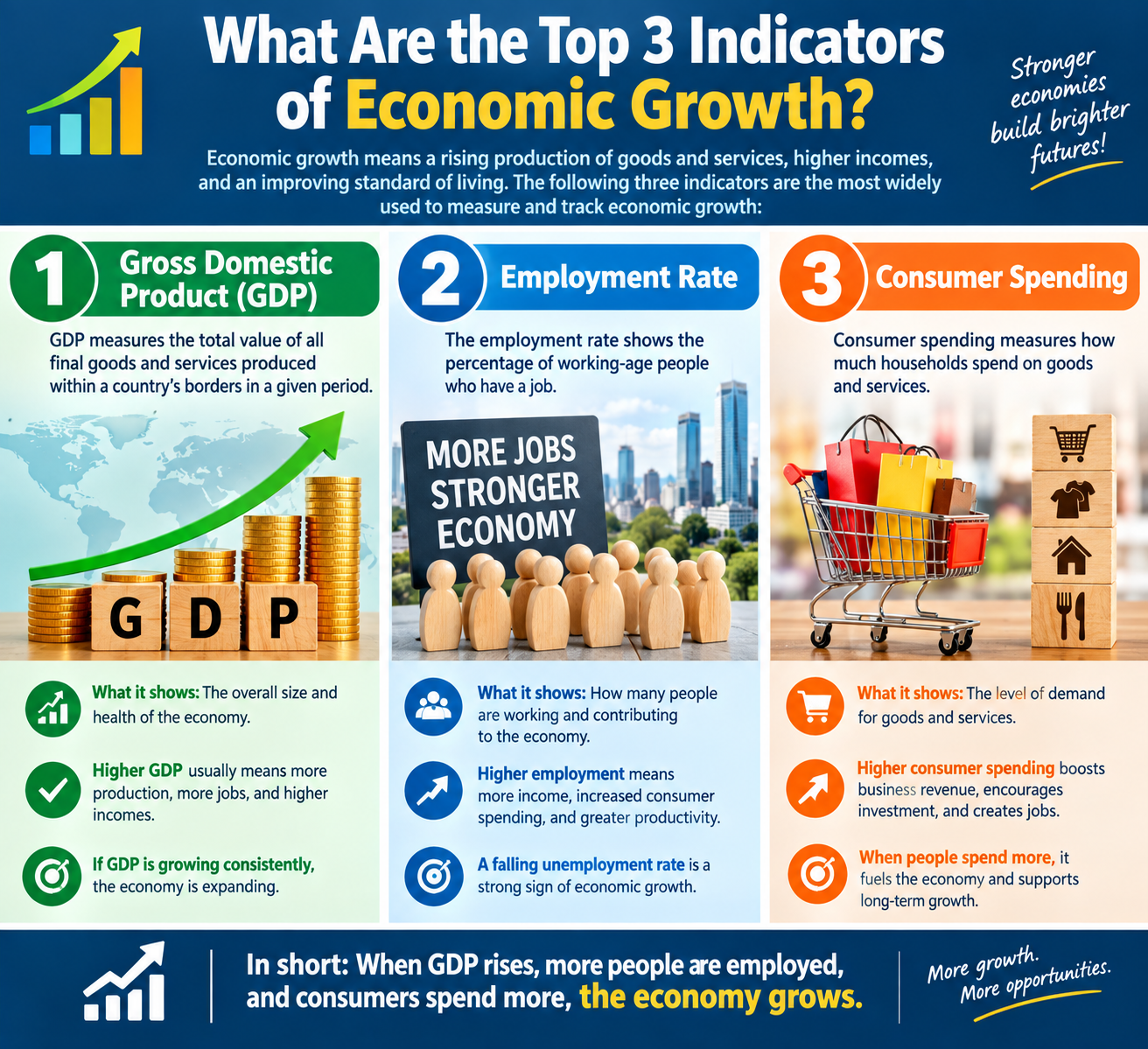
Economic growth means that a country’s economy is producing more goods and services than it did previously. In Nigeria’s case, recent data suggests that economic activity is gradually strengthening.
The NBS reported 3.89% real GDP growth in Q1 2026, an improvement from the 3.13% recorded during the same quarter of 2025. The manufacturing sector grew by 3.29%, while trade expanded by 2.08%. The oil sector also recorded 2.57% year-on-year growth.
The World Bank says the economy strengthened further during the first half of 2026, with real GDP growth reaching 4.2%, compared with 3.9% during the same period a year earlier. According to the World Bank, services and agriculture were important drivers of this performance.
These numbers indicate that Nigeria’s economy is not stagnant. Economic activity is expanding.
But GDP growth is only one part of the story.
Why Is Nigeria Growing?
Several sectors are contributing to Nigeria’s economic growth.
1. Services
Nigeria’s services sector is one of the country’s most important economic engines.
Banking, telecommunications, information technology, entertainment, transportation, professional services and other businesses contribute significantly to economic activity.
Nigeria has one of Africa’s largest consumer markets, and its growing population creates demand for digital payments, mobile communications, financial services, entertainment and online businesses.
The World Bank identifies services as one of the key drivers of Nigeria’s recent economic expansion.
2. Agriculture
Agriculture remains extremely important to Nigeria because it employs millions of people and supplies much of the country’s food.
The sector has also contributed to recent economic growth. However, agriculture continues to face problems involving insecurity, inadequate infrastructure, high fertilizer costs, climate pressures and limited access to financing.
Improving agricultural productivity could therefore have a major impact on Nigeria’s future economic growth.
More productive agriculture could reduce food imports, improve food security, create jobs and potentially reduce inflationary pressure.
3. Oil and Gas
Oil remains a major part of Nigeria’s economy, even though the country has been working to diversify beyond petroleum.
The IMF expects Nigeria’s oil and gas sector to grow by approximately 4.5% in 2026, while crude-oil production is projected to increase from about 1.64 million barrels per day in 2025 to 1.71 million barrels per day in 2026.
Higher oil production can increase export earnings and government revenue.
However, Nigeria remains vulnerable to fluctuations in global oil prices. A sharp decline in oil prices could reduce foreign-exchange earnings and government revenues.
4. Manufacturing and Construction
Manufacturing and construction are also important signs of economic activity.
NBS data shows that real manufacturing GDP grew by 3.29% year-on-year in Q1 2026. Construction accounted for 4.85% of total real GDP during the quarter, slightly higher than its contribution in Q1 2025.
More investment in factories, housing, roads, power infrastructure and other projects could strengthen these sectors further.
What About Inflation?
This is where the story becomes more complicated.
Nigeria can experience economic growth while people simultaneously feel poorer.
The reason is inflation.
If wages rise by 5% but consumer prices increase by 10%, people’s purchasing power falls even though the economy is growing.
The IMF projects Nigeria’s average consumer-price inflation at around 16% in 2026, with end-of-year inflation projected at about 17%. The IMF also warned that higher global fuel, food and fertilizer prices could create additional inflationary pressure.
This is particularly important for Nigerian households because food and transportation represent significant portions of household spending.
Therefore, one of Nigeria’s biggest economic challenges is not simply achieving GDP growth. It is ensuring that economic growth leads to better purchasing power and improved living standards.
Are the Government’s Economic Reforms Working?
Nigeria has introduced significant economic reforms over the past few years, particularly involving exchange-rate policy, fuel subsidies, public finances and revenue collection.
The IMF says reforms over the past three years have improved Nigeria’s macroeconomic outcomes and resilience. It also points to stronger macroeconomic stability as one factor supporting the country’s growth outlook.
The World Bank similarly says recent reforms have improved macroeconomic stability, increased revenues and reserves, and enhanced exchange-rate flexibility.
However, reforms can have both short-term costs and long-term benefits.
Changes to fuel subsidies and exchange-rate policies can increase prices in the short term, putting pressure on households and businesses.
The longer-term objective is to create a more stable economic environment in which private businesses can invest, produce and create jobs.
Is Nigeria Becoming Less Dependent on Oil?
There are encouraging signs.
According to NBS, the non-oil sector accounted for 96.08% of Nigeria’s real GDP in Q1 2026.
This demonstrates that Nigeria’s economy is much broader than petroleum.
Services, agriculture, manufacturing, trade, construction, telecommunications and other activities are increasingly important.
However, oil remains crucial for Nigeria’s foreign-exchange earnings and government revenue.
The goal should therefore not simply be to eliminate oil from the economy. Instead, Nigeria needs to use its oil and gas resources to support investments in infrastructure, education, technology, healthcare and productive industries.
What Are the Biggest Challenges?
Despite the positive growth figures, Nigeria still faces serious economic challenges.
High Cost of Living
Many households continue to struggle with food, transportation, housing and energy costs.
Electricity
Unreliable electricity increases operating costs for businesses and makes it harder for manufacturers and small enterprises to compete.
Infrastructure
Nigeria needs continued investment in roads, railways, ports, electricity, water systems and digital infrastructure.
Unemployment and Underemployment
GDP growth needs to translate into productive employment, particularly for Nigeria’s large young population.
Debt-Service Costs
Government debt and debt-service payments can limit the amount of money available for infrastructure and social investment. The IMF estimates that federal government interest payments will consume more than half of federal government revenue in 2026.
Food Security
Agricultural productivity must improve if Nigeria is going to keep food prices under control while supporting population growth.
What Is the Outlook for Nigeria?
The outlook is cautiously positive.
The IMF projects 4.1% economic growth in 2026 and 4.3% in 2027. It expects agriculture, real estate, information and communication, and oil and gas to contribute to growth.
The World Bank’s current country outlook is also positive, projecting average growth of approximately 4.4% during 2026–2028. However, the bank emphasizes that Nigeria needs greater private investment, productivity and job creation if economic stabilization is to translate into improved living standards.
This is perhaps the most important point about Nigeria’s future.
Economic growth is happening, but the quality of that growth matters.
If growth produces more jobs, higher incomes, better infrastructure, lower inflation and improved productivity, Nigerians will feel its benefits more directly.