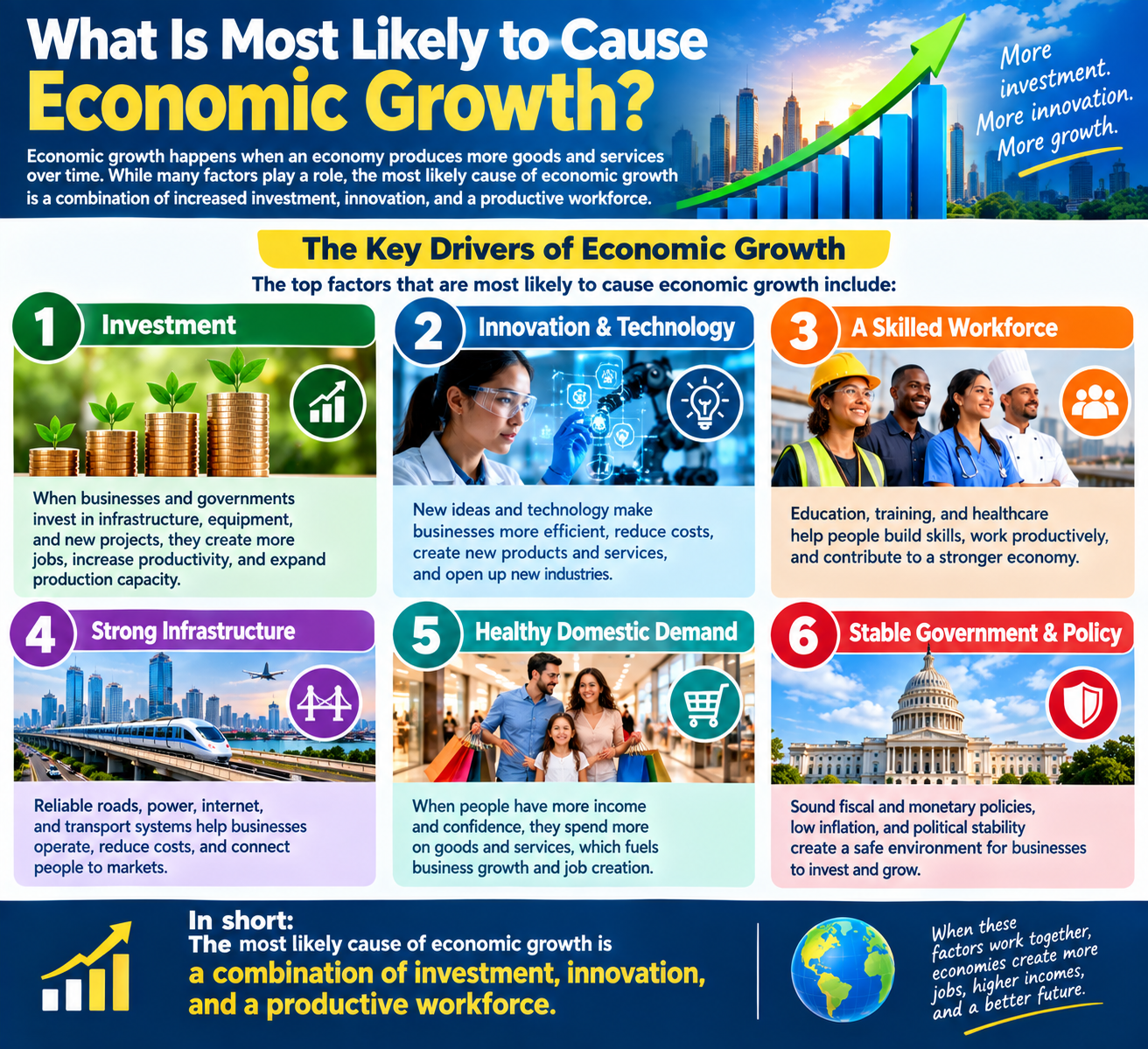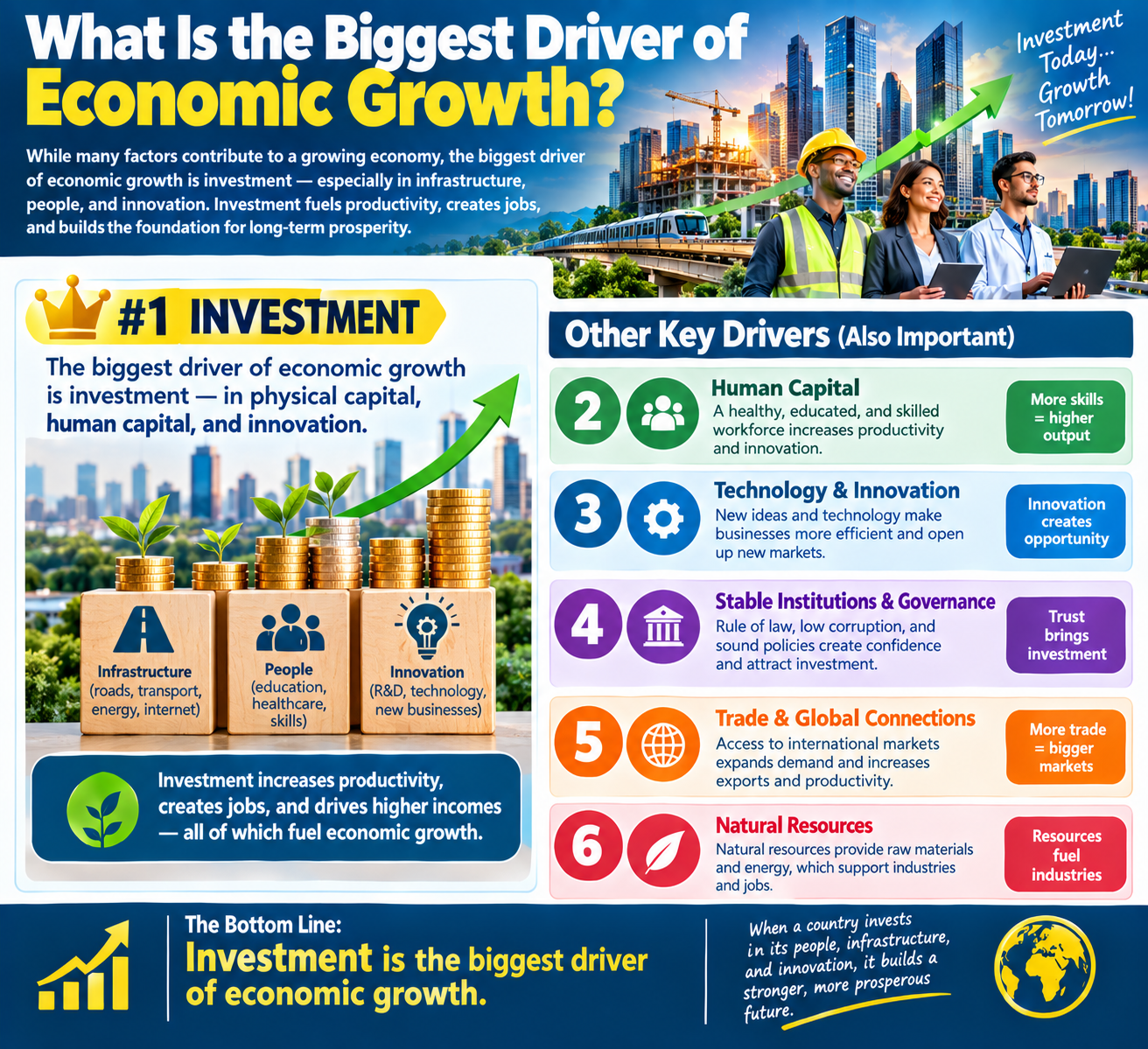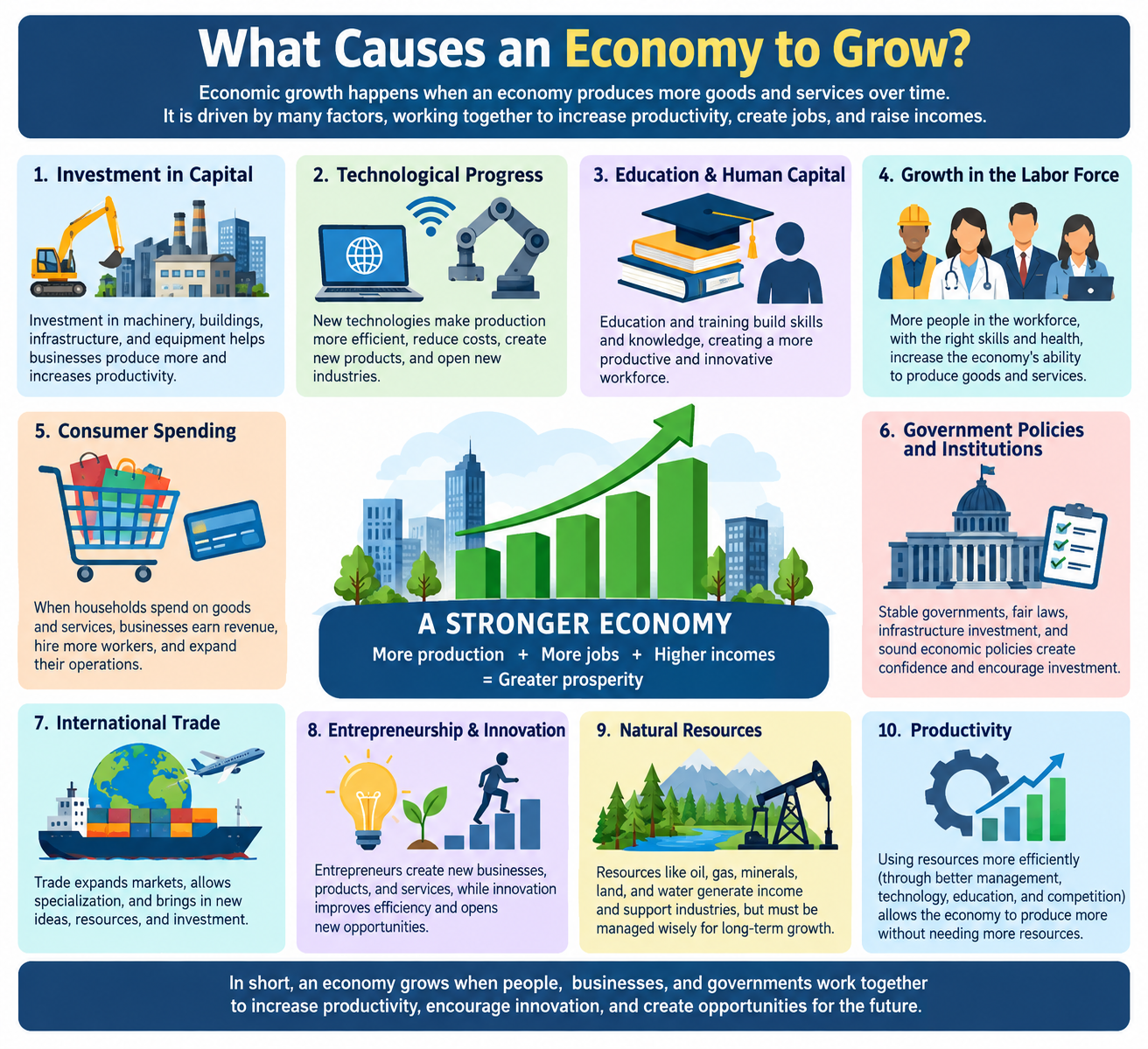
Economic growth is one of the most important measures of a country’s economic performance. It generally refers to an increase in the amount of goods and services produced by an economy over time. When an economy grows, businesses may expand, workers can find more employment opportunities, incomes may rise, and governments may collect more tax revenue to invest in public services. But what makes an economy grow? The answer involves several interconnected factors, including investment, productivity, technology, education, employment, trade, infrastructure, and economic institutions.
Investment in Businesses and Capital
One of the most important drivers of economic growth is investment. Businesses need factories, machinery, equipment, technology, offices, vehicles, and other forms of capital to produce goods and services. When companies invest in these resources, they can increase their productive capacity.
For example, a manufacturing company that purchases modern machinery may be able to produce twice as many products in the same amount of time. A transportation company that invests in a larger fleet can serve more customers, while a technology company can use investment to develop new software and services.
Government investment is also important. Spending on roads, bridges, airports, ports, electricity networks, and communication systems can make it easier and cheaper for businesses to operate. Therefore, both private and public investment can contribute to economic growth.
Productivity
Productivity is another key factor behind long-term economic growth. It measures how efficiently an economy uses its resources to produce goods and services. In simple terms, productivity increases when workers and businesses can produce more output with the same amount of labor, capital, or other resources.
Higher productivity can lead to higher wages and greater business profits. It can also allow companies to lower costs and offer products at more competitive prices.
Productivity can improve through better technology, employee training, improved management, better infrastructure, and more efficient production methods. For this reason, productivity is often considered one of the foundations of sustainable economic growth.
Technology and Innovation
Technological progress can dramatically increase the productive capacity of an economy. New technologies allow businesses to perform tasks faster, reduce waste, improve quality, and create products that did not previously exist.
The internet, computers, smartphones, automation, cloud computing, artificial intelligence, and advanced manufacturing are examples of technologies that have transformed economic activity.
Innovation can also create entirely new industries. Companies developing new technologies may create jobs directly, while businesses that adopt those technologies can become more efficient. Over time, technological improvements can spread throughout an economy and raise overall productivity.
However, technology alone does not guarantee growth. Workers need the skills to use new technologies, businesses need access to investment, and institutions need to create an environment where innovation can develop.
Education and Human Capital
A country’s workforce is one of its most valuable economic resources. Education and training improve what economists call human capital, which refers to the knowledge, skills, experience, and abilities that people bring to the workplace.
An educated workforce can generally adapt more easily to technological change and perform complex tasks. Universities, schools, vocational programs, apprenticeships, and professional training can all contribute to developing human capital.
For example, an economy with a strong supply of engineers, scientists, healthcare professionals, financial specialists, skilled technicians, and entrepreneurs may be better positioned to develop innovative businesses and industries.
Investment in education therefore contributes to growth not only by improving individual career opportunities but also by increasing the productive capacity of the economy.
Employment and the Labor Force
Economic growth also depends on the availability of workers. When more people participate in the labor force and find productive employment, an economy has greater capacity to produce goods and services.
Population growth can increase the potential size of the workforce, but simply having more people does not automatically produce economic growth. Workers need education, skills, capital, infrastructure, and opportunities to be productive.
Labor force participation is also important. If people who are able and willing to work are able to find suitable employment, the economy can make better use of its available human resources.
Entrepreneurship
Entrepreneurs contribute to economic growth by creating businesses, developing new products, identifying market opportunities, and taking financial risks.
New businesses can create jobs and increase competition. Competition can encourage existing companies to improve their products, reduce costs, and innovate.
Small businesses and startups are particularly important sources of experimentation. Although not every new business succeeds, successful businesses can introduce innovations that influence entire industries.
A strong entrepreneurial environment generally requires access to finance, reasonable regulations, skilled workers, infrastructure, and a legal system that protects contracts and property rights.
Infrastructure
Infrastructure provides the foundation for economic activity. Roads, railways, airports, ports, electricity, water systems, telecommunications, and digital networks allow businesses and consumers to interact efficiently.
Consider a company that needs to transport products across a country. Poor roads and unreliable transportation can increase costs and cause delays. Improved infrastructure can reduce these problems and make businesses more competitive.
Digital infrastructure has become increasingly important as well. High-speed internet and reliable communication networks allow businesses to operate across regions and countries, support remote work, process payments, and reach customers around the world.
International Trade
Trade allows countries to specialize in producing goods and services in which they are relatively efficient. Businesses can sell their products to customers in other countries, expanding their potential markets.
Exports can increase production, employment, and business investment. Imports can give consumers access to a wider variety of products while providing businesses with raw materials, machinery, and technology.
International trade can also encourage competition and innovation. Businesses exposed to global competition may have stronger incentives to improve productivity and develop better products.
At the same time, changes in global trade can create challenges for particular industries and workers. Successful economies often need policies that help people and businesses adapt to changing international conditions.
Financial Systems and Investment
A healthy financial system helps connect people and organizations that have savings with businesses and individuals that need funds for investment.
Banks can provide loans to businesses seeking to expand. Capital markets allow companies to raise money by issuing shares or bonds. Investors can provide funding for new businesses and innovative projects.
When businesses have access to reliable financing, they can purchase equipment, hire employees, build facilities, and develop new products. Financial stability is therefore an important part of a healthy economy.
However, financial systems also need appropriate oversight. Excessive risk-taking, unstable credit markets, or financial crises can damage investment and economic growth.
Strong Institutions and Stability
Economic growth is also influenced by the quality of a country’s institutions. Businesses and individuals are more likely to invest when they have confidence that contracts will be enforced, property rights will be protected, and laws will be applied predictably.
Political and economic stability can also encourage long-term investment. Businesses generally need confidence about the future before committing large amounts of money to factories, research, technology, and employees.
Effective institutions can therefore create an environment where entrepreneurship, investment, and innovation can flourish.
Consumer Spending and Demand
Consumer spending is another important part of economic activity. When households purchase goods and services, businesses receive revenue. Strong demand can encourage companies to increase production, hire employees, and invest in expansion.
For example, if consumers begin purchasing more homes, cars, electronics, or restaurant services, businesses in those industries may respond by increasing their activity.
However, consumption by itself cannot guarantee long-term growth. Sustainable growth requires an economy to continuously improve its productive capacity through investment, education, technology, and innovation.