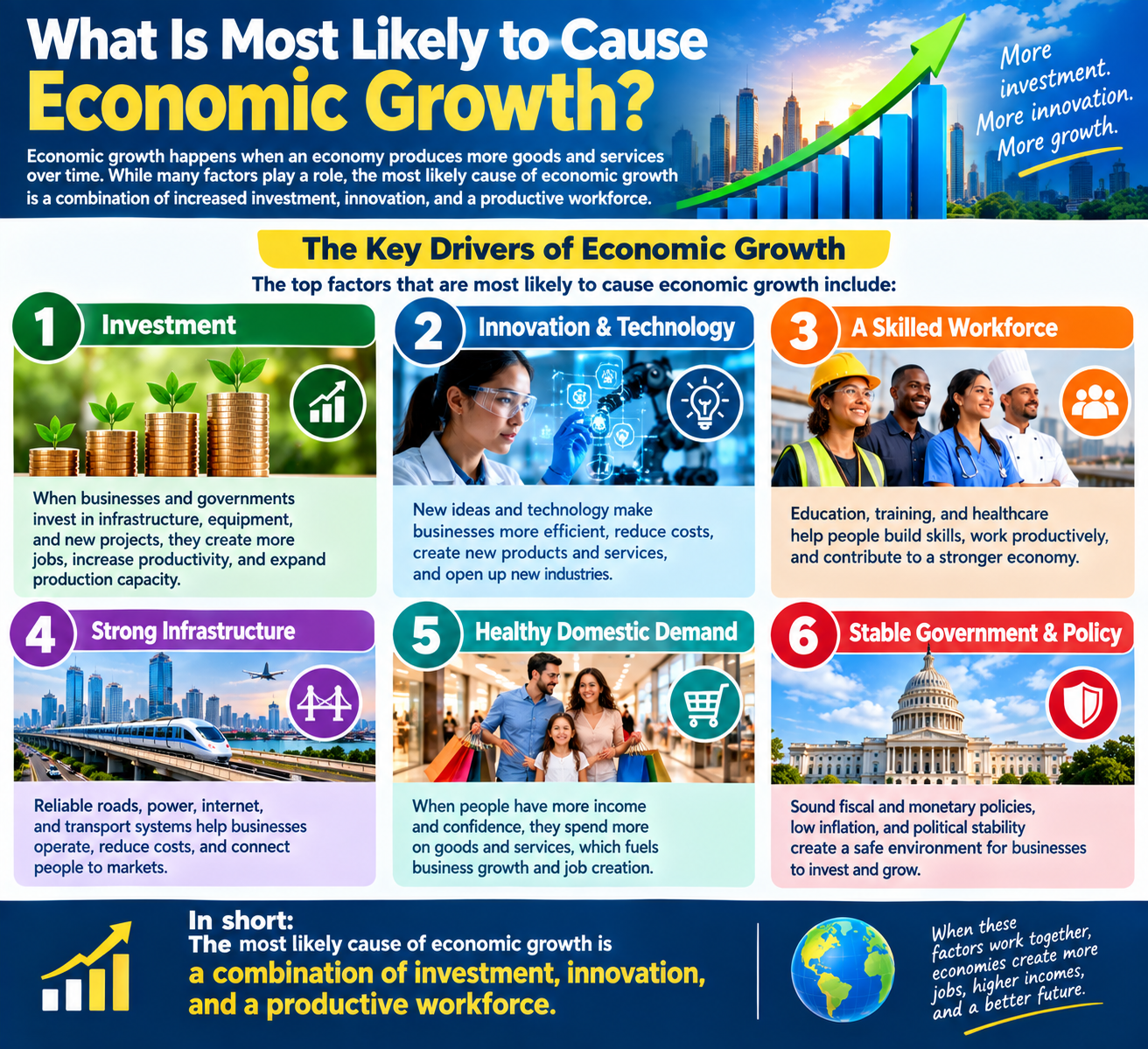
Economic growth occurs when an economy increases its ability to produce goods and services over time. It is usually measured by the increase in real Gross Domestic Product (GDP). Growth can improve employment opportunities, increase household incomes, encourage business investment, and provide governments with more resources to support public services.
But what is most likely to cause economic growth? Economies grow for many different reasons, but the most important long-term causes are generally increases in productivity, technological progress, investment, human capital, and the effective use of labor and other resources. These factors work together to increase an economy’s productive capacity.
1. Higher Productivity
One of the strongest causes of long-term economic growth is an increase in productivity. Productivity describes how efficiently an economy uses its resources to produce goods and services.
For example, imagine that a factory has 100 employees and produces 10,000 products each month. If the company introduces better production methods and can produce 15,000 products with the same workforce, productivity has increased.
Higher productivity allows an economy to produce more without requiring the same proportional increase in workers, factories, or natural resources.
Productivity can improve through better management, employee training, improved infrastructure, more efficient supply chains, and technological innovation.
This is why productivity is particularly important for long-term growth. An economy cannot indefinitely depend on simply adding more workers or using more physical resources. Eventually, the available supply of labor and natural resources becomes limited. Producing more efficiently becomes essential.
2. Technological Progress
Technological progress is closely connected to productivity and is one of the most powerful forces behind economic growth.
New technologies can allow workers and businesses to accomplish tasks faster, more accurately, and at lower cost. Computers, the internet, automation, robotics, artificial intelligence, advanced machinery, and digital platforms have all changed the way economic activity is conducted.
Technology can also create entirely new industries. The development of the internet, for example, contributed to the growth of e-commerce, digital advertising, cloud computing, online entertainment, and many other industries.
Technological progress does not necessarily mean inventing a completely new product. It can also involve improving existing production processes.
For example, a farmer who uses satellite data and automated equipment may be able to produce more crops using fewer resources. A logistics company can use software to optimize delivery routes. A manufacturer can use robotics to increase production.
When these improvements spread across an economy, they can significantly increase overall productivity and economic output.
3. Investment in Capital
Investment is another major cause of economic growth. Businesses need capital to produce goods and services. Capital includes machinery, factories, computers, vehicles, equipment, software, and other productive assets.
When businesses invest in new capital, they can expand their production capacity.
For example, a construction company that purchases additional equipment can take on more projects. A manufacturer that builds a new factory can increase its production. A technology company that invests in data centers and software development can provide more digital services.
Government investment can also support growth. Roads, ports, airports, electricity systems, schools, hospitals, and digital infrastructure can improve the overall productivity of an economy.
Investment is particularly important because it creates the physical foundation for future production.
4. Education and Human Capital
Workers are another essential source of economic growth. Education and training improve what economists call human capital.
Human capital includes people’s knowledge, skills, experience, and abilities. A highly skilled workforce can use advanced technologies, solve complex problems, develop new products, and adapt to changes in the economy.
For example, investment in engineering education can increase the supply of skilled engineers who can design new infrastructure and technologies. Vocational training can create skilled technicians for manufacturing and construction.
Education also supports entrepreneurship and innovation. People with strong skills may be better equipped to identify business opportunities and develop new ideas.
For these reasons, countries that invest in education and workforce development can create a stronger foundation for long-term economic growth.
5. A Productive Labor Force
Economic growth can also result from an increase in the number of people participating in the labor force.
If more people are working productively, an economy has more labor available to produce goods and services. Population growth, immigration, and increased labor-force participation can increase the supply of workers.
However, the number of workers is only part of the equation. Workers need access to capital, technology, education, and productive employment.
For example, adding workers to an economy without providing sufficient equipment or infrastructure may not produce large increases in output. Combining labor with investment and technology is much more likely to generate sustainable growth.
6. Entrepreneurship and Innovation
Entrepreneurs contribute to growth by creating businesses, introducing new products, developing new services, and taking risks.
New businesses can create jobs and increase competition. Competition encourages existing companies to become more efficient, reduce costs, improve quality, and innovate.
Successful entrepreneurs can also introduce technologies that transform entire industries.
For example, a new company might develop software that makes financial transactions faster or a manufacturing process that reduces energy use. If other businesses adopt the innovation, productivity can increase throughout the economy.
Entrepreneurship therefore provides an important link between ideas, investment, innovation, and economic activity.
7. Infrastructure
Infrastructure can have a major influence on economic growth. Businesses rely on transportation, electricity, telecommunications, water systems, and digital networks to operate efficiently.
Poor infrastructure can increase costs and create delays. Good infrastructure can reduce these costs and allow businesses to reach customers and suppliers more efficiently.
Digital infrastructure is increasingly important. Reliable internet connections allow businesses to communicate, conduct transactions, access information, provide digital services, and participate in international markets.
Infrastructure investment can therefore increase productivity while encouraging businesses to invest in new activities.
8. International Trade
International trade can also contribute to economic growth by allowing countries to specialize and access larger markets.
When businesses export products, they can reach customers outside their domestic economy. This can increase production and encourage investment.
Imports can also support growth by providing businesses with machinery, raw materials, energy, technology, and other resources.
International trade can increase competition and encourage businesses to improve productivity. Foreign investment can additionally bring capital, technology, management expertise, and connections to global supply chains.
However, trade can also create challenges for industries that face increased international competition. The long-term benefits depend partly on how effectively economies adapt to these changes.
9. Strong Institutions
Economic growth also depends on the institutions that govern economic activity.
Businesses are more likely to invest when property rights are protected, contracts are enforced, regulations are reasonably predictable, and financial systems are reliable.
Political and economic stability can encourage long-term investment. If businesses believe that policies and regulations may change unpredictably, they may delay investment decisions.
Strong institutions can therefore create an environment where entrepreneurship, investment, innovation, and trade can develop.
10. Consumer Demand
Consumer spending is an important source of short-term economic activity. When households spend money, businesses receive revenue and may respond by increasing production and employment.
For example, rising demand for homes can increase activity in construction, manufacturing, finance, and real estate services.
However, consumer spending by itself is not enough to generate sustainable long-term growth. If demand rises without an increase in productive capacity, it can contribute to inflation rather than lasting growth.
Long-term growth requires improvements in productivity, investment, technology, and human capital.
The Most Important Cause: Productivity Growth
Although many factors contribute to economic growth, productivity growth is arguably the most important long-term cause.
Investment, education, technology, infrastructure, and entrepreneurship all matter partly because they can increase productivity.
An economy that becomes more productive can produce more goods and services with the same resources. This creates the potential for higher wages, greater business profits, increased investment, and improved living standards.
For example, technological innovation can make workers more productive. Education can help workers use technology effectively. Investment provides businesses with the equipment needed to implement new technologies. Infrastructure makes it easier to move goods and communicate. Entrepreneurship brings these resources together to create new products and businesses.
This demonstrates that economic growth is best understood as a connected process rather than the result of one individual factor.