Economic growth is one of the most closely watched measures of a country’s economic performance. When an economy grows, it produces more goods and services, businesses may expand, employment opportunities can increase, and household incomes can potentially rise. Because countries grow at different rates, economists and investors often ask an important question: Which economy is growing the fastest?
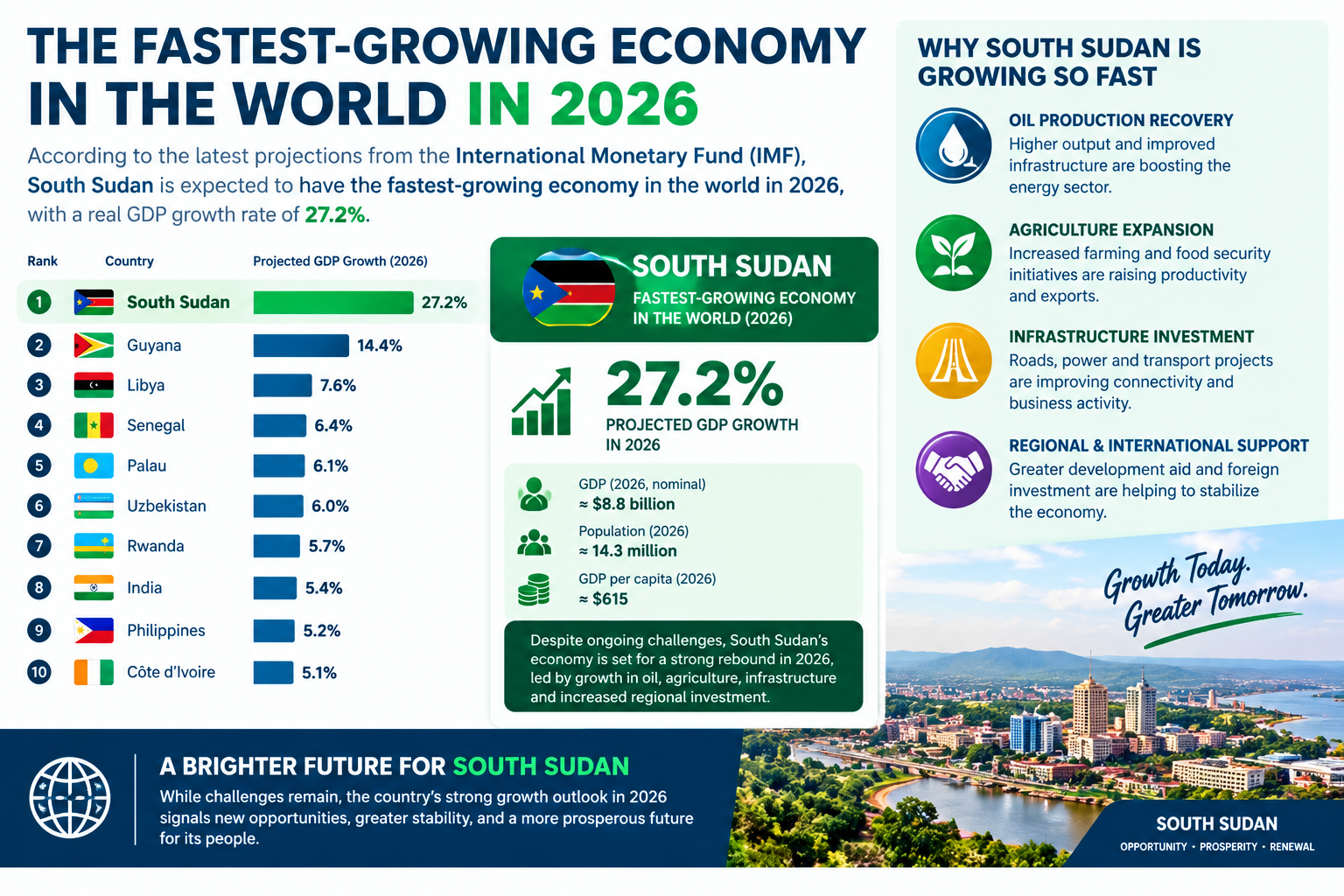
The answer depends on how “fastest-growing economy” is defined. Economists generally compare countries using the annual percentage change in real GDP. A small developing economy can sometimes grow at a much faster percentage rate than a large developed economy. Therefore, it is important to distinguish between the fastest-growing country overall and the fastest-growing major economy.
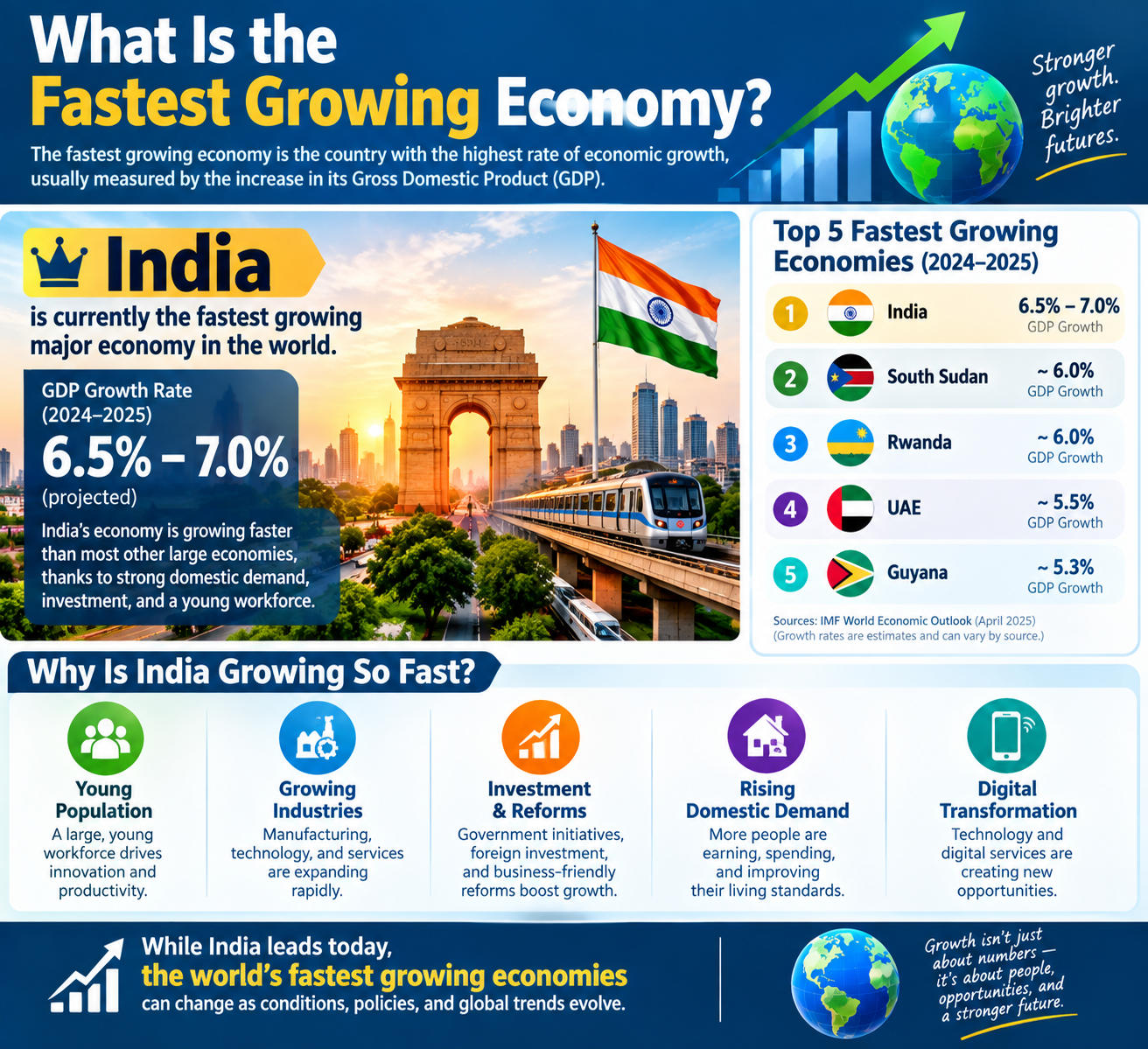
In 2026, several emerging economies are expected to record strong growth. The International Monetary Fund’s July 2026 World Economic Outlook projects global economic growth of about 3.0% in 2026. Among major economies, India remains one of the fastest-growing, while some smaller emerging economies are projected to grow even more rapidly.
India: One of the Fastest-Growing Major Economies
India has become one of the world’s most important engines of economic growth. The IMF’s July 2026 outlook projects India’s economy to grow by 6.4% in fiscal year 2026–27, followed by 6.7% growth in 2027. The IMF describes India as one of the fastest-growing economies in the world.
Several factors contribute to India’s strong growth.
First, India has a large and expanding domestic market. A growing population and rising demand for consumer goods, housing, transportation, financial services, and digital products can support economic activity.
Second, India’s services sector is an important source of growth. Information technology, business services, financial services, telecommunications, and other professional services have become major contributors to the economy.
Third, investment in infrastructure and manufacturing is supporting economic development. Improvements in roads, transportation, digital infrastructure, energy, and industrial capacity can increase productivity and make it easier for businesses to operate.
India is also benefiting from the expansion of digital technology. Digital payments, online commerce, mobile communications, and technology-based services have transformed many parts of the economy.
Vietnam: A Rapidly Growing Economy
Vietnam is another economy attracting significant attention. According to the IMF’s July 2026 World Economic Outlook, Vietnam’s economic growth is projected at 7.5% in 2026, following stronger-than-expected technology exports and continued domestic demand.
Vietnam has increasingly integrated itself into global manufacturing and supply chains. International companies have invested in manufacturing facilities in the country, particularly in areas such as electronics and technology-related production.
Exports are therefore an important source of economic activity. Strong demand for Vietnamese manufactured goods can increase industrial production, employment, investment, and income.
Vietnam’s domestic economy also plays a role. Rising incomes and urbanization can increase demand for housing, transportation, retail, financial services, and other consumer activities.
Why Do Some Economies Grow Faster Than Others?
There is no single reason why an economy grows quickly. Several factors usually work together.
1. Investment
Investment increases an economy’s productive capacity. Businesses that build factories, purchase equipment, develop technology, and expand operations can increase production.
Foreign investment can also be important for developing economies. International companies may bring capital, technology, management expertise, and access to global markets.
2. A Growing Workforce
Countries with large or rapidly expanding working-age populations may have greater potential for economic growth.
A large workforce can support manufacturing, services, construction, technology, agriculture, and other industries. However, population growth alone does not guarantee strong economic performance. Workers need education, skills, capital, and productive employment opportunities.
3. Technology
Technology can dramatically increase productivity. Businesses can use automation, artificial intelligence, software, advanced machinery, and digital systems to produce more efficiently.
Countries that successfully adopt new technologies may experience faster productivity growth.
The IMF’s 2026 outlook highlights the importance of the technology cycle, noting that AI-driven demand is benefiting economies integrated into the global technology value chain.
4. International Trade
Export-oriented economies can experience rapid growth when global demand for their products increases.
Trade allows businesses to access markets much larger than their domestic economies. Countries can specialize in industries where they have competitive advantages, such as electronics, automobiles, energy, agriculture, textiles, or business services.
International trade can also encourage businesses to become more productive because they face competition from companies around the world.
Does Fast Economic Growth Mean a Country Is Wealthy?
Not necessarily.
This is an important distinction. A country can have a very high economic growth rate while still having a relatively low income per person.
For example, a developing economy might grow by 7% in a year because it is rapidly industrializing and investing in infrastructure. A wealthy developed economy might grow by only 2% because it already has highly developed infrastructure and a large capital base.
This means that the fastest-growing economy is not automatically the richest economy.
Economists therefore examine other measures, including GDP per capita, productivity, wages, employment, inflation, living standards, and income distribution.
The Difference Between GDP Growth and Living Standards
GDP growth measures the expansion of economic production, but it does not tell us everything about people’s quality of life.
Suppose a country’s GDP grows rapidly, but housing costs rise sharply and income inequality increases. Some households may not experience the benefits of growth equally.
For this reason, economists also examine indicators such as real wages, employment, poverty, healthcare, education, and household consumption.
Sustainable economic growth is generally more valuable when it translates into higher productivity, better employment opportunities, and improved living standards.
What About China and the United States?
China and the United States remain two of the world’s largest economies, but their growth rates are generally lower than those of some rapidly developing economies.
The IMF’s July 2026 forecast puts China’s growth at 4.6% in 2026, while the United States is projected to grow more slowly than the fastest-growing emerging economies.
China remains an enormous contributor to global economic activity because of the sheer size of its economy. Even a growth rate below that of India or Vietnam can represent a very large increase in total economic output.
The United States also remains a major economic power, supported by a large consumer market, advanced technology sector, deep financial markets, high levels of business innovation, and strong productivity in several industries.
Therefore, economic importance should not be confused with growth rate.
Risks to Fast-Growing Economies
Rapid growth also creates challenges.
Fast-growing economies can experience inflation if demand increases faster than supply. Rapid investment can also lead to excessive borrowing or financial risks if projects are poorly managed.
Infrastructure may struggle to keep up with population growth and urbanization. Environmental pressures can increase as industrial production expands.
External shocks can also affect rapidly growing economies. Changes in global energy prices, trade restrictions, geopolitical conflicts, financial conditions, or weaker demand from major trading partners can reduce growth.
The IMF’s July 2026 outlook emphasizes that global growth remains exposed to geopolitical risks and financial-market repricing, while the global inflation outlook has also become less favorable.