When people ask which country is the fastest-growing in the world, the answer can be more complicated than it first appears. Economic growth is usually measured by the percentage increase in a country’s real gross domestic product (GDP). However, growth rates change from year to year, and smaller economies can sometimes record extremely high growth rates that are not directly comparable with the growth of large economies.
In 2026, India is one of the fastest-growing major economies in the world, with the International Monetary Fund (IMF) projecting growth of around 6.4% for fiscal year 2026–27. This is considerably higher than the projected growth rate for the global economy, which the IMF estimates at about 3.0% in 2026.
However, India is not necessarily the country with the single highest percentage growth rate among every country in the world. Some smaller developing economies can record growth rates above 7% or even higher. The answer therefore depends on whether we are comparing all countries, major economies, or long-term economic performance.
What Does “Fastest-Growing Economy” Mean?
Economic growth refers to an increase in the production of goods and services within an economy. The most common measurement is real GDP growth.
For example, if a country’s economy produces $100 billion worth of goods and services in one year and $105 billion the following year, its economy has grown by approximately 5% in real terms, assuming the calculation removes the effect of inflation.
A high growth rate means that economic activity is expanding quickly. However, a high growth rate does not automatically mean that people in that country are wealthy or that living standards are higher than elsewhere.
This distinction is important when comparing countries. A relatively small economy can grow rapidly because it is starting from a low economic base, while a very large economy may grow at a slower percentage rate even though it adds a much larger amount of economic output.
India: One of the Fastest-Growing Major Economies
India has become one of the most important examples of rapid economic growth among large economies.
According to the IMF’s July 2026 World Economic Outlook update, India’s growth for fiscal year 2026–27 is projected at 6.4%, with growth projected to rise to 6.7% in 2027. The IMF describes India as one of the world’s fastest-growing economies and an important engine of global growth.
India’s large domestic market is one reason for its strong growth potential. With a huge population and a growing middle class, the country has a substantial base of consumers and workers. Rising demand for housing, transportation, technology, financial services, healthcare, retail products and other goods and services can support economic expansion.
Investment is another important factor. Businesses and governments have been investing in infrastructure, manufacturing, digital services, transportation and energy. These investments can increase productive capacity and improve the country’s ability to produce goods and services.
Why Is India Growing So Quickly?
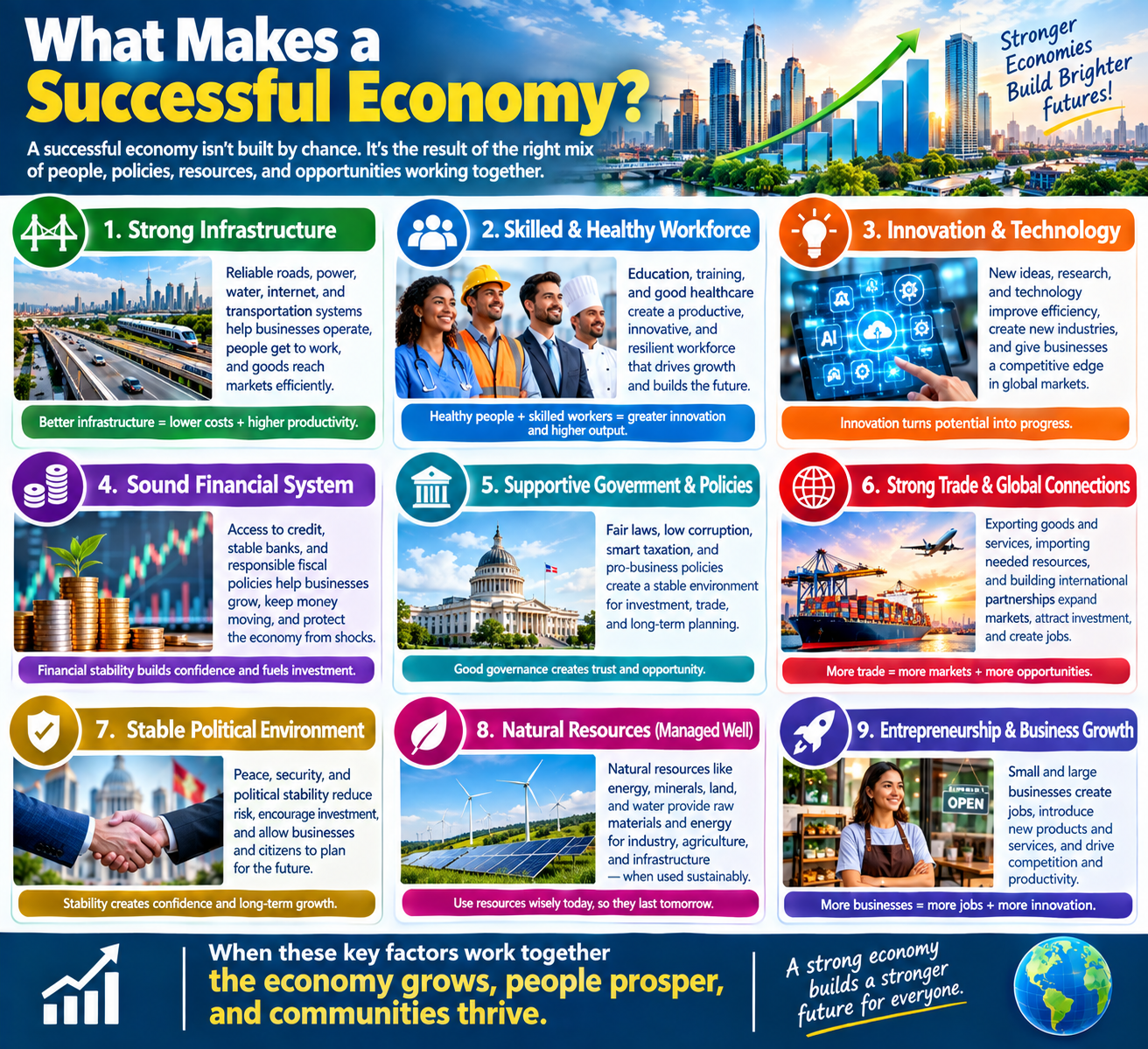
Several factors help explain India’s strong economic performance.
1. A Large and Growing Workforce
India has a very large working-age population. A growing workforce can contribute to economic growth when people find productive employment.
More workers can mean more goods and services are produced. At the same time, employment creates incomes, which can increase household consumption and stimulate additional economic activity.
The benefits of a large workforce, however, depend on education, skills, job creation and productivity.
2. Investment in Infrastructure
Infrastructure plays an important role in economic development. Roads, railways, airports, ports, electricity networks and telecommunications systems make it easier for businesses to operate.
India has invested heavily in infrastructure and connectivity. Better infrastructure can reduce transportation costs, improve access to markets and encourage companies to expand production.
3. Technology and Digital Services
Technology has become another major driver of India’s economy. India has developed a large information-technology and business-services sector, while digital payments and online services have expanded rapidly.
Technology can increase productivity by allowing companies to produce more output with the same amount of labor and capital.
4. Manufacturing and Foreign Investment
India is also seeking to strengthen manufacturing and attract international investment.
Foreign companies can bring capital, technology, management expertise and access to international markets. If investment creates new factories and businesses, it can contribute to employment and long-term economic growth.
What About Other Fast-Growing Countries?
India’s 6.4% growth forecast is impressive, but it does not mean India has the highest growth rate of every country.
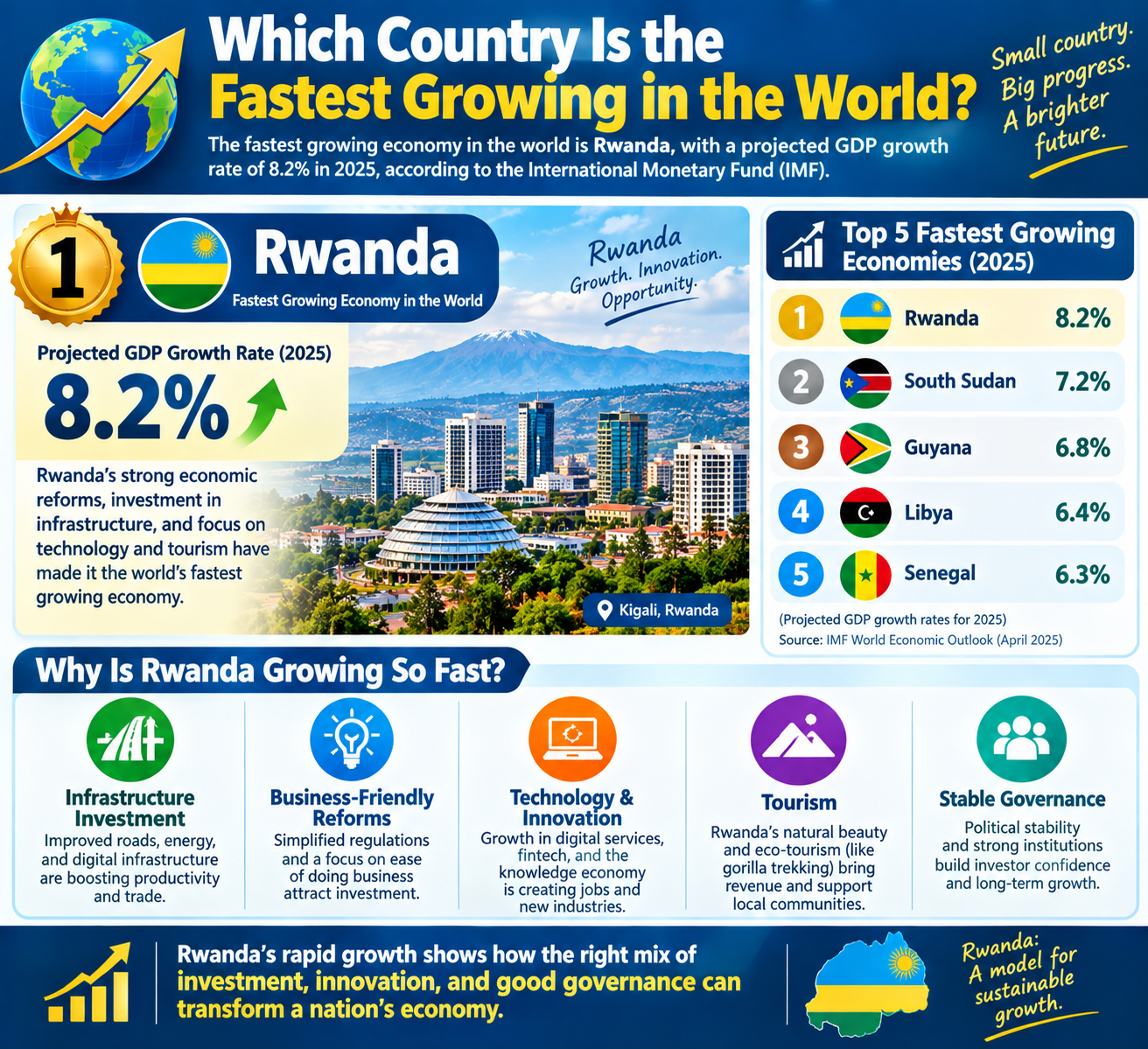
The IMF’s 2026 data show several smaller economies with projected growth rates above India’s. For example, the April 2026 IMF database projected growth of 7.5% for Vietnam, 7.5% for Uganda, 7.2% for Rwanda and 7.0% for Benin.
These figures demonstrate why the phrase “fastest-growing country” needs context.
Vietnam, for example, has become an important manufacturing center and is closely connected to international trade and global supply chains. Smaller African economies can also experience rapid growth as investment, infrastructure development and expanding production increase their economic output.
Therefore, there is no single permanent answer to the question. The country with the highest growth rate can change depending on the year, economic conditions and the forecasts being used.
Why Fast Growth Matters
Rapid economic growth can provide important benefits.
When an economy grows sustainably, businesses may create more jobs, governments may collect more tax revenue and household incomes can increase. Higher economic output can also provide resources for investment in education, healthcare, infrastructure and public services.
For developing countries, sustained economic growth can be especially important because it can help narrow the income gap between poorer and richer countries.
However, growth needs to be sustainable. Rapid expansion accompanied by high inflation, excessive borrowing, financial instability or environmental damage may create problems in the future.
The IMF’s July 2026 outlook highlights that the global economy is facing significant uncertainty, including geopolitical tensions, inflation risks and changing financial conditions. Global growth is projected at 3.0% in 2026 and 3.4% in 2027.
Fast Growth Does Not Always Mean High Living Standards
It is also important to distinguish economic growth from economic prosperity.
A country can have a very high GDP growth rate while still having relatively low income per person. Conversely, a wealthy country may have a relatively low growth rate because its economy is already highly developed.
For this reason, economists also look at GDP per capita, productivity, employment, wages, inflation and measures of living standards.
A country that grows at 7% for several years may transform its economy, but the benefits depend on whether growth creates productive jobs, raises incomes and improves opportunities for the population.
India Compared With Other Major Economies
India’s growth rate stands out when compared with many other large economies.
The IMF’s July 2026 projections put China’s growth at about 4.6% in 2026, while the United States is projected to grow more slowly than India. The IMF has also highlighted structural challenges facing China, including weaker productivity growth, subdued domestic demand and demographic pressures.
This illustrates an important feature of the global economy: growth is increasingly spread across different regions. Emerging economies can grow faster than established economies because they have opportunities to invest in infrastructure, technology, education and industrial capacity.