Interest rates are one of the most powerful tools used to influence an economy. When central banks raise or lower interest rates, the decision can affect almost every part of economic life, from household spending and business investment to inflation, employment, housing, exchange rates, and government borrowing.
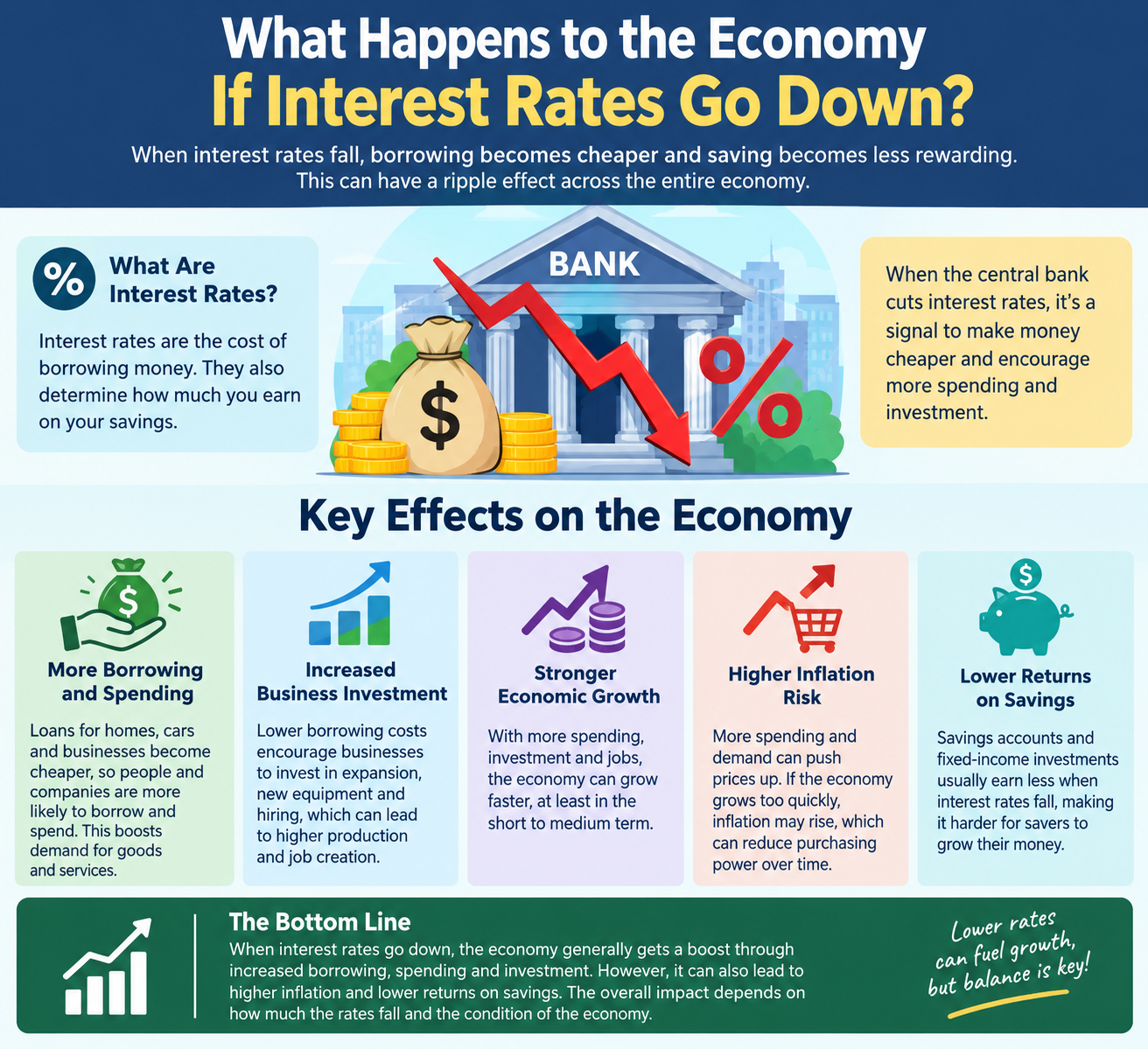
When interest rates go down, borrowing generally becomes cheaper. This can encourage consumers and businesses to spend and invest more, helping economic activity increase. However, lower interest rates can also create risks, particularly if they remain low for too long. They may contribute to rising inflation, excessive borrowing, asset-price increases, or pressure on a country’s currency.
Understanding what happens when interest rates fall is therefore important for anyone interested in economics, finance, business, or personal money management.
1. Borrowing Becomes Cheaper
One of the most immediate effects of lower interest rates is cheaper borrowing.
Banks and other financial institutions generally reduce the interest they charge on loans when the broader cost of money falls. This can make mortgages, business loans, personal loans, and other forms of credit more affordable.
For example, imagine a business wants to borrow money to purchase new equipment. If interest rates are high, the cost of repaying that loan may discourage the company from investing. But if rates fall, the same project may become more attractive.
Consumers can experience something similar. Lower mortgage rates can reduce monthly housing payments, while cheaper personal loans can make it easier for households to finance major purchases.
As borrowing becomes cheaper, economic activity can increase.
2. Consumer Spending Usually Increases
Lower interest rates can encourage households to spend more money.
When borrowing becomes cheaper, consumers may be more willing to purchase homes, cars, appliances, electronics, and other expensive goods. Existing borrowers may also have lower monthly interest payments, leaving them with more disposable income.
For example, someone who previously spent a large portion of their income servicing a loan may have more money available after interest rates decline. They might use that additional money to buy goods and services.
This increase in consumer spending can benefit businesses because companies receive more revenue. Businesses may then respond by producing more goods, hiring additional workers, or investing in expansion.
As a result, lower interest rates can create a cycle of increased spending and economic activity.
3. Businesses May Increase Investment
Businesses are another major beneficiary of lower interest rates.
Companies frequently borrow money to purchase equipment, construct factories, develop technology, open new locations, or expand their operations. When borrowing costs decline, more investment projects become financially attractive.
For instance, a company may decide not to build a new factory when borrowing costs are extremely high. If interest rates fall significantly, however, the expected return from the factory may become greater than the cost of financing it.
Increased business investment can improve productivity and create jobs. Over time, this can contribute to stronger economic growth.
4. Employment Can Increase
When consumers spend more and businesses invest more, companies may need additional workers.
A restaurant experiencing stronger customer demand may hire more employees. A construction company receiving more projects may need additional workers. A manufacturer experiencing higher demand may increase production and expand its workforce.
Therefore, lower interest rates can contribute to falling unemployment, particularly when the economy has significant unused capacity.
However, the relationship is not automatic. Businesses will only hire more workers if they expect increased demand to continue. If companies believe the economic slowdown will persist, they may remain cautious even when borrowing costs decline.
5. Economic Growth Can Accelerate
One of the main reasons central banks lower interest rates is to stimulate economic growth.
When borrowing becomes cheaper, spending and investment can increase. Higher demand encourages businesses to produce more goods and services. This can increase overall economic output, often measured through gross domestic product, or GDP.
Lower interest rates are therefore often used during periods of weak economic growth or recession.
The goal is not simply to make loans cheaper. The broader objective is to encourage economic activity and prevent a temporary slowdown from becoming a deeper economic crisis.
6. Housing Markets Can Become Stronger
Interest rates have a major influence on housing markets.
When mortgage rates decline, buying a home becomes more affordable for many households. More people may qualify for mortgages, while existing homeowners may refinance their loans at lower rates.
This can increase demand for housing.
Higher demand can encourage construction companies to build more homes, creating jobs in construction, manufacturing, transportation, and related industries.
However, there is another side to this effect. If housing supply is limited, increased demand may push property prices higher. This can make homes more expensive, particularly for first-time buyers.
7. Stock and Other Asset Prices May Rise
Lower interest rates can also influence financial markets.
When interest rates on savings accounts and bonds decline, investors may search for assets that offer higher potential returns. Some of this money may move into stocks, real estate, or other investments.
Lower interest rates can also make future corporate earnings more valuable when investors calculate the present value of those earnings.
As a result, falling interest rates can support stock-market valuations.
But higher asset prices can create risks. If investors become excessively optimistic, asset prices may rise much faster than the underlying economy, potentially creating financial bubbles.
8. Savings Become Less Attractive
Lower interest rates are not necessarily good for everyone.
People who depend on interest income from savings accounts, certificates of deposit, or other interest-bearing investments may receive lower returns.
This can be particularly important for retirees and other individuals who rely heavily on income from savings.
When savings earn less, some people may choose to spend more or invest their money in assets with higher potential returns. This can stimulate economic activity, but it can also increase investment risk.
9. Inflation May Increase
One of the biggest risks of lower interest rates is higher inflation.
If cheaper borrowing causes consumers and businesses to spend significantly more, demand for goods and services can increase. If businesses cannot increase production quickly enough, prices may rise.
This is why central banks must carefully balance economic growth with price stability.
If inflation is already high, cutting interest rates may make the problem worse. But if inflation is low and the economy is weak, lower rates may provide useful support.
The appropriate interest-rate policy therefore depends heavily on the economic conditions of a country.
10. The Currency Can Weaken
Lower interest rates can also affect a country’s exchange rate.
When domestic interest rates fall, investments denominated in that country’s currency may become less attractive compared with investments offering higher returns elsewhere.
As a result, demand for the currency can decline, potentially causing it to weaken.
A weaker currency can make exports more competitive because domestically produced goods become cheaper for foreign buyers. However, it can also make imports more expensive.
For countries that rely heavily on imported fuel, food, machinery, or technology, currency depreciation can contribute to higher domestic prices.
11. Government Borrowing Can Become Cheaper
Governments borrow money by issuing bonds and other debt instruments. When interest rates decline, the cost of new government borrowing can decrease.
This can give governments more room to finance infrastructure, public services, education, healthcare, or economic-support programs.
Lower borrowing costs can be particularly valuable for countries with large amounts of public debt.
However, governments must still manage debt carefully. Lower interest rates do not eliminate the obligation to repay borrowed money.
12. Lower Interest Rates Are Not Always the Answer
Although lower interest rates can stimulate an economy, they are not a universal solution.
If rates are reduced too aggressively, inflation may accelerate. Excessive borrowing may also increase household and corporate debt. Investors may take on too much risk, and property or financial markets may become overheated.
There is also a limit to how effective interest-rate cuts can be. If consumers and businesses are extremely pessimistic, they may refuse to borrow even when loans are cheap.
In such circumstances, governments may need to use other policies, such as targeted fiscal spending, structural reforms, or measures designed to improve productivity.