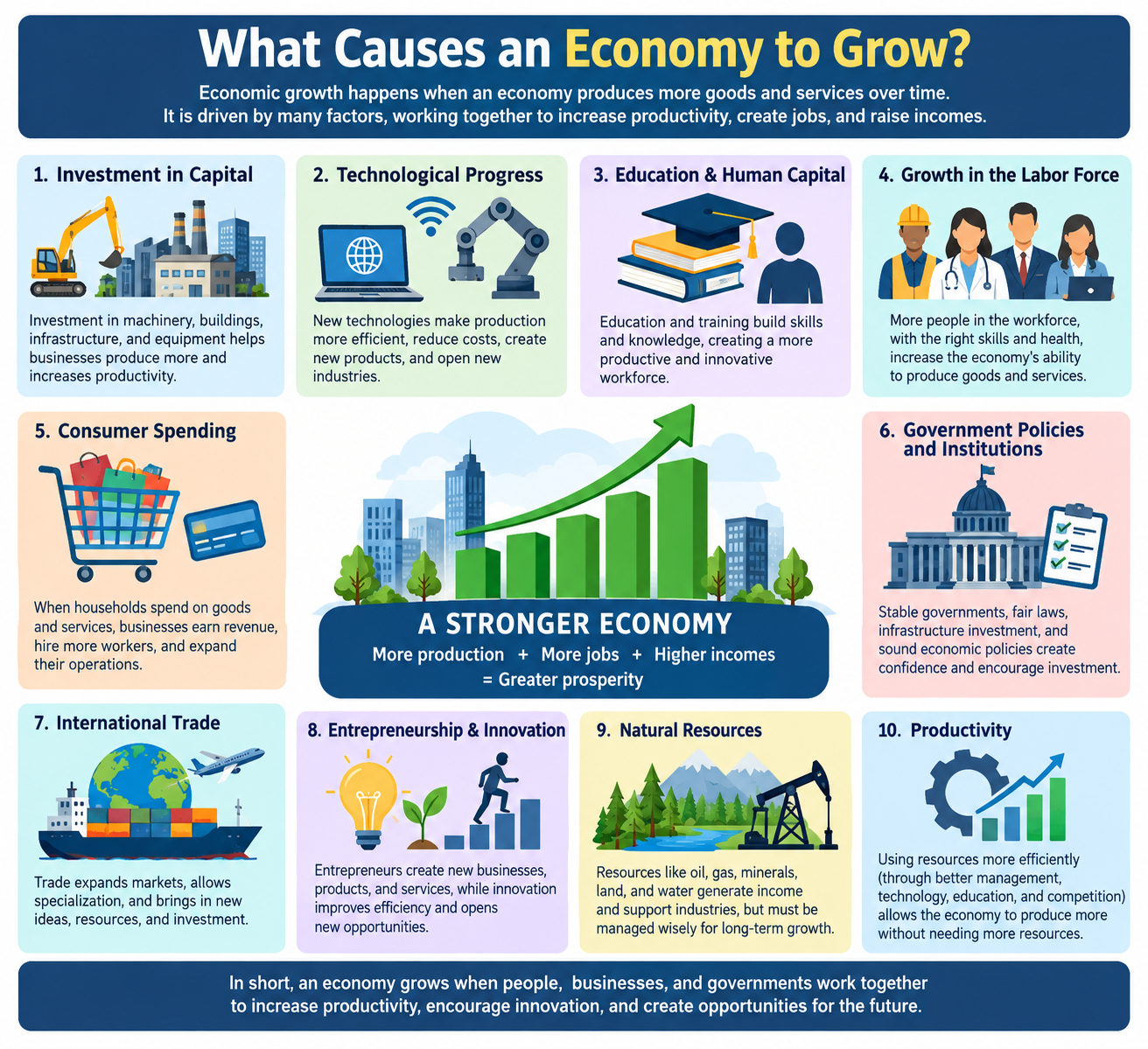
Economic growth is one of the most important indicators of a country’s economic health. It refers to an increase in the production of goods and services within an economy over a period of time. When an economy grows, businesses generally produce more, people may earn higher incomes, employment opportunities can increase, and governments may have more resources to invest in public services. But what actually causes an economy to grow? Economic growth is not caused by a single factor. Instead, it results from the interaction of investment, technology, human skills, infrastructure, institutions, trade, and consumer and business activity.
1. Investment in Capital
One of the main drivers of economic growth is investment in capital. Capital includes machinery, factories, equipment, technology, buildings, and other assets that businesses use to produce goods and services.
When companies invest in new machines or expand their factories, they can often produce more output in less time. For example, a manufacturing company that replaces outdated equipment with modern automated machinery may be able to produce more products while using fewer resources.
Investment can also come from governments. Public investment in roads, airports, ports, electricity systems, and communication networks can make it easier and cheaper for businesses to operate. As investment increases the productive capacity of an economy, it can contribute significantly to long-term economic growth.
2. Technological Progress
Technology is another major source of economic growth. Technological improvements allow businesses and workers to produce more output using the same amount of resources.
For example, the development of computers, the internet, artificial intelligence, automation, and advanced manufacturing technologies has transformed the way businesses operate. Technology can reduce production costs, improve efficiency, create new products, and open up entirely new industries.
Technological progress is particularly important because economic growth cannot rely indefinitely on simply using more workers or more natural resources. Improvements in productivity allow an economy to produce more without requiring a proportional increase in inputs.
3. Education and Human Capital
People are one of the most valuable resources in any economy. The knowledge, skills, experience, and abilities of workers are often referred to as human capital.
Education and training can increase worker productivity. A highly educated and skilled workforce is better able to use advanced technologies, solve problems, develop new products, and adapt to changing economic conditions.
For example, investment in universities, vocational training, professional education, and workplace training can help create a workforce capable of working in industries such as finance, technology, engineering, healthcare, and manufacturing.
Countries that consistently invest in education and skills development can therefore build a stronger foundation for long-term economic growth.
4. A Growing Labor Force
Economic growth can also result from an increase in the number of people participating in the workforce. If more people are employed, the economy has more workers available to produce goods and services.
Population growth can increase the size of the potential workforce, although population growth by itself does not guarantee economic growth. The additional workers need appropriate skills, jobs, capital, and infrastructure.
Labor force participation is also important. When more people who are able to work actually enter employment, the economy can increase its productive capacity. Policies that support childcare, transportation, education, flexible working arrangements, and employment opportunities can sometimes help increase labor force participation.
5. Entrepreneurship and Innovation
Entrepreneurs play an important role in economic growth because they create businesses, introduce new products, develop new services, and take risks in search of opportunities.
Successful entrepreneurs can create employment and encourage competition. Competition can push businesses to improve quality, reduce costs, and develop innovative products.
Innovation does not only come from large corporations. Small businesses and startups can also introduce new technologies and business models. When successful innovations spread across an economy, they can improve productivity and create new sources of economic activity.
6. Infrastructure
Strong infrastructure provides the foundation for economic activity. Infrastructure includes transportation systems, electricity networks, telecommunications, water systems, ports, airports, and digital networks.
Good infrastructure reduces the costs and time associated with producing and transporting goods and services. For example, efficient roads and ports can help manufacturers receive raw materials and send finished products to domestic and international markets.
In the modern economy, digital infrastructure is increasingly important. Reliable internet access and telecommunications allow businesses to communicate, conduct transactions, access information, and participate in global markets.
7. International Trade
International trade can also contribute to economic growth. By trading with other countries, economies can specialize in producing goods and services in which they are relatively efficient.
Exports allow domestic businesses to reach larger markets, increasing production and potentially creating more employment. Imports can provide consumers and businesses with products, raw materials, machinery, and technologies that may not be produced efficiently domestically.
International investment can also bring capital, technology, management expertise, and access to global supply chains. However, the benefits of trade depend on factors such as a country’s institutions, competitiveness, infrastructure, and ability to adapt to changes in global markets.
8. Strong Institutions and Political Stability
Economic growth depends not only on resources but also on the rules under which economic activity takes place. Strong institutions can provide businesses and individuals with confidence to invest and make long-term decisions.
Property rights, effective legal systems, reliable financial institutions, transparent government, and predictable regulations can encourage investment and entrepreneurship.
Political and economic stability are also important. Businesses are more likely to invest when they believe that contracts will be enforced, property will be protected, and economic policies will remain reasonably predictable.
9. Access to Finance
Businesses often need financing to start, expand, purchase equipment, hire workers, and develop new products. Banks, capital markets, and other financial institutions connect savings with productive investment.
When businesses can obtain affordable credit or raise capital, they are better positioned to expand their operations. Financial systems therefore play an important role in converting savings into investment and supporting economic activity.
However, excessive debt or poorly regulated financial markets can create risks. Sustainable economic growth requires a financial system that supports investment while maintaining financial stability.
10. Consumer Spending and Demand
Consumer spending is another important component of economic activity. When households purchase goods and services, businesses receive revenue. This can encourage companies to increase production, hire workers, and invest in expansion.
Strong consumer demand can therefore contribute to short- and medium-term economic growth. However, consumption alone does not guarantee sustainable long-term growth. An economy also needs investment, productivity improvements, innovation, and the development of productive capacity.