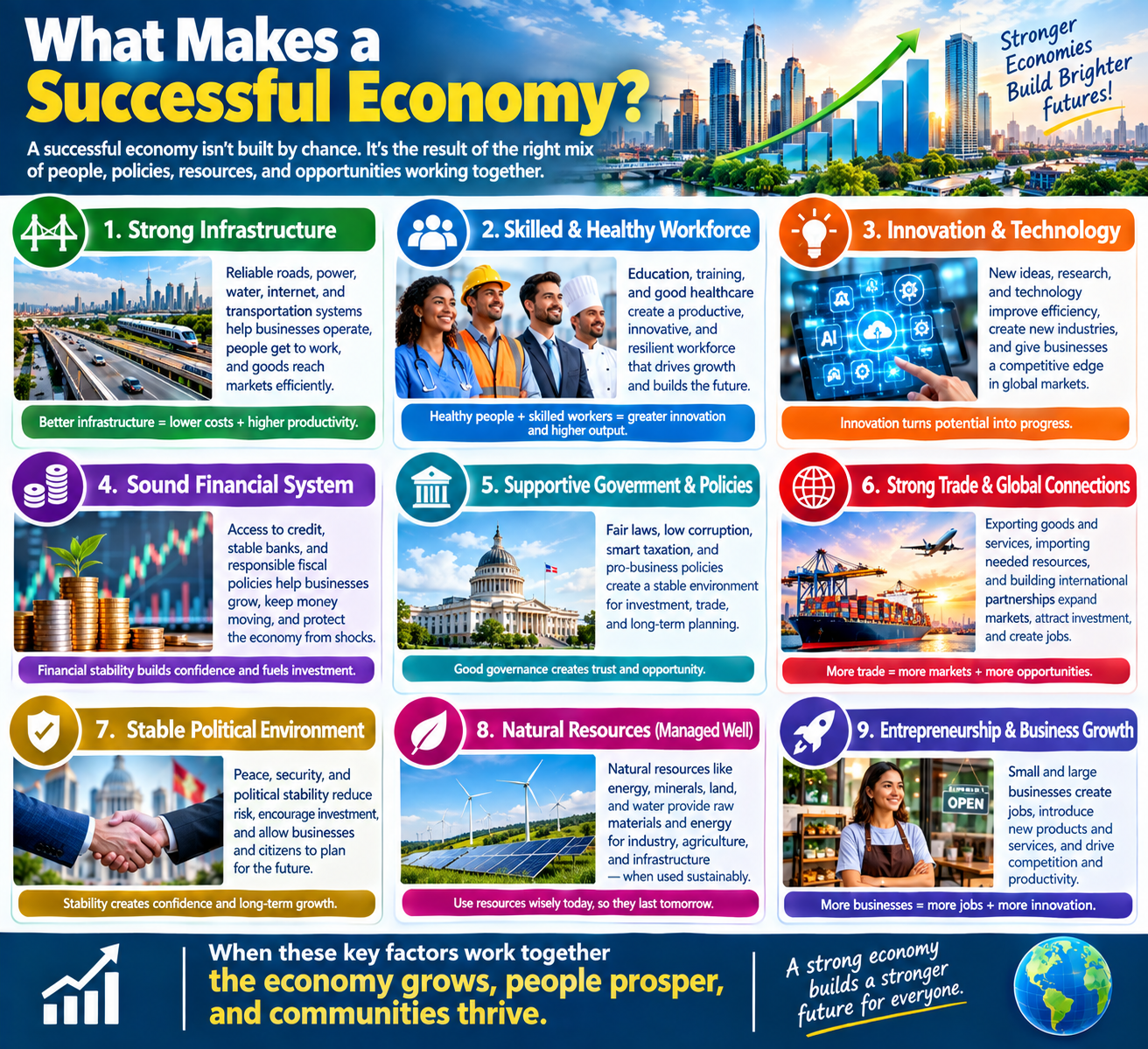
A successful economy is more than simply a country that produces a large amount of goods and services. Economic success is usually measured by a combination of strong growth, high employment, rising incomes, stable prices, productive businesses, innovation, and a good quality of life. A country can have a large economy but still face serious problems if wealth is concentrated, unemployment is high, or inflation is out of control.
The world’s most successful economies generally share several characteristics. They create opportunities for businesses and workers, invest in education and infrastructure, maintain reliable institutions, encourage innovation, and provide an environment where people can plan for the future. Understanding these factors helps explain why some countries become prosperous while others struggle to achieve sustained development.
1. Strong and Sustainable Economic Growth
One of the most important characteristics of a successful economy is sustainable economic growth. Economic growth means that the amount of goods and services produced by an economy increases over time.
Growth can create jobs, increase household incomes and provide governments with additional revenue for public services. However, growth needs to be sustainable. An economy that expands rapidly for a short period but then experiences a severe recession may not be as successful as an economy that grows steadily for decades.
Long-term growth is particularly important because even modest annual increases in economic output can make a significant difference over many years.
2. High Employment and Productive Jobs
Employment is another major measure of economic success. A healthy economy generally provides opportunities for people who want to work.
When more people have jobs, households have income to spend on housing, food, transportation, education and other products and services. This consumer spending supports businesses, which can then hire more workers and invest in expansion.
However, simply having a high employment rate is not enough. The quality and productivity of jobs also matter. An economy is stronger when workers can earn reasonable incomes, develop valuable skills and move into higher-productivity occupations.
3. A Highly Skilled Workforce
Education and skills are fundamental to a successful economy. Workers with strong education and specialized skills are generally able to produce more value and adapt more easily to technological changes.
Countries that invest in schools, universities, vocational training and lifelong learning can develop a workforce capable of working in industries such as technology, healthcare, engineering, finance and advanced manufacturing.
Human capital can therefore be viewed as an economic investment. Better skills can increase productivity, encourage innovation and improve workers’ earning potential.
4. Innovation and Technology
Technology is one of the strongest long-term drivers of economic success.
Companies that develop new products, improve production methods or use technology more efficiently can produce more output with fewer resources. This increases productivity and can make businesses more competitive in international markets.
Successful economies tend to encourage research and development, entrepreneurship and the adoption of new technologies. Innovations in areas such as artificial intelligence, biotechnology, renewable energy, telecommunications and advanced manufacturing can create entirely new industries.
Technology can also make existing industries more efficient, helping an economy produce more without requiring a proportional increase in labor or natural resources.
5. Strong Infrastructure
Infrastructure provides the foundation on which economic activity takes place. Roads, railways, ports, airports, electricity systems, water networks and telecommunications all influence how efficiently an economy operates.
Businesses depend on reliable infrastructure to transport products, communicate with customers and suppliers, and access energy and other essential resources.
Digital infrastructure has become particularly important. High-speed internet, data networks and digital payment systems allow businesses to reach customers and participate in international markets.
Countries that consistently invest in infrastructure can create an environment where businesses are more productive and investment becomes more attractive.
6. Stable Financial and Banking Systems
A successful economy also needs a financial system that works effectively.
Banks and other financial institutions connect people who have savings with businesses and individuals that need capital. Companies can use financing to purchase equipment, build factories, hire employees and develop new products.
A stable banking system also helps households obtain mortgages, finance education and make major purchases.
Financial instability, on the other hand, can cause serious economic damage. Banking failures, excessive debt and sudden losses of confidence can reduce investment and consumer spending. Strong financial regulation and responsible lending therefore play an important role in maintaining economic stability.
7. Political and Economic Stability
Businesses and individuals are more likely to invest when they have confidence in the future.
Political and economic stability allows companies to make long-term plans. Businesses are more willing to build factories, employ workers and invest in research when they believe property rights, contracts and economic rules will remain reasonably predictable.
Strong institutions are particularly important. Courts, regulators, government agencies and financial institutions need to operate effectively and transparently.
When corruption, uncertainty or sudden policy changes become widespread, businesses may reduce investment and move capital elsewhere.
8. International Trade
International trade can make an economy more productive by allowing countries to specialize in activities where they have advantages.
Exports allow businesses to reach customers in other countries, while imports give consumers and companies access to products and resources that may be cheaper or unavailable domestically.
Trade can also expose domestic companies to international competition, encouraging them to improve productivity and quality.
Many successful economies are deeply connected to global supply chains. They export manufactured goods, technology, financial services, agricultural products or other specialized products and services.
9. Entrepreneurship and Business Investment
Entrepreneurs play an important role in successful economies because they create new businesses, products and services.
New businesses can introduce innovative ideas and challenge established companies. Competition can encourage firms to reduce costs, improve quality and respond more effectively to customers.
Business investment is equally important. Companies that invest in machinery, buildings, software, research and employee training can increase their productive capacity.
An economy becomes more dynamic when people have opportunities to start businesses and when successful companies can expand.
10. Stable Prices and Sensible Economic Policies
Economic stability also depends on maintaining reasonably stable prices.
High and unpredictable inflation reduces purchasing power and makes it difficult for households and businesses to plan. If prices rise rapidly, consumers may struggle to afford essential goods while businesses face uncertainty over costs.
Central banks and governments therefore have an important role in maintaining economic stability. Monetary and fiscal policies need to balance growth, employment, inflation and financial stability.
Sound economic policies can increase confidence and create conditions that support long-term investment.
11. A Good Quality of Life
Ultimately, the success of an economy should not be judged only by GDP.
A successful economy should help improve people’s standard of living. Factors such as healthcare, education, housing, public safety, environmental quality and access to essential services all matter.
GDP measures economic production, but it does not capture every aspect of people’s well-being. A country may have a large GDP while still experiencing significant inequality or poor access to essential services.
For this reason, economists and policymakers often examine GDP per capita, wages, employment, productivity, poverty and other measures alongside overall economic output.
12. Inclusive Economic Opportunities
Another important characteristic of a successful economy is the ability to provide opportunities to a broad section of society.
Economic growth is more sustainable when people from different backgrounds can access education, employment, finance and entrepreneurship.
If economic gains are concentrated among a small group, social and political tensions can increase. Broad access to opportunity can help ensure that economic growth translates into higher living standards for a larger proportion of the population.