Economic growth is one of the most important goals for countries around the world. When an economy grows, it produces more goods and services, businesses expand, employment opportunities can increase, and people’s incomes can rise. But what actually causes an economy to grow over the long term?
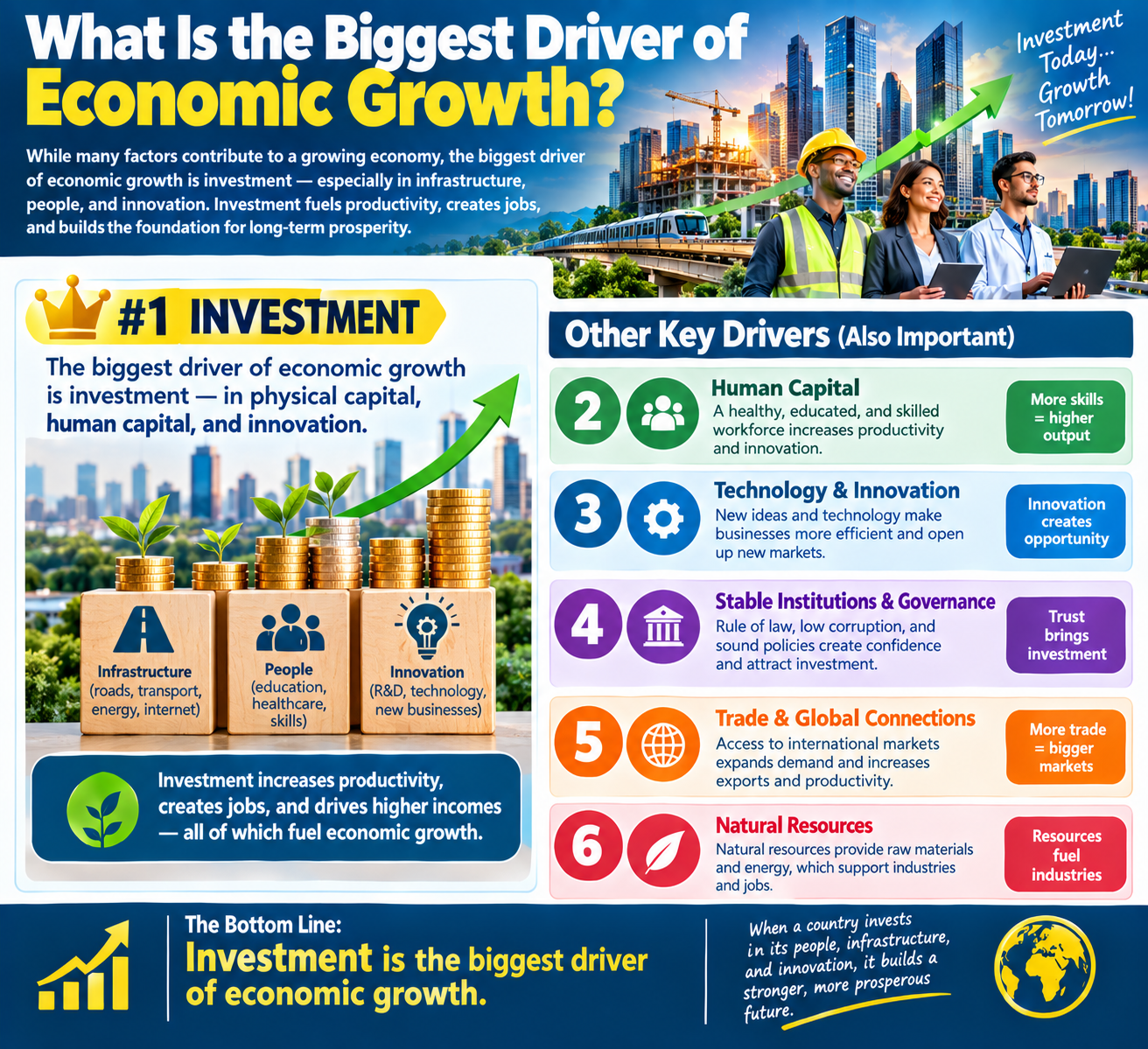
There are several important drivers of economic growth, including investment, education, population growth, entrepreneurship, international trade, infrastructure, and government policy. However, productivity growth, particularly through technological progress and innovation, is widely considered the biggest long-term driver of economic growth.
Productivity means how efficiently an economy uses its resources to produce goods and services. When workers and businesses can produce more output with the same amount of labor, capital, and natural resources, the economy’s productive capacity increases. Over time, improvements in productivity can have a much greater effect on living standards than simply increasing the number of workers or machines.
What Is Economic Growth?
Economic growth generally refers to an increase in the amount of goods and services produced by an economy over time. Economists commonly measure it using changes in real gross domestic product, or real GDP.
For example, if a country produces more cars, houses, software, food, healthcare services, and other products than it did the previous year, its economy has expanded.
Growth can happen because an economy has more workers, more machinery, more natural resources, or greater productivity. Of these factors, productivity is particularly important because it determines how efficiently an economy transforms its resources into economic output.
Why Productivity Is the Biggest Driver
Imagine an economy with 10 million workers. If those workers produce exactly the same amount every year, economic output may remain relatively stable unless the country adds more workers or capital.
Now imagine that technology, skills, and production methods improve. The same 10 million workers may be able to produce significantly more goods and services.
This is productivity growth.
For example, a farmer using modern machinery, improved seeds, data and irrigation technology may produce far more food than a farmer using traditional methods. A factory using robotics and advanced software may produce more products with the same number of employees. A software company can serve millions of customers using digital systems that would have been impossible decades ago.
These improvements allow an economy to increase output without needing a proportional increase in resources.
Technology and Innovation
Technology is one of the most powerful sources of productivity growth.
Technological innovation can make existing processes faster, cheaper and more efficient. It can also create entirely new products and industries.
The internet, smartphones, cloud computing, artificial intelligence, advanced manufacturing and biotechnology have transformed the way businesses operate. Earlier technological breakthroughs such as electricity, automobiles, telecommunications and industrial machinery had similarly large effects on economic production.
Innovation can increase productivity in almost every sector. Farmers can use technology to monitor crops. Manufacturers can automate production. Banks can provide digital financial services. Hospitals can use advanced medical equipment and software. Businesses can use data to make better decisions.
Because technology can spread throughout an economy, its impact can extend far beyond the company that originally develops it.
Investment in Capital
Although productivity is a major driver of long-term growth, investment in physical capital is also essential.
Capital includes machinery, factories, computers, transportation equipment and other resources businesses use to produce goods and services.
When companies invest in better equipment, they can often produce more efficiently. A modern factory may produce more output than an older facility. A logistics company with better vehicles and software can move products more efficiently. A business using modern computers and digital systems may complete tasks faster.
Investment can therefore increase both the quantity and quality of an economy’s productive resources.
However, simply accumulating more capital is not enough forever. The most important gains often come from using capital more efficiently through better technology, organization and skills.
Education and Human Capital
Workers are another major source of economic growth.
Education and training increase human capital, which refers to the knowledge, skills and abilities that people use in productive activities.
A highly educated and skilled workforce can adapt to new technologies and perform increasingly complex tasks. Engineers can design advanced products, healthcare professionals can provide specialized services, and skilled technicians can operate sophisticated machinery.
Education can also support innovation. Universities and research institutions often contribute to scientific discoveries and technological developments that later become commercially valuable.
For this reason, countries that invest in education and workforce development can improve their long-term growth potential.
Entrepreneurship
Entrepreneurs also play an important role in economic growth.
Entrepreneurs identify opportunities, create businesses and introduce new products and services. They are often willing to take risks in exchange for the possibility of creating something valuable.
Successful entrepreneurs can increase competition and force established companies to become more efficient. New businesses can also create jobs and attract investment.
Entrepreneurship becomes particularly powerful when combined with technology and access to capital. A new company with a useful innovation can grow rapidly and potentially create an entirely new industry.
Infrastructure
Infrastructure provides the foundation for economic activity.
Roads, railways, airports, ports, electricity networks, water systems and telecommunications allow workers and businesses to operate efficiently.
Good infrastructure reduces transportation costs, improves access to markets and makes it easier for businesses to exchange goods and information.
Digital infrastructure has become increasingly important as well. High-speed internet and reliable communications allow companies to participate in global markets and adopt new technologies.
Infrastructure investment can therefore support productivity by making other economic resources more effective.
International Trade
International trade can also contribute significantly to economic growth.
Countries can specialize in producing goods and services in which they are relatively efficient and trade with other countries for products they produce less efficiently.
International markets also give businesses access to a much larger customer base. A company that can sell internationally has greater opportunities to expand production and investment.
Trade can also encourage competition and technology transfer. Companies exposed to international competition may have stronger incentives to improve their productivity and adopt better technologies.
Population and Employment
Population growth can contribute to economic growth by increasing the size of the workforce and consumer market.
If more people enter productive employment, the economy can produce more goods and services. A growing population can also increase demand for housing, food, transportation, entertainment and other products.
However, population growth alone does not guarantee higher living standards. If employment opportunities, infrastructure and productivity do not keep pace, rapid population growth can create economic pressures.
This is why productivity remains so important. A country needs not only more workers but also workers who can produce increasing amounts of valuable output.
Strong Institutions and Economic Stability
A successful economy also needs institutions that support investment and entrepreneurship.
Businesses are more likely to invest when property rights are protected, contracts can be enforced and economic rules are reasonably predictable.
Stable financial systems and responsible economic policies can also encourage investment. High inflation, financial instability, corruption or unpredictable regulation can discourage businesses from making long-term investments.
Strong institutions do not directly produce goods and services, but they create the environment in which productivity, investment and innovation can flourish.
Consumer Spending and Demand
Consumer spending is another important part of economic activity.
When consumers purchase homes, cars, food, entertainment and other products, businesses receive revenue. Strong demand can encourage companies to hire workers, increase production and invest in expansion.
However, consumer spending is generally more important for supporting short- and medium-term economic activity than for explaining long-term increases in productive capacity.
An economy cannot sustainably grow simply by spending more. Long-term growth ultimately depends on the economy’s ability to produce more efficiently.
Why Productivity Matters for Living Standards
One of the strongest reasons productivity is considered the biggest driver of economic growth is its connection to living standards.
If workers become more productive, businesses can potentially produce more output per worker. Higher productivity can support higher wages, greater business profits, increased investment and more government revenue.
Over decades, even small improvements in productivity can compound into major increases in economic output.
This is why technological progress and innovation have played such a significant role in the development of modern economies.