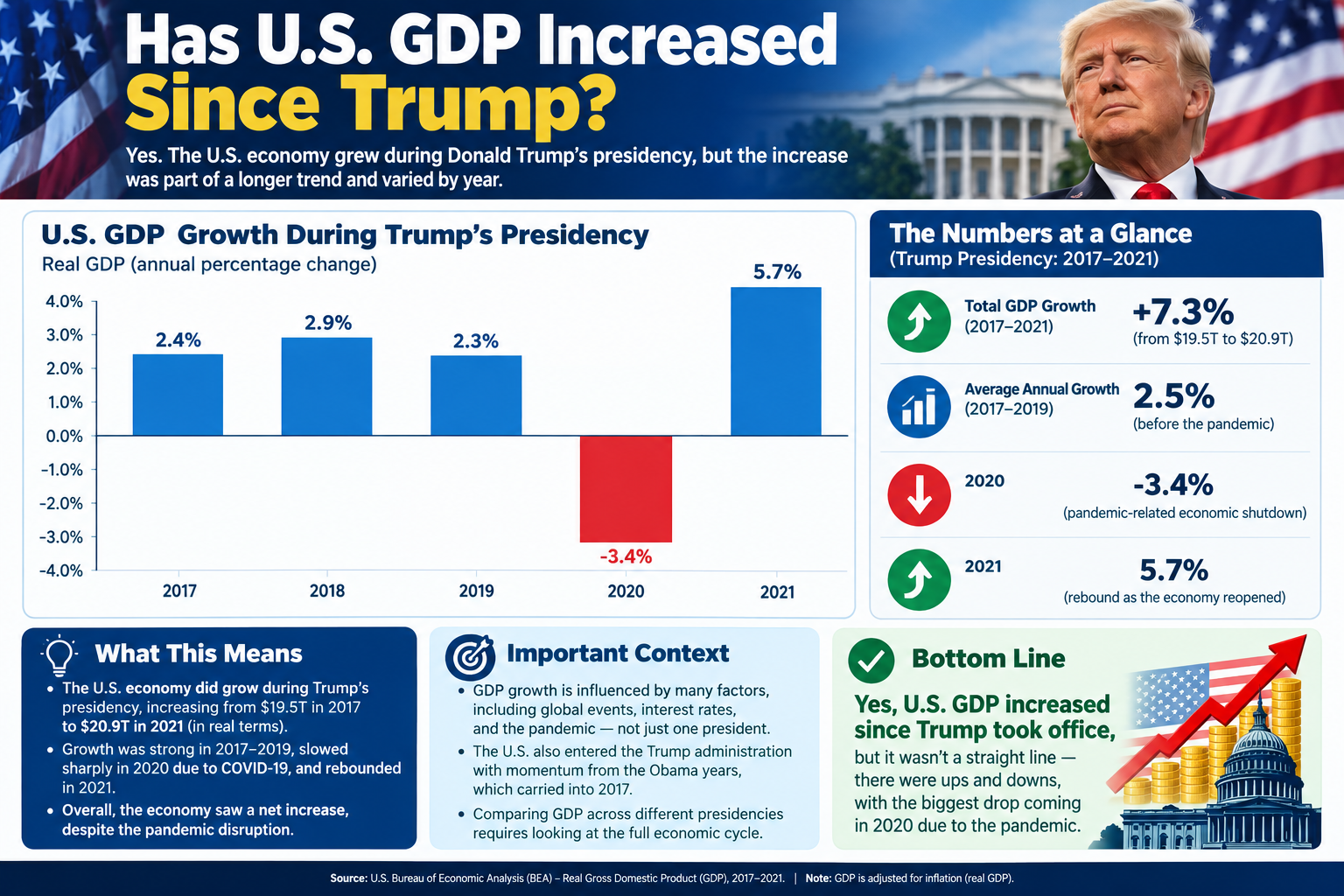
Since Donald Trump returned to the White House in January 2025, one of the most important economic questions has been whether the U.S. economy has actually grown. Gross domestic product, or GDP, is one of the main measures used to answer that question.
The short answer is yes: U.S. GDP has increased since Trump took office. Real GDP, which adjusts for inflation, continued to expand during 2025 and the first half of 2026. However, the pace of growth has not been consistently strong, and it is important to distinguish between the economy growing and proving that a president’s policies caused that growth.
According to the U.S. Bureau of Economic Analysis (BEA), real GDP increased by 2.1% in 2025 compared with the 2024 annual level. In 2026, real GDP increased at an annualized rate of 2.5% in the first quarter and 2.2% in the second quarter.
What Does GDP Tell Us?
GDP measures the value of goods and services produced within the United States. When economists talk about economic growth, they generally focus on real GDP, because it removes the effect of inflation.
This distinction matters. If prices rise but the amount of goods and services produced does not increase, nominal GDP can rise even though the economy has not actually produced more. Real GDP provides a better indication of whether economic activity has expanded.
By this measure, the U.S. economy has continued to grow since Trump returned to office.
GDP Growth During 2025
The U.S. economy entered 2025 with relatively strong momentum. Real GDP increased at an annual rate of 2.4% in the fourth quarter of 2024, according to the final BEA estimate.
During 2025, however, growth was uneven.
The first quarter saw a contraction, while growth rebounded strongly in the second and third quarters. Real GDP increased at an annualized rate of 4.4% in the third quarter of 2025, one of the strongest quarterly performances of Trump’s second term. Growth then slowed sharply in the fourth quarter. The final BEA estimate showed real GDP increasing only 0.5% at an annualized rate during the fourth quarter.
Despite the uneven quarterly results, the economy as a whole grew 2.1% during 2025. That means the overall size of the inflation-adjusted economy was larger in 2025 than in 2024.
GDP Continued Growing in 2026
The expansion continued during the first half of 2026.
BEA data show that real GDP increased at an annualized rate of 2.5% during the first quarter of 2026. Growth then reached 2.2% during the second quarter. Consumer spending, investment and exports were among the contributors to second-quarter growth.
These numbers are important because they show that the U.S. economy did not enter a sustained recession during this period.
At the same time, the figures should not be interpreted as evidence of an economic boom. Growth around 2% is meaningful, but it is considerably different from an economy expanding at 4% or 5% for a prolonged period.
The overall picture is therefore one of continued economic expansion, but with periods of weakness and volatility.
Did Trump Cause GDP to Increase?
This is where the question becomes more complicated.
GDP increased after Trump took office, but that does not automatically mean Trump’s policies caused the increase.
Economic growth is influenced by hundreds of factors. Consumer spending, business investment, interest rates, Federal Reserve policy, technological innovation, population growth, productivity, international trade and global economic conditions all affect GDP.
There is also a time lag between economic policies and their effects. Policies introduced by one administration can influence the economy months or years later, while economic conditions inherited from a previous administration can continue affecting growth.
For example, the U.S. economy was already expanding before Trump returned to office. Real GDP increased 2.8% in 2024, according to the BEA.
Therefore, simply comparing GDP before and after January 2025 does not provide enough information to determine how much of the growth was caused by Trump’s policies.
What Has Been Driving Growth?
One of the most important sources of GDP growth has been consumer spending.
American households account for a large share of economic activity. When consumers purchase housing-related services, food, vehicles, entertainment, healthcare and other goods and services, those transactions contribute to GDP.
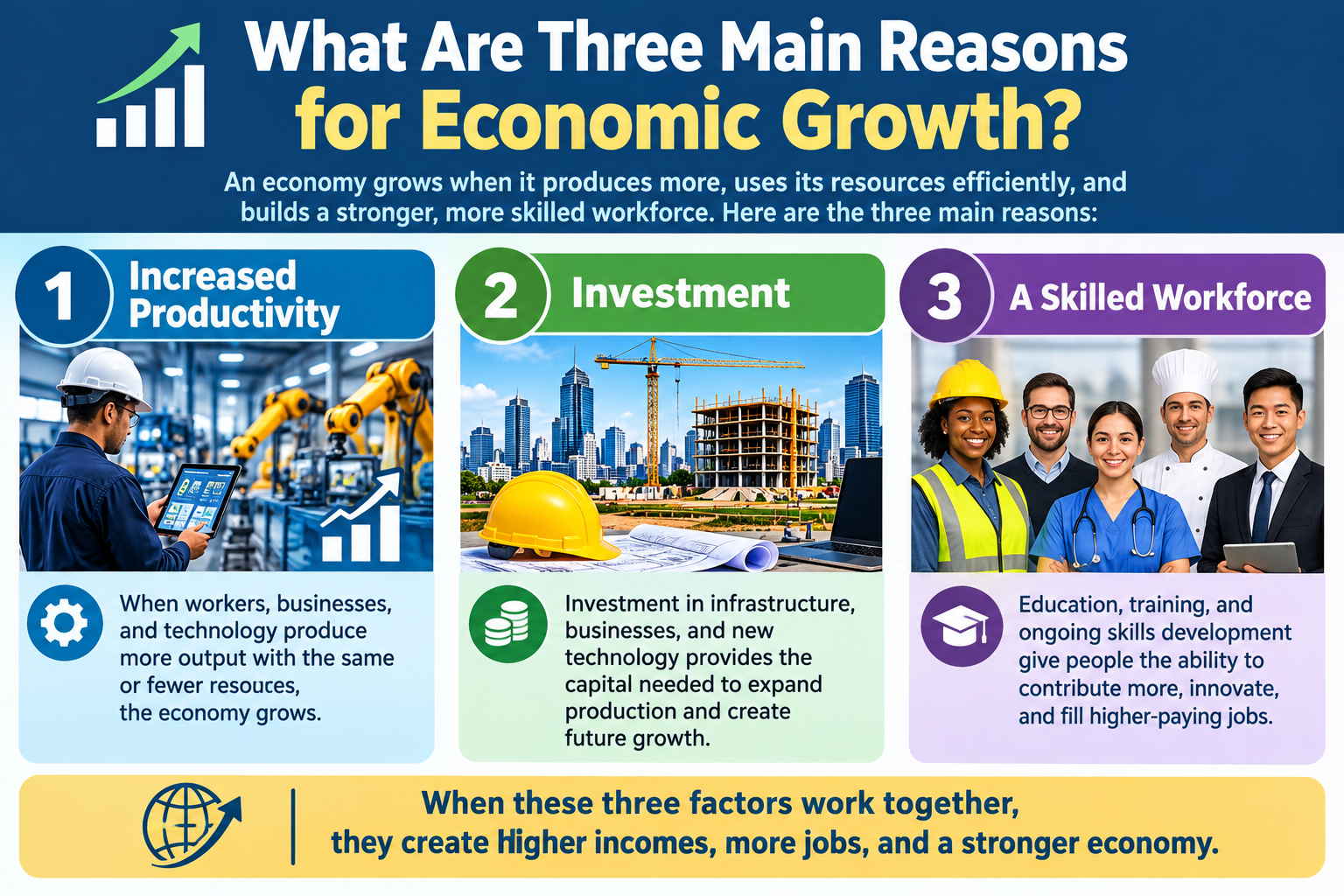
Business investment has also contributed to growth. Companies investing in equipment, structures, technology and other productive assets can increase the economy’s capacity to produce goods and services.
The BEA reported that consumer spending and investment were important contributors to GDP growth during 2025, while the second quarter of 2026 also benefited from consumer spending, investment and exports.
Technology has also become increasingly important. Investment in artificial intelligence, computing infrastructure, software and other technologies has created significant demand for capital and business investment.
GDP Is Not the Same as Living Standards
Another important point is that a rising GDP does not necessarily mean every American is financially better off.
GDP measures total economic production. It does not directly measure household wealth, income distribution, affordability or quality of life.
For example, GDP can increase while households continue to face high housing costs, expensive healthcare, rising food prices or other financial pressures.
This is why economists also examine employment, wages, inflation, productivity, household income and consumer confidence when evaluating the health of the economy.
Real GDP can tell us whether the economy is producing more, but it cannot tell the entire story of how Americans are experiencing the economy.
How Strong Is the U.S. Economy Under Trump?
The evidence so far suggests that the U.S. economy has continued expanding under Trump’s second term, rather than experiencing a major economic contraction.
However, growth has been uneven. The economy contracted in early 2025, rebounded strongly later in the year, slowed sharply in the fourth quarter, and then returned to growth during the first two quarters of 2026.
That makes the description of the economy more complicated than simply saying it is either “booming” or “failing.”
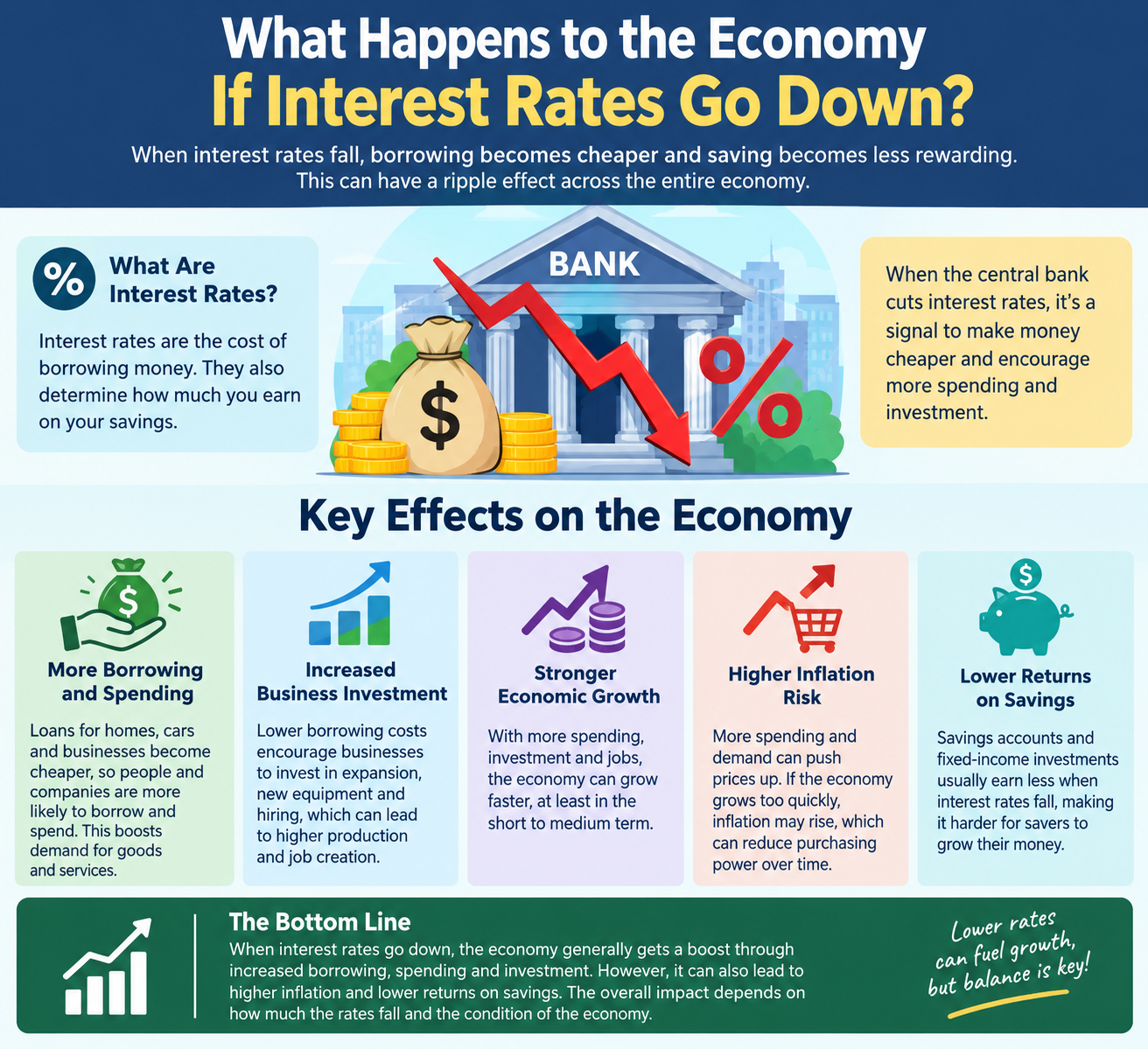
The data point toward an economy that has continued to grow but has also faced significant challenges, including inflation, changing interest rates, trade uncertainty and periods of weaker economic activity.