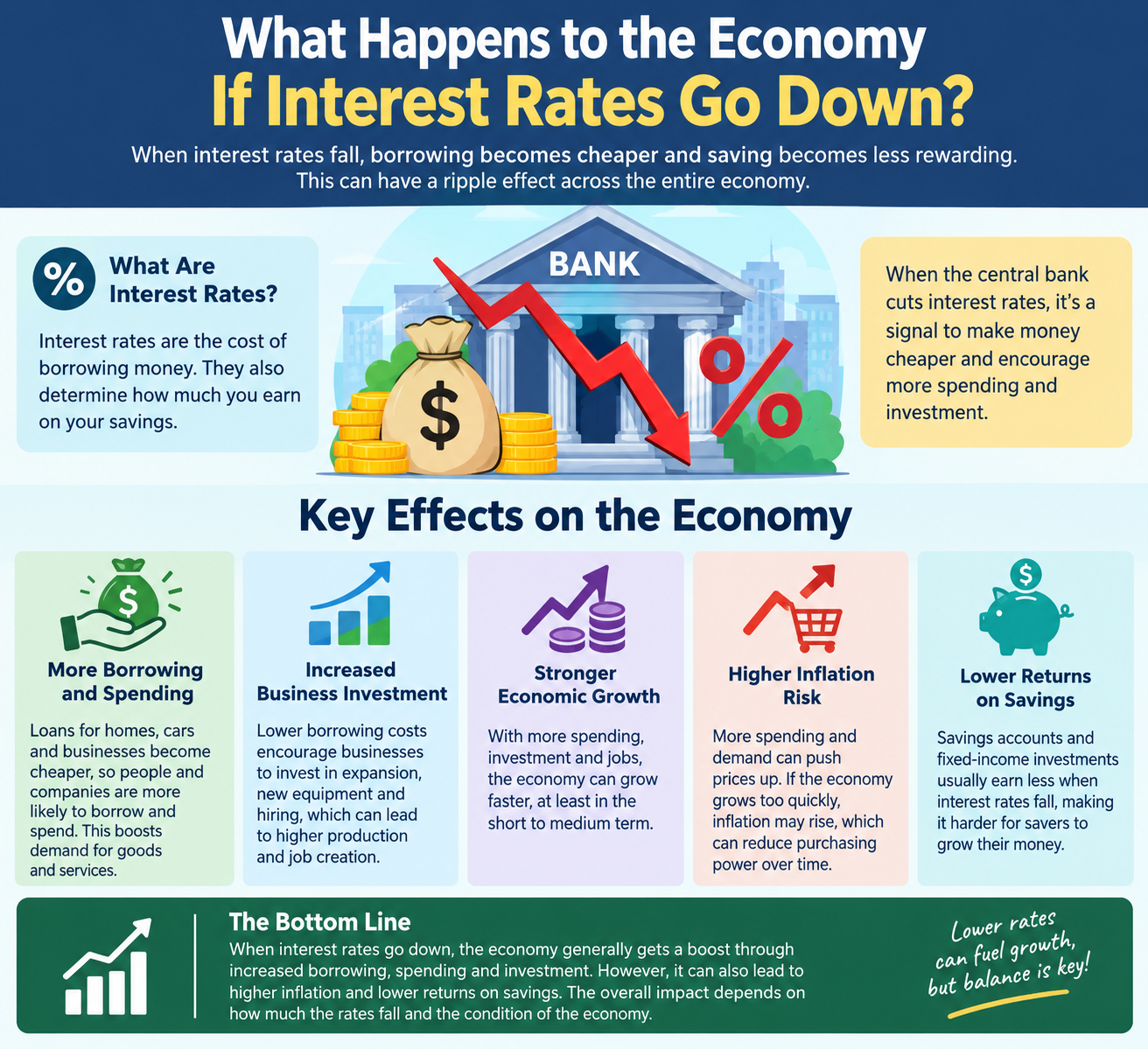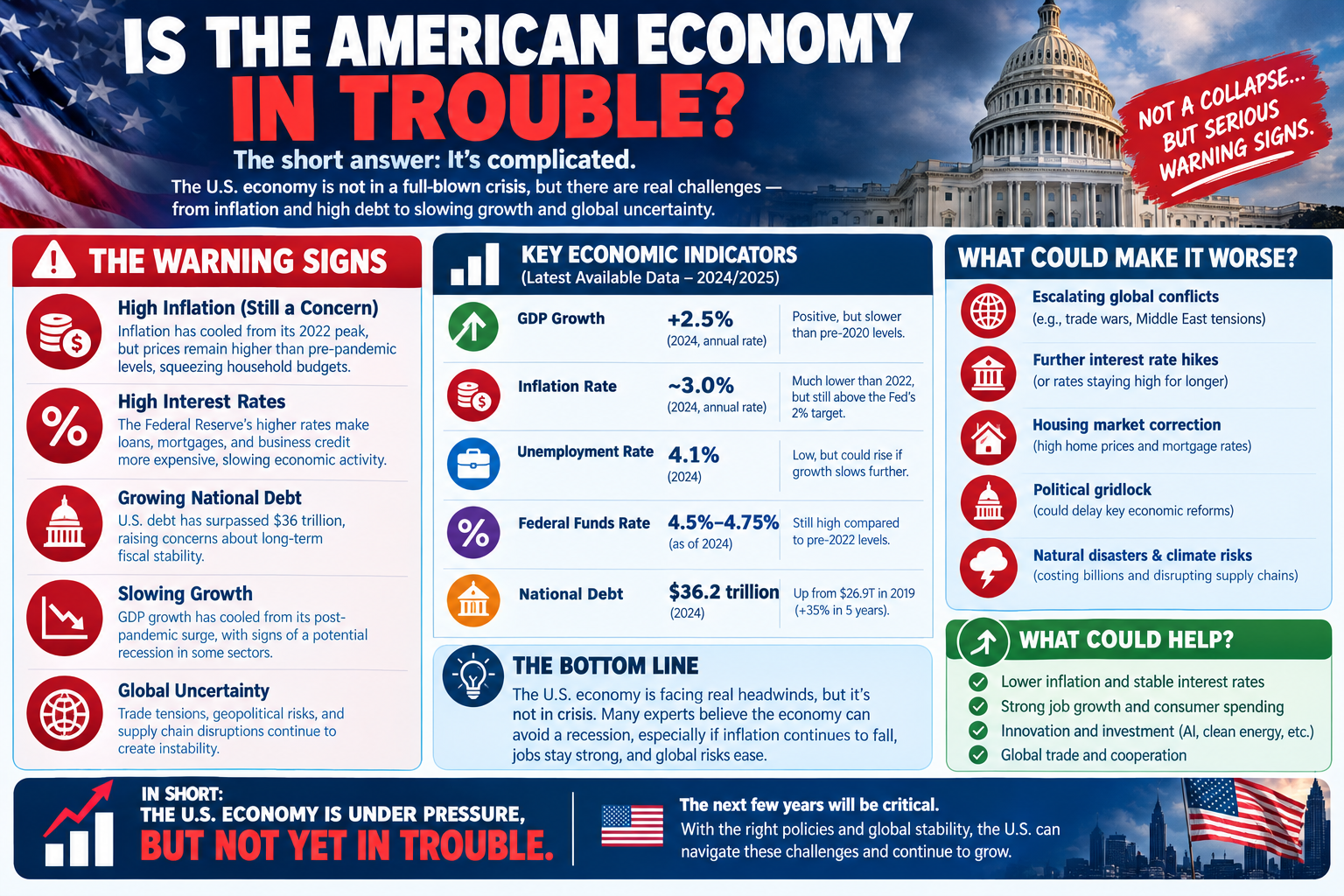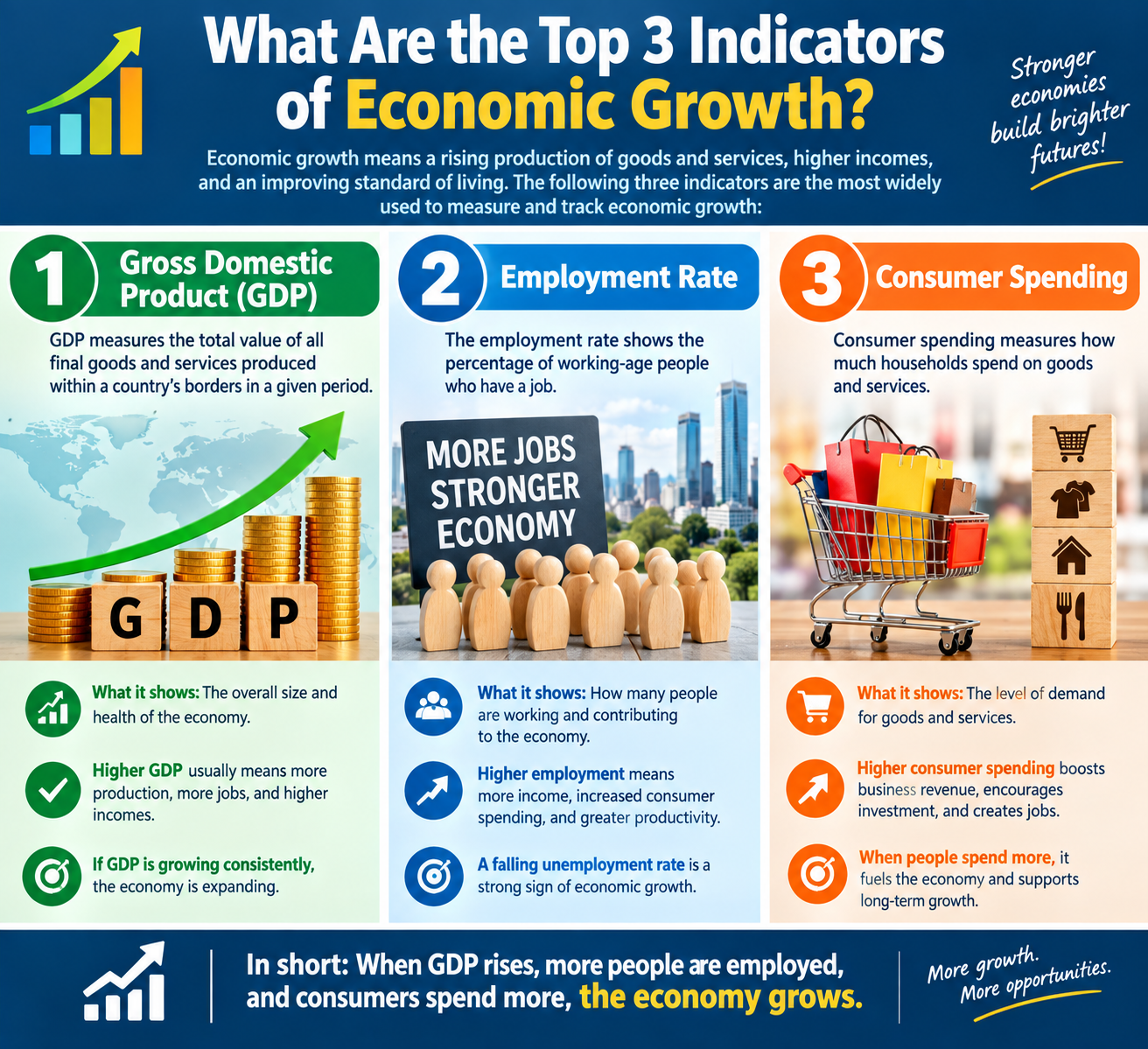
Economic growth is an important measure of how an economy is performing over time. It generally means that an economy is producing more goods and services than it did previously. Economic growth can influence employment, household incomes, business activity, government revenues, and living standards.
Economists use many different statistics to understand whether an economy is growing. Some measure total economic output, while others provide information about employment, prices, investment, productivity, and household conditions.
Although there are many useful economic indicators, three of the most important are real GDP growth, employment and unemployment, and productivity. Together, these indicators provide a broad picture of whether an economy is expanding, how the labor market is performing, and whether the economy is becoming more efficient.
1. Real GDP Growth
The first and most widely used indicator of economic growth is real Gross Domestic Product (GDP).
GDP measures the total value of final goods and services produced within an economy during a particular period. Real GDP adjusts for changes in prices, making it more useful for measuring changes in actual economic output.
For example, if nominal GDP increases by 6% but prices have also increased significantly, the economy may not have produced 6% more goods and services. Real GDP attempts to separate changes in production from changes caused by inflation.
The growth rate of real GDP is therefore an important indicator of whether an economy is expanding or contracting.
When real GDP rises consistently, it generally indicates that businesses are producing more goods and services. Companies may increase production, invest in new equipment, hire additional workers, and expand their operations.
When real GDP declines significantly, it can indicate that economic activity is weakening. Businesses may reduce production, delay investment, or cut employment.
Why GDP Is Important
Real GDP provides a broad measure of economic activity. It includes consumption, business investment, government spending, and net exports.
For this reason, governments, businesses, investors, and economists closely monitor GDP data when assessing the direction of the economy.
However, GDP has limitations. It does not show how income is distributed among households, and it does not directly measure people’s happiness, health, environmental quality, or many forms of unpaid work.
GDP growth also does not necessarily mean that every individual or industry is doing better. An economy can grow while some households continue to experience financial difficulties.
Therefore, GDP is an important starting point, but it should be considered alongside other indicators.
2. Employment and Unemployment
The second major indicator of economic growth is the condition of the labor market.
Employment measures the number of people who have jobs, while the unemployment rate measures the percentage of people in the labor force who are actively looking for work but do not currently have a job.
When an economy is expanding, businesses often need more workers to meet increased demand. Companies may hire additional employees, increase working hours, and create new positions.
As employment rises, households generally have more income available to spend. Increased consumer spending can then support businesses and encourage further economic activity.
For example, imagine that consumer demand for automobiles increases. Automobile manufacturers may respond by increasing production. They may hire additional factory workers, engineers, transportation employees, and sales staff. Those workers receive incomes and may spend part of their earnings on housing, food, entertainment, and other services.
This creates a connection between employment and economic activity.
Unemployment as a Warning Signal
A rising unemployment rate can be a warning that economic growth is weakening.
If businesses experience falling sales, they may reduce hiring or eliminate positions. If this happens across many industries, unemployment can increase and consumer spending may decline.
However, employment data needs to be interpreted carefully. A low unemployment rate does not always mean an economy is performing perfectly. People may leave the workforce, work fewer hours than they want, or face difficulties finding jobs that match their skills.
This is why economists also consider measures such as labor-force participation and wage growth when evaluating labor-market conditions.
Why Employment Matters
Employment is particularly important because it connects economic growth to people’s everyday lives. GDP may increase, but if employment and incomes do not improve, households may not feel the benefits of economic expansion.
Strong employment can therefore provide evidence that economic growth is translating into increased economic opportunities.
3. Productivity
The third major indicator is productivity. Productivity measures how efficiently an economy transforms inputs such as labor and capital into output.
One commonly examined measure is labor productivity, which looks at the amount of output produced per hour worked or per worker.
Suppose a factory produces 10,000 products with 1,000 hours of labor. If improvements in technology and management allow the factory to produce 12,000 products using the same number of hours, productivity has increased.
Productivity is particularly important because it is one of the foundations of long-term economic growth.
An economy can increase production by simply adding more workers or machines, but there are limits to how much this can be done. Productivity growth allows an economy to produce more without requiring the same proportional increase in resources.
What Increases Productivity?
Several factors can improve productivity.
Technology is one of the most important. Computers, automation, artificial intelligence, advanced machinery, and improved software can allow workers to complete tasks more efficiently.
Education and training also matter. Skilled workers can often perform complex tasks more effectively and adapt more easily to technological changes.
Infrastructure can increase productivity as well. Reliable transportation, electricity, telecommunications, and internet access can reduce delays and operating costs.
Better management and organization can also improve productivity by reducing waste and making better use of available resources.
Why Productivity Is Important for Living Standards
Productivity has a strong connection to long-term living standards. When workers produce more value per hour, businesses may have greater capacity to pay higher wages.
Higher productivity can also allow companies to reduce production costs, invest in expansion, develop new products, and become more competitive internationally.
This makes productivity particularly important when evaluating whether economic growth is sustainable.
How the Three Indicators Work Together
Real GDP growth, employment, and productivity provide different pieces of information about an economy.
Real GDP tells us whether the economy is producing more or less overall.
Employment and unemployment tell us what is happening in the labor market and whether businesses are creating or eliminating jobs.
Productivity tells us how efficiently the economy is producing goods and services.
Consider an economy in which real GDP is growing rapidly. If employment is also increasing, this may indicate that businesses are expanding and hiring workers. If productivity is increasing at the same time, it may suggest that the economy is becoming more efficient as well.
On the other hand, if GDP grows while employment remains weak and productivity declines, economists may investigate whether the growth is sustainable or concentrated in only a few sectors.
Using several indicators together therefore provides a much clearer picture than relying on one statistic alone.
Other Indicators to Consider
Although GDP, employment, and productivity are among the most important indicators, economists also examine many other measures.
Inflation shows how quickly prices are changing. Consumer spending provides information about household demand. Business investment indicates whether companies are expanding productive capacity. Interest rates influence borrowing and investment. Wage growth provides information about workers’ incomes.
Consumer and business confidence can also provide clues about future economic activity.
These indicators complement the three main measures and help economists understand both current conditions and potential future trends.