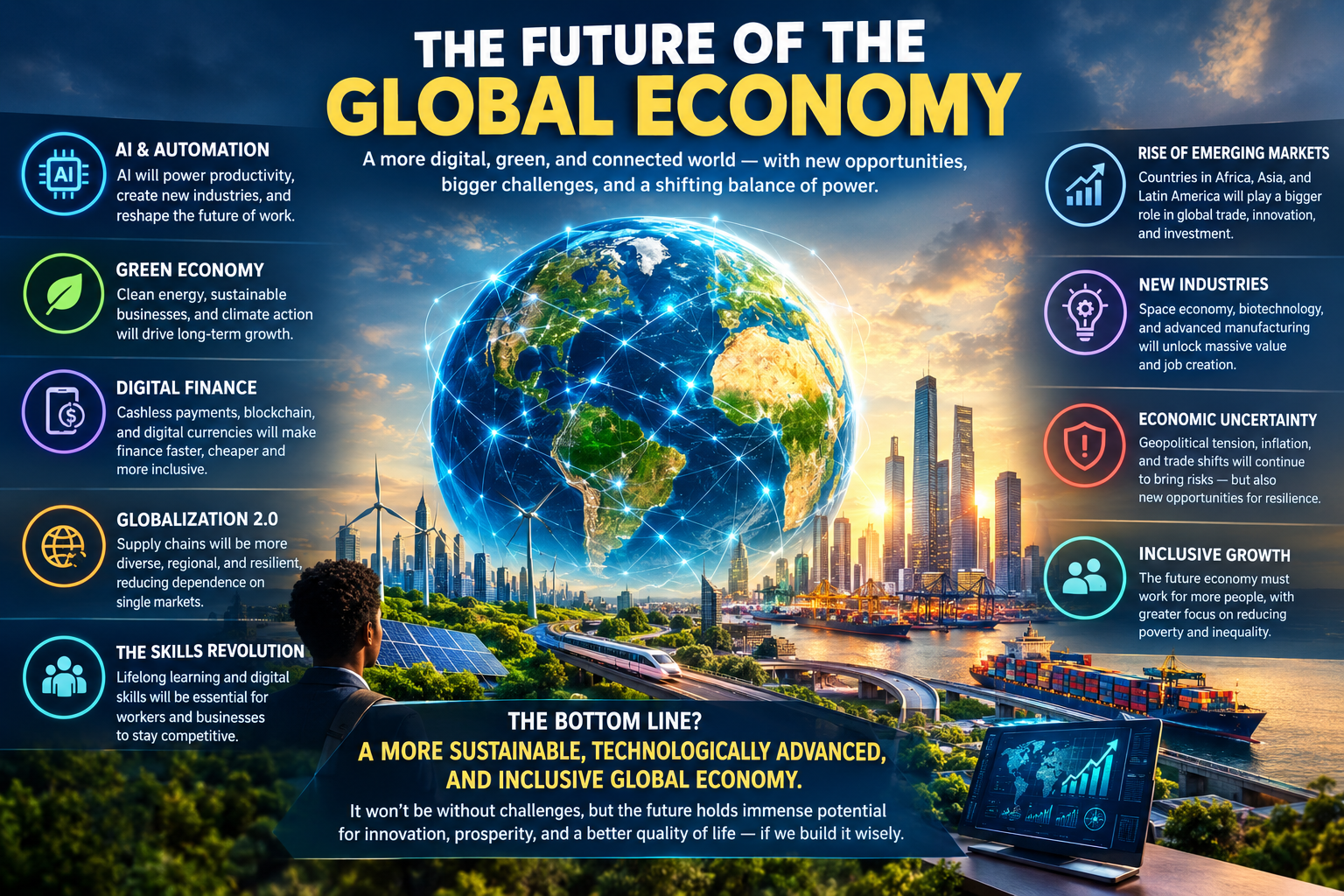
The future of the global economy is likely to be shaped by a combination of technology, artificial intelligence, demographic change, climate pressures, geopolitical competition, changing patterns of global trade, and the growing importance of emerging markets. The world economy is unlikely to follow one simple path. Instead, different countries and industries will experience very different opportunities and challenges.
Over the coming decade, economic growth will increasingly depend on how successfully governments and businesses adapt to rapid technological change while managing inflation, debt, inequality and geopolitical uncertainty.
A World of Moderate Economic Growth
The global economy is likely to continue growing in the years ahead, but growth may be slower than during some previous periods of rapid expansion.
Many advanced economies are dealing with aging populations, high public debt and relatively weak productivity growth. At the same time, developing economies have the potential to grow faster because of urbanization, expanding consumer markets, infrastructure investment and increasing digitalization.
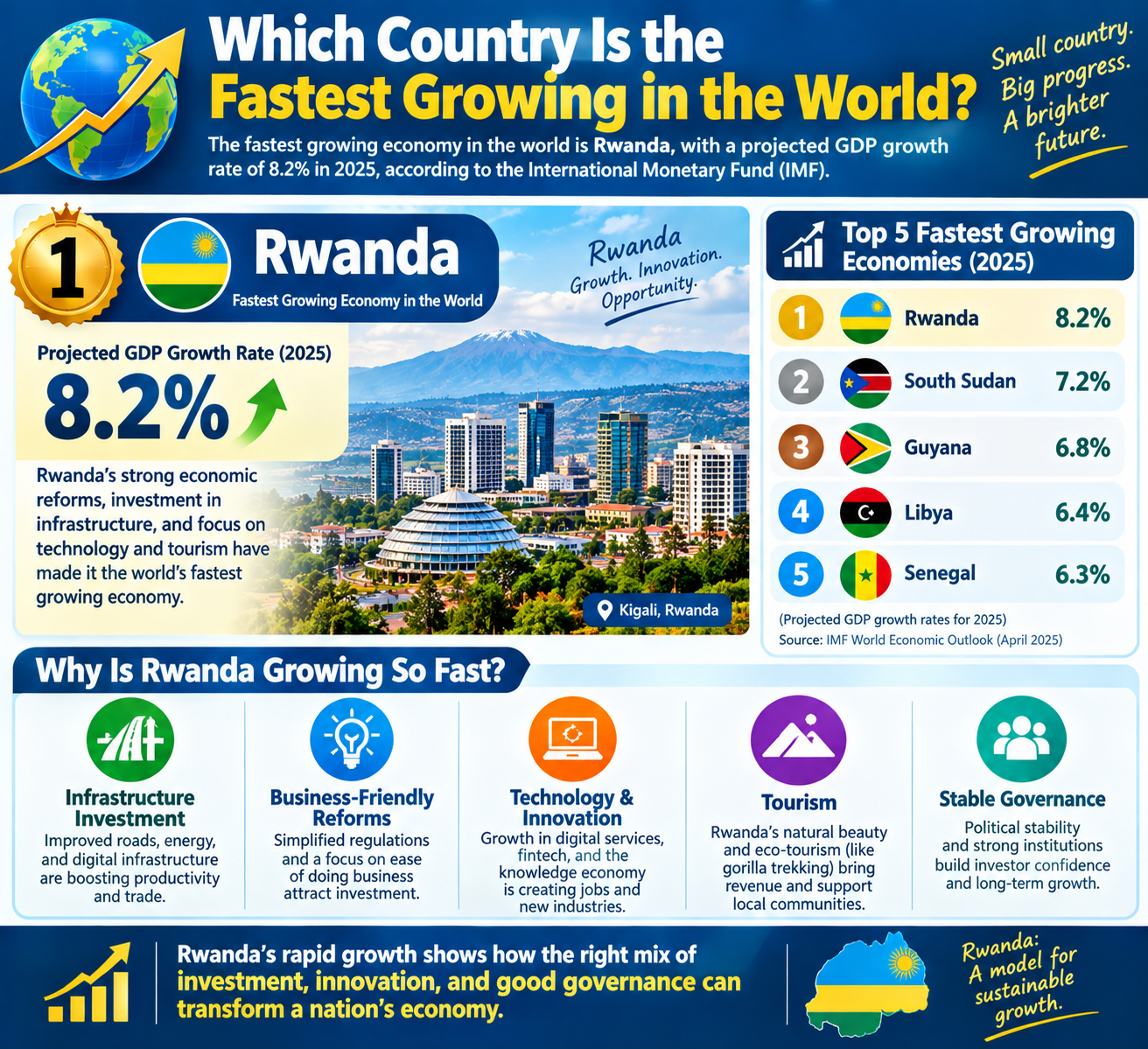
This means that future global growth may become increasingly dependent on emerging and developing economies.
Countries in Africa, Asia and Latin America have young populations and rapidly growing cities. As millions of people enter the middle class, demand for housing, transportation, healthcare, education, technology, food and financial services could increase dramatically.
The challenge will be turning population growth into productive employment and higher living standards.
Artificial Intelligence Will Transform the Economy
One of the most important forces shaping the future global economy is artificial intelligence.
AI is already changing how businesses operate, but its influence could become much larger. Companies are using AI to automate routine tasks, analyze information, improve customer service, develop products and increase productivity.
Over time, AI could transform industries such as banking, healthcare, manufacturing, transportation, education, agriculture and entertainment.
The economic impact could be enormous. Businesses that use AI effectively may produce more goods and services with fewer resources, potentially increasing productivity and economic growth.
However, the transformation will also create challenges.
Some jobs will disappear or be significantly changed, while new occupations will emerge. Workers who can combine human skills with AI tools may become increasingly valuable.
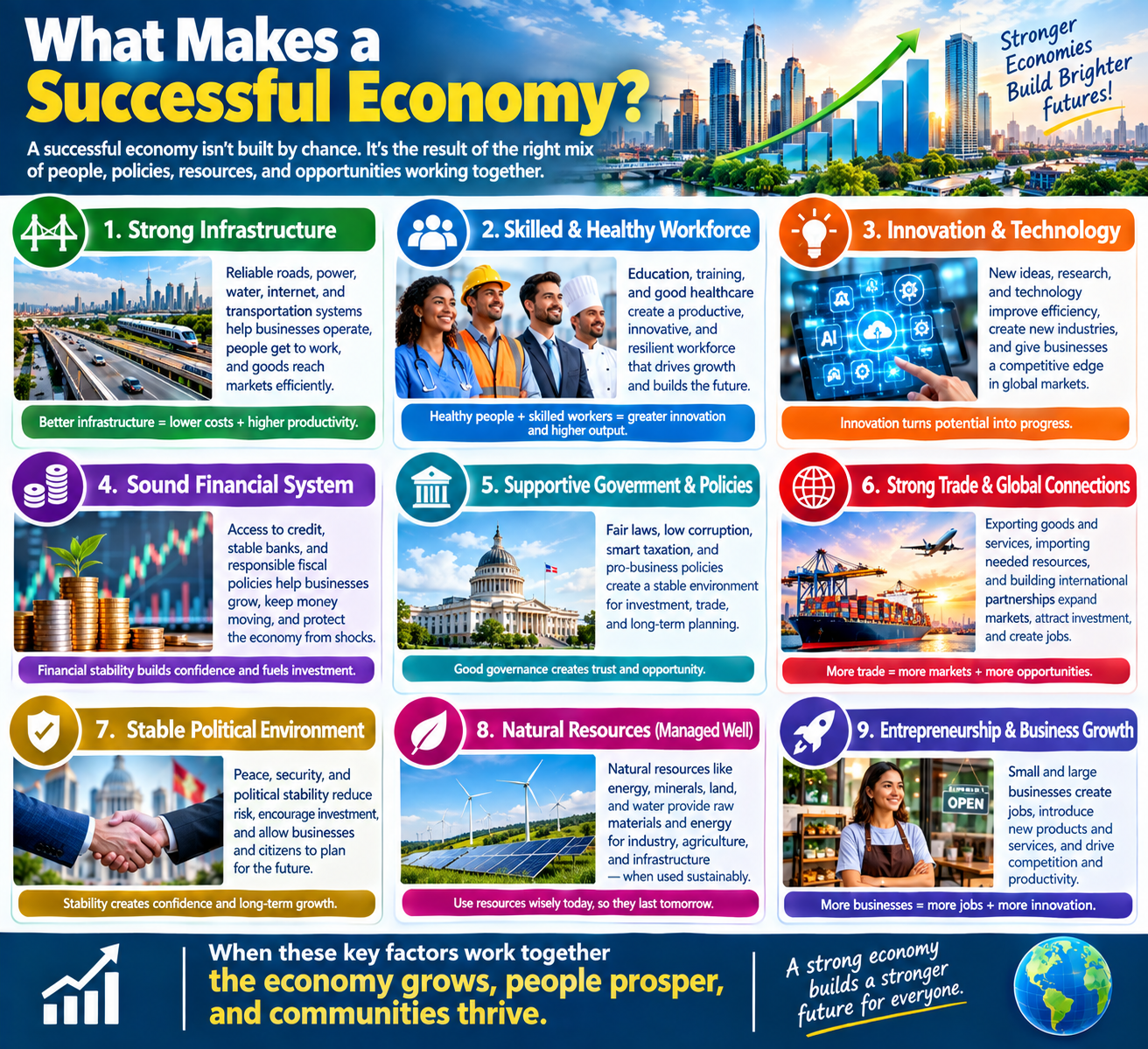
This means education and workforce training will become central to economic policy. Countries that prepare their workers for an AI-driven economy could gain a major competitive advantage.
The Future of Work Will Change
The traditional idea of employment is also likely to evolve.
Remote work, automation, digital platforms and AI-assisted jobs are already changing the relationship between employers and employees. In the future, people may work alongside AI systems rather than simply competing with them.
Jobs requiring creativity, critical thinking, leadership, communication and complex problem-solving may remain particularly important.
At the same time, repetitive administrative and manufacturing tasks could become increasingly automated.
This creates an important question: Will technology create enough new opportunities to replace the jobs it transforms?
The answer will depend partly on government policies, education systems and the ability of workers to acquire new skills.
Global Trade Will Become More Strategic
Globalization is unlikely to disappear, but it is changing.
For decades, companies focused heavily on producing goods wherever costs were lowest. Today, businesses and governments are increasingly concerned about supply-chain security, national security and geopolitical risks.
Countries are therefore trying to diversify suppliers and bring some strategic manufacturing closer to home.
This could create opportunities for countries that can offer reliable infrastructure, skilled workers, competitive costs and political stability.
Africa, Southeast Asia and parts of Latin America could benefit from this shift if they attract manufacturing investment.
However, increased tariffs and trade restrictions could also make products more expensive and reduce the efficiency of international trade.
The future economy will therefore probably feature globalization with greater strategic competition.
Emerging Markets Could Become More Important
One of the biggest changes in the global economy could be the growing importance of emerging markets.
Countries such as India, Indonesia, Brazil, Vietnam, Nigeria and other developing economies have large populations and expanding domestic markets.
As incomes rise, consumers are likely to spend more on technology, financial services, healthcare, transportation, education and consumer products.
Africa is particularly important because of its young and rapidly growing population.
But demographic growth alone is not enough. Governments will need to invest in electricity, roads, ports, telecommunications, education and healthcare.
If these investments are successful, emerging markets could become some of the world’s most important sources of economic growth.
Energy Will Remain Critical
The global economy cannot grow without energy.
For much of the industrial era, economic development has depended heavily on oil, natural gas and coal. The future is likely to involve a gradual shift toward renewable energy, nuclear power, batteries and other low-carbon technologies.
Solar and wind power are becoming increasingly important, while electric vehicles and battery storage are transforming the transportation and energy industries.
However, the energy transition will not happen overnight.
Oil and gas are likely to remain important for many years, particularly in transportation, industry and petrochemicals.
The countries that control critical minerals and energy technologies could become increasingly influential in the global economy.
Climate Change Will Have Economic Consequences
Climate change is another major factor shaping the future economy.
Extreme heat, flooding, droughts, storms and rising sea levels can damage infrastructure, reduce agricultural production and increase insurance costs.
This means climate change is not only an environmental issue. It is also an economic issue.
Governments and companies will increasingly need to spend money on climate adaptation and resilient infrastructure.
At the same time, the transition to cleaner energy could create enormous investment opportunities in renewable power, electric transportation, energy storage, sustainable construction and other industries.
The result could be a new global investment cycle centered around the energy transition.
Debt Will Be a Major Challenge
Another major issue for the future global economy is debt.
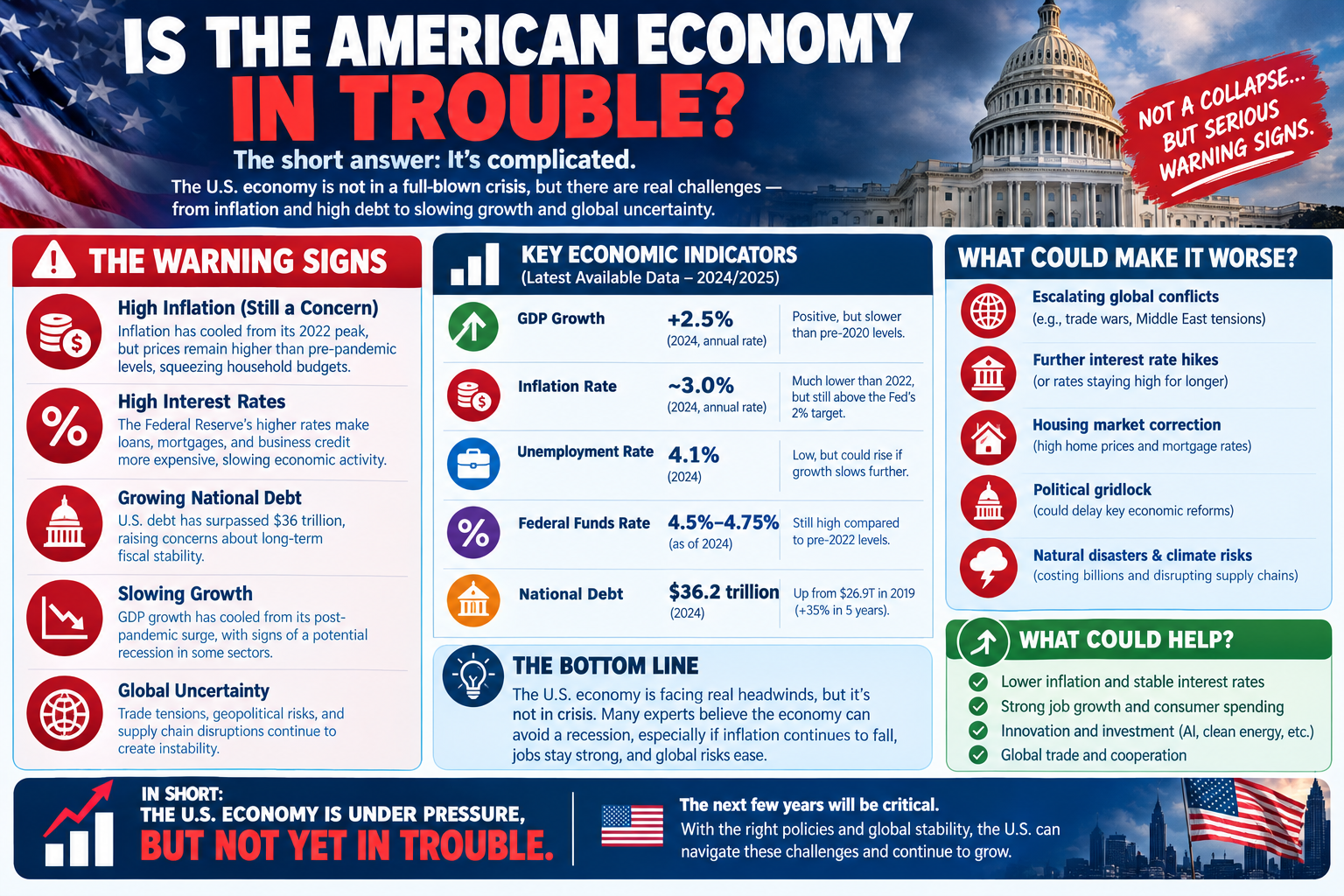
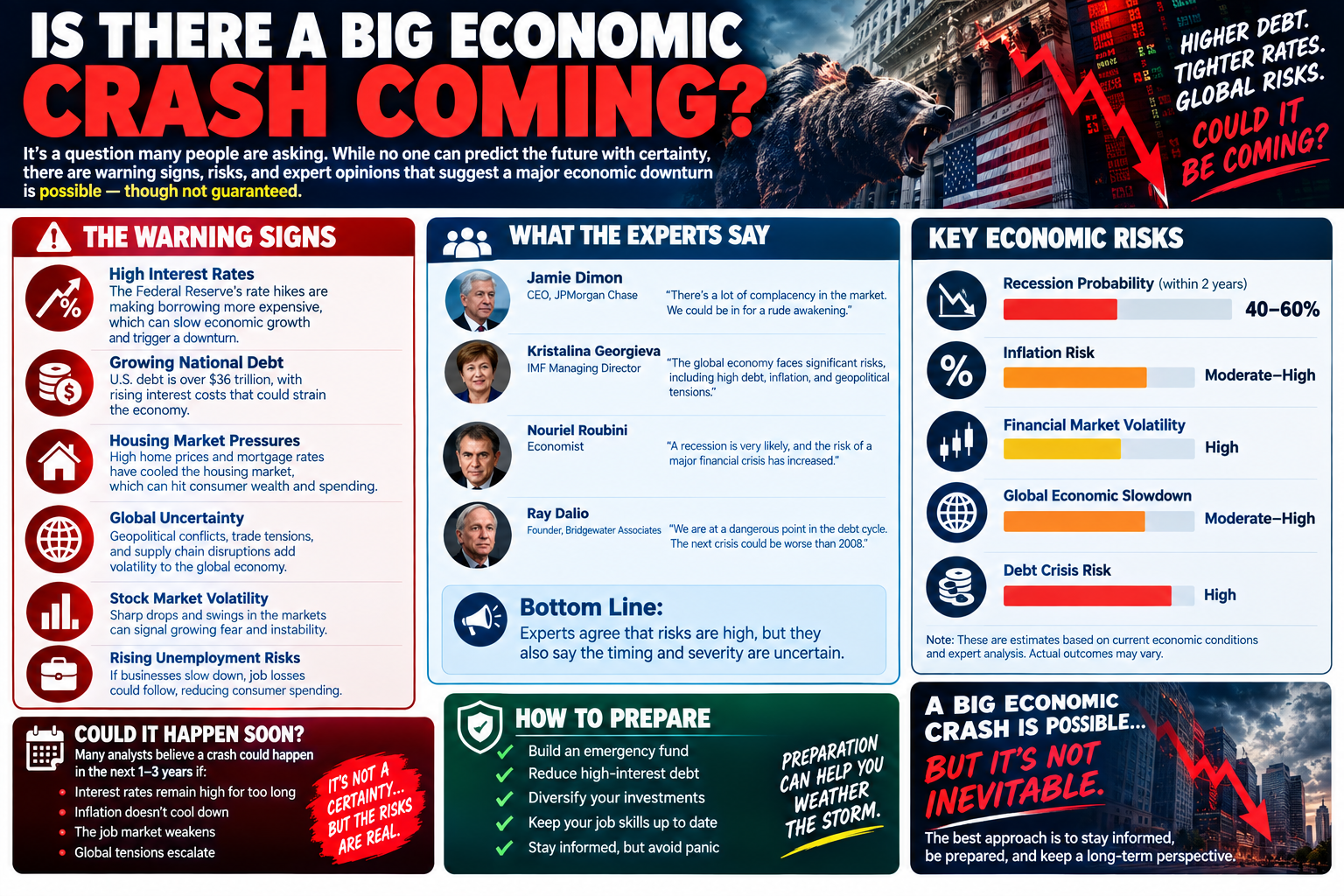
Governments, companies and households in many countries have accumulated substantial levels of debt. When interest rates are high, servicing that debt becomes more expensive.
High debt can limit the ability of governments to respond to recessions or invest in infrastructure.
Developing countries can face an additional problem: if their currencies weaken against major currencies such as the U.S. dollar, foreign-currency debt can become even more expensive.
Managing debt while still funding economic development will therefore be one of the biggest challenges for governments.
Inequality Could Shape Economic Policy
Economic growth does not automatically benefit everyone equally.
Technology and globalization can create enormous wealth, but the benefits may be concentrated among highly skilled workers, investors and companies.
If inequality becomes too severe, governments may face increasing pressure to improve education, healthcare, taxation and social protection.
The future global economy will therefore involve a major debate about how to distribute the benefits of technological progress.
The countries that manage this transition successfully will need to encourage innovation while ensuring that ordinary workers and communities can participate in economic growth.
The Rise of Digital Finance
Money itself is also changing.
Digital payments, mobile banking, online lending and financial technology are expanding rapidly around the world. In many developing economies, mobile technology is allowing people to access financial services without traditional bank branches.
Central banks are also exploring digital currencies and new forms of payment infrastructure.
These developments could make financial transactions faster and cheaper while bringing millions of people into the formal financial system.
However, cybersecurity, financial fraud, privacy and regulation will become increasingly important.