Economic growth is one of the most important measures of a country’s economic progress. When an economy grows, it generally produces more goods and services, creates new employment opportunities, increases business activity, and can improve people’s standard of living. But what causes an economy to grow? Economists look at many different factors, including investment, technology, education, trade, government policy, and consumer spending.
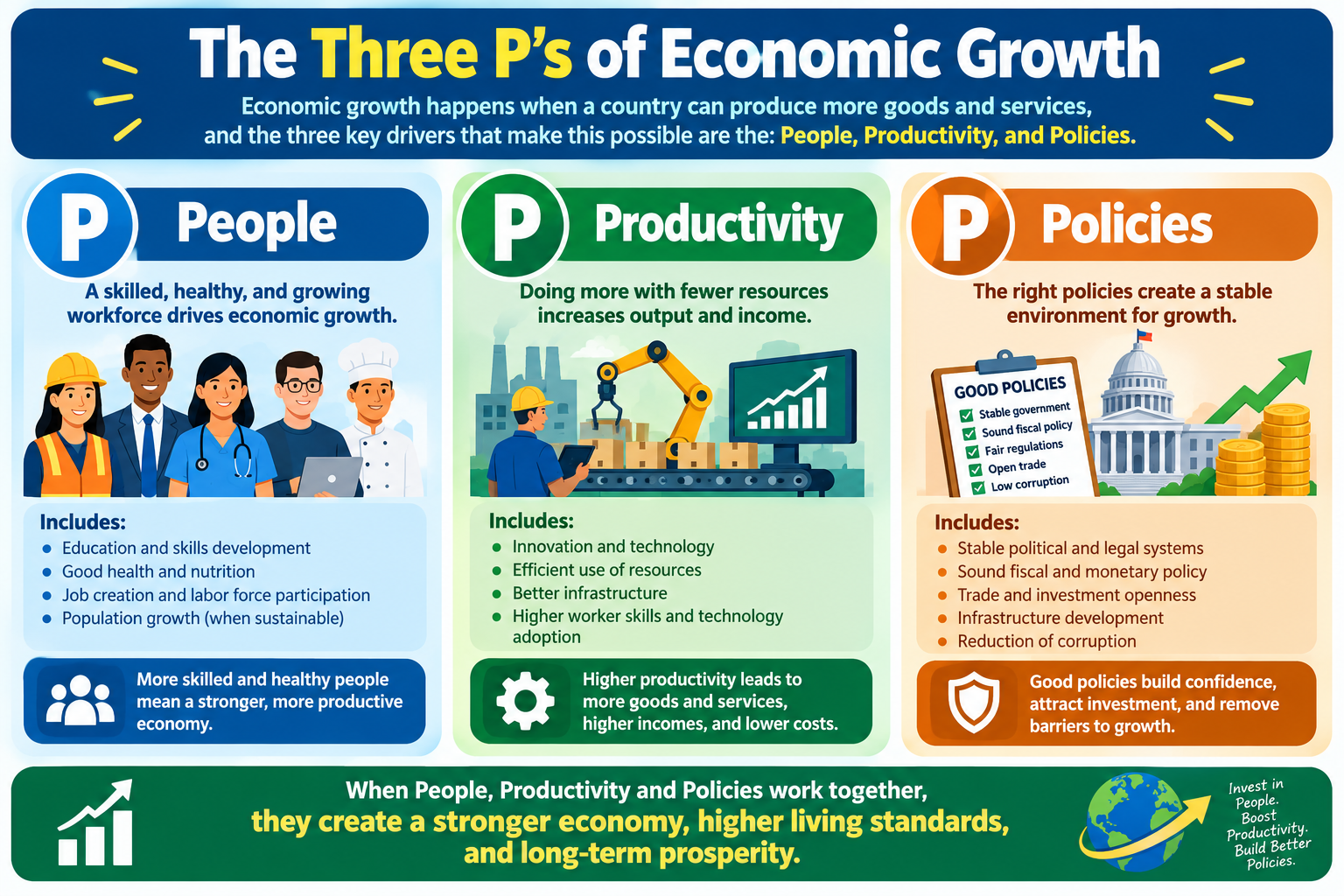
A useful way to understand the foundations of long-term economic growth is through the three P’s: population, participation, and productivity. These three factors focus on the size of the workforce, the number of people actively contributing to the economy, and how efficiently those workers produce goods and services.
Understanding the three P’s helps explain why some economies grow faster than others and why countries need more than simply a large population to achieve long-term prosperity.
1. Population
The first P is population. Population is important because people are both workers and consumers within an economy.
A growing population can provide a larger potential workforce. More workers can allow businesses to produce more goods and services, expand their operations, and serve a larger number of customers. A larger population can also create a bigger domestic market, giving businesses more opportunities to sell their products.
For example, a country with a rapidly growing population may experience increased demand for homes, schools, hospitals, transportation, food, clothing, and entertainment. Businesses may respond by increasing investment and hiring more workers.
However, population growth alone does not guarantee economic growth. A growing population needs access to education, healthcare, infrastructure, and employment opportunities. If population growth is not matched by sufficient job creation and investment, unemployment and pressure on public services can increase.
The age structure of a population is also important. A country with a large working-age population can have a significant economic advantage because many people are available to work and produce goods and services. Economists sometimes describe this as a demographic dividend.
On the other hand, an aging population can create challenges. If the number of retirees grows faster than the working population, governments may face greater spending requirements for healthcare and pensions while businesses may experience labor shortages.
This means that population is most beneficial to economic growth when people are healthy, educated, skilled, and able to participate in productive employment.
2. Participation
The second P is participation. Participation refers to the extent to which people of working age are involved in the labor market and economic activity.
A country may have a large population, but its economy will not benefit fully from that population if a significant proportion of working-age people cannot or do not participate in the workforce.
Labor-force participation can be influenced by many factors, including education, childcare, health, retirement decisions, transportation, working conditions, and the availability of suitable jobs.
When more people enter productive employment, the economy can increase its total output. Workers earn incomes, which they can spend on goods and services. That spending generates revenue for businesses and can encourage additional investment and employment.
For example, suppose a country introduces better vocational training programs that help unemployed workers gain skills needed by growing industries. More people may find employment, businesses can fill vacant positions, and overall economic production can increase.
Participation can also increase when barriers to employment are reduced. Affordable childcare, flexible working arrangements, accessible transportation, and better employment services can make it easier for people to enter or remain in the workforce.
Young people are another important part of participation. Providing education, apprenticeships, internships, and entry-level employment opportunities can help young workers develop skills and become productive members of the economy.
However, participation is not simply about getting as many people into jobs as possible. The quality and productivity of those jobs matter as well. An economy benefits most when workers are employed in activities that generate valuable goods and services and provide opportunities to develop skills.
Participation therefore helps an economy make better use of the people it already has.
3. Productivity
The third P is productivity, and it is arguably the most important factor for long-term improvements in living standards.
Productivity refers to how efficiently an economy uses its resources to produce goods and services. One common measure is labor productivity, which looks at how much output is produced per worker or per hour worked.
Consider two factories with the same number of employees. If one factory produces twice as many products because it uses better machinery, technology, organization, and worker skills, that factory has higher productivity.
Productivity can increase for many reasons.
Technology
Technology is one of the most powerful sources of productivity growth. Computers, automation, artificial intelligence, robotics, advanced machinery, and digital systems can allow businesses to produce more efficiently.
For example, automated equipment can perform repetitive tasks quickly and accurately, while software can help companies manage inventory, logistics, accounting, and customer relationships.
Education and Skills
Education and training also increase productivity. Skilled workers are generally better equipped to solve problems, operate advanced equipment, adapt to new technologies, and perform complex tasks.
Investment in schools, universities, vocational education, apprenticeships, and professional training can therefore contribute to long-term economic growth.
Capital Investment
Businesses need productive capital such as machinery, factories, computers, vehicles, and equipment. Investment in better capital can allow workers to produce more output.
For example, a construction worker using modern equipment may be able to complete a project much faster than someone relying on outdated tools.
Infrastructure
Infrastructure can also improve productivity. Reliable roads, railways, ports, electricity systems, telecommunications networks, and internet connections help businesses operate efficiently.
Poor infrastructure can increase transportation costs, cause delays, and reduce productivity. High-quality infrastructure allows businesses and workers to spend more time on productive activities.
How the Three P’s Work Together
The three P’s are most powerful when they work together.
Imagine a country with a rapidly growing population. If the government and private sector provide good education and training, workers can develop valuable skills. If businesses create employment opportunities, more people can participate in the economy. If companies invest in technology and machinery, those workers can become increasingly productive.
The result can be faster economic growth.
This relationship can be summarized simply:
Population provides potential workers. Participation puts those workers into economic activity. Productivity determines how much value those workers create.
A country that has a large population but low participation may fail to use its available human resources effectively. A country with high participation but low productivity may have many people working without producing enough output to generate strong improvements in living standards.
Similarly, a country with a small population can still become extremely prosperous if its workers are highly productive and the economy makes effective use of technology, capital, and skills.
Why Productivity Is Especially Important
Population and participation can increase the number of workers available to an economy, but there are limits to how much this can contribute to growth.
Productivity provides a way to increase output without simply adding more workers.
For example, if a country’s workforce remains the same size but workers become 2% more productive each year, the economy can continue increasing its productive capacity.
Over several decades, these improvements can compound into significant differences in income and living standards.
This is why innovation, technological progress, education, and investment are central to long-term economic development.
The Role of Government
Governments can influence all three P’s through economic policy.
They can support population development through healthcare, education, housing, and infrastructure. They can increase participation by improving job training, childcare, transportation, and employment services.
Governments can also promote productivity by encouraging investment, research and development, innovation, entrepreneurship, infrastructure development, and competition.
Economic stability is important as well. Businesses are more likely to invest when inflation is reasonably stable, financial markets function effectively, property rights are protected, and economic rules are predictable.